
“And for a fortnight there, we were forever,” sang present-day philosophizer of friendship Taylor Swift, acknowledging that even the most sincere friendship bonds have their moment, then fade. Playwright Rajiv Joseph explores a sincere yet troubled connection that spans 30 years in his gut-wrenching 2012 work Gruesome Playground Stories.
Joseph’s funny and sad play begins with a meet-cute in the nurse’s office of an elementary school. Kayleen is there clutching a bucket and throwing up: “Food makes me sick,” she states. Doug shows up battered and bandaged, with an eye patch. “Did it hurt?” Kayleen asks when he explains he wants to be like Evel Knievel — the 1970s daredevil motorcyclist known for superhuman cycle jumps off cliffs, across rivers, and the like. Copycat Doug rode his bike off the school roof, ending up with a smashed eye and gravel in his hands, but plenty of bravado left.
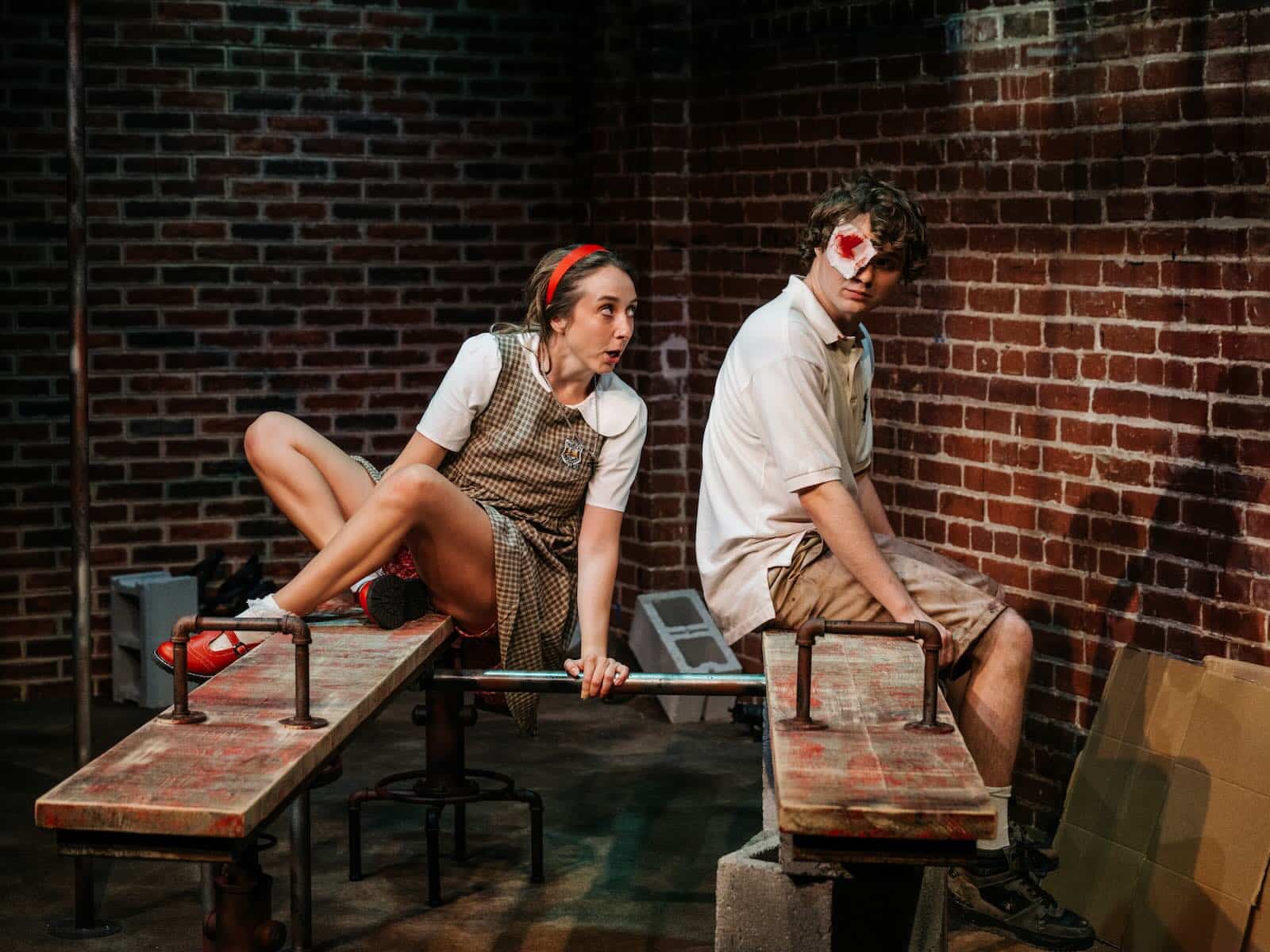
The kids are eight. Still filled with child wonder and criticism, awe and disgust about blood and vomit. Kids? Of course, they’re honest and awesome to a fault.
Joseph’s two-hander, which had a limited off-Broadway run in the fall of 2025, follows these unlikely childhood friends across three decades as they meet sporadically, go their separate ways and reconnect — sometimes voluntarily, other times coincidentally. They’re small-town kids with small-town dreams: survive school to grow up, get on with life while burying their childhood traumas beneath witty banter. Its humorous and cheerful moments contrast with later darker encounters, until, ultimately, these two unlikely BFFs — the quiet girl and the reckless boy — grow up and break your heart.
Set designer Josh Sticklin gives us our first view of the Keegan Theatre production: an adult-sized retro 1970s playground, equipped with an old-school swing set with monkey bars, a pole to slide down, a pair of teeter totters and a sandbox — none of it molded plastic. It looks like old-fashioned steel, the kind that, when it got hot, you had to throw sand on the slide so you wouldn’t burn the undersides of your legs. Sliced into the upstage wall is what looks like a huge laceration held together by stitches.
We meet Kayleen and Doug there as eight-year-olds, and follow them through time, with stops during a junior high school dance, high school, and, post-graduation, in hospital rooms and funeral homes. Joseph keeps both actors on stage for the entire play. Scenic changes often feature the swing set and sandbox revolving on the turntable while the performers strip down to their basic black underwear and don new age-appropriate costumes. Kayleen’s little-girl red dress and Mary Janes get switched for jeans, T-shirts, skirts, sequined tops, and baggy hoodies, while Doug doffs knee-length school-uniform shorts for cargos, denims, polo shirts, and the like. Along the way, accident-prone Doug acquires a bevy of different bandages and medical equipment (from costume and prosthetics designer Alison Johnson) in nearly every scene, demarcated by projections noting age and years lapsed.
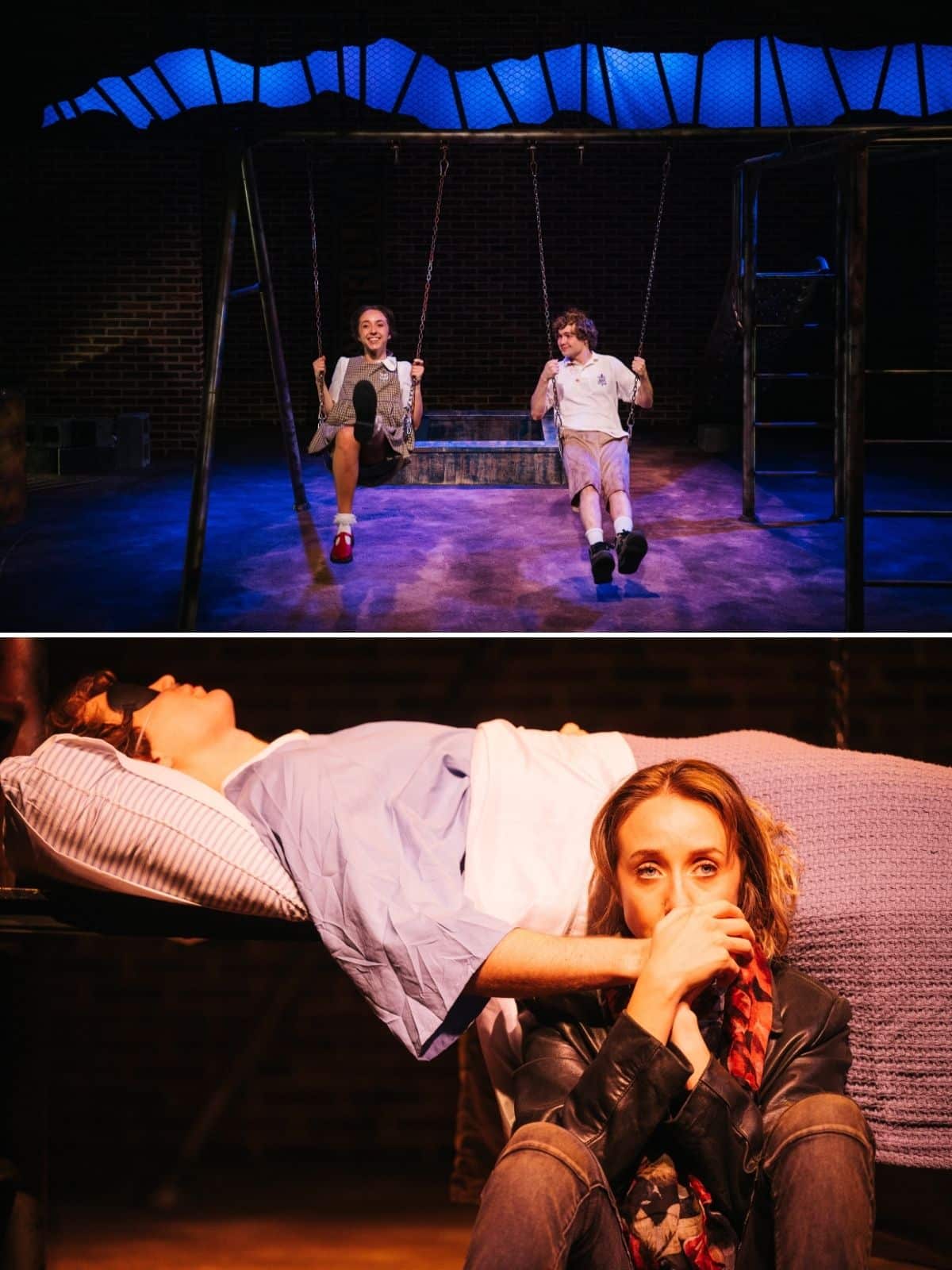
While the playground serves as the singular set, the story often shifts to indoor spaces: that nurse’s office, a teenage bedroom, hospital rooms, and other locales. Co-directors Susan Marie Rhea and Kurt Boehm have followed Joseph’s script to keep scene changes spare. In this production, no extraneous furniture or set pieces are used. The seesaws become beds, as does the platform at the top of the slide, and, as in many playgrounds, a sidelined park bench rarely gets used, while the swings, at center stage, often hold one or both actors. Sound designer Brandon Cook has gathered the rambunctious sounds of children at play outdoors, along with street noises, sirens, and ’80s pop songs to ground us as this journey across the years unfolds in nonsequential years. And it works.
Irene Hamilton as Kayleen finesses the difficult task of playing an eight-year-old without the treacly overt cuteness that many performers can’t avoid. She’s unfiltered, like many third-graders, curious, and fascinated by the dare-devilry of Doug. Jimmy Bartlebaugh has a bit of a tougher time playing young, but as the scenes unfurl, his transformation into a pre-teen then high schooler feels more believable. As adults dealing with tough luck, bad choices, and inherited trauma, both actors make difficult conversations — and unspoken sentiments — realistic and emotionally searing.
As both actors navigate the intensity of what has remained unspoken with equal parts pain and frustration, the question arises of which injuries hurt more, the physical or the emotional. And can these friends survive the unspoken suffering they have both faced? Playwright Joseph expounds on the beauty and brutality of friendship across this fraught 30-year relationship. The adage that comes to mind — “hurt people hurt people” — belies the deep love that rests at the root of Gruesome Playground Injuries, and the humanity of these characters.
Running Time: 85 minutes, no intermission.
Gruesome Playground Injuries plays through September 6, 2026, at The Keegan Theatre, 1742 Church St NW, Washington, DC, with performances Thursdays–Saturdays at 7:30 pm, Sundays at 3:00 pm, and select Mondays at 7:30 pm. Tickets are $45–$55 (with discounts for seniors 62+ and students/under 25) and available online. Discounted rush tickets are also sold at the door, when available, starting one hour before showtime.
The cast and creative team are here.
Features adult language and simulated blood.