
“When things are gone, we thirst for their details,” says painter Marc Chagall (Jamie Smithson) early in The Flying Lovers of Vitebsk by Daniel Jamieson, now playing in its DC premiere at Theater J. Smithson’s Chagall first appears as an old man, holding up a small black-and-white postcard to the audience as “all that remains” of his hometown.
The black-and-white photograph of Vitebsk (in present-day Belarus, part of the Russian Empire during Chagall’s early life) appears projected behind Smithson, filling the stage backdrop.
“But of course, it wasn’t black and white!” says Smithson’s Chagall as he launches into vivid sensory recall of the Vitebsk of his youth — the sound of water bubbling for tea in the samovar, the smell of cow dung, and the colors of the town — as Camilla Tassi’s projections behind him shift from black and white into vivid color.
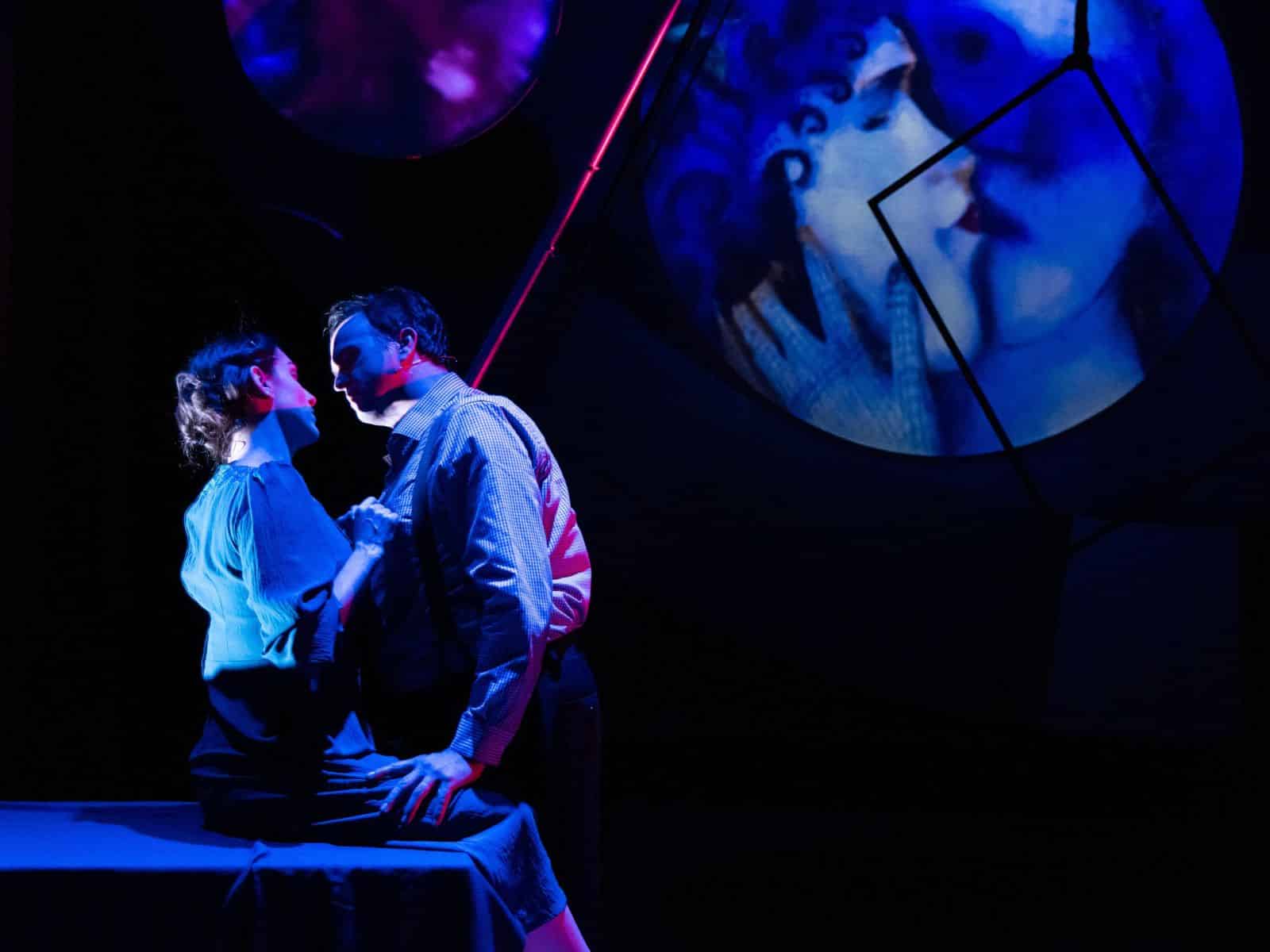
From the moment she appears on stage, Chagall’s wife Bella (Dani Stoller) brings the color to her husband’s world. Vivacious and mischievous, graceful in her movements, and poetic in her monologues, Stoller as Bella commands the attention of both Marc and the audience from the moment she appears on stage.
The image of him and Bella as “flying lovers” floating above the streets of prewar Vitebsk recurs in Chagall’s paintings and serves as a central motif for the play. Where the original production of The Flying Lovers of Vitebsk by the UK’s Kneehigh Theatre in 2016 cast Cirque du Soleil-trained acrobat and actress Audrey Brisson as Bella and actor and dancer Marc Antolin as Marc, Theater J’s production, directed by Artistic Director Hayley Finn, features aerial artistry by Thomas Martin and Rachael Small (choreographed by Gwynne Flanagan Cox) mirroring Stoller’s and Smithson’s movements on stage to depict the Chagalls’ romance.
This romance is soon tested by new parenthood, by Marc’s career as an artist overshadowing Bella’s aspirations as a writer, and by the world wars, revolution, and antisemitism that force the Chagalls to leave their beloved Vitebsk behind. Bella’s statement that “we pack what we love into our minds and take it with us” proves heartrendingly prescient, as what the Chagalls take with them — their memories and a small suitcase with Shabbat candles and Bella’s notebooks (Aoife Creighton, props designer) — becomes all that remains of the home that they can never return to.
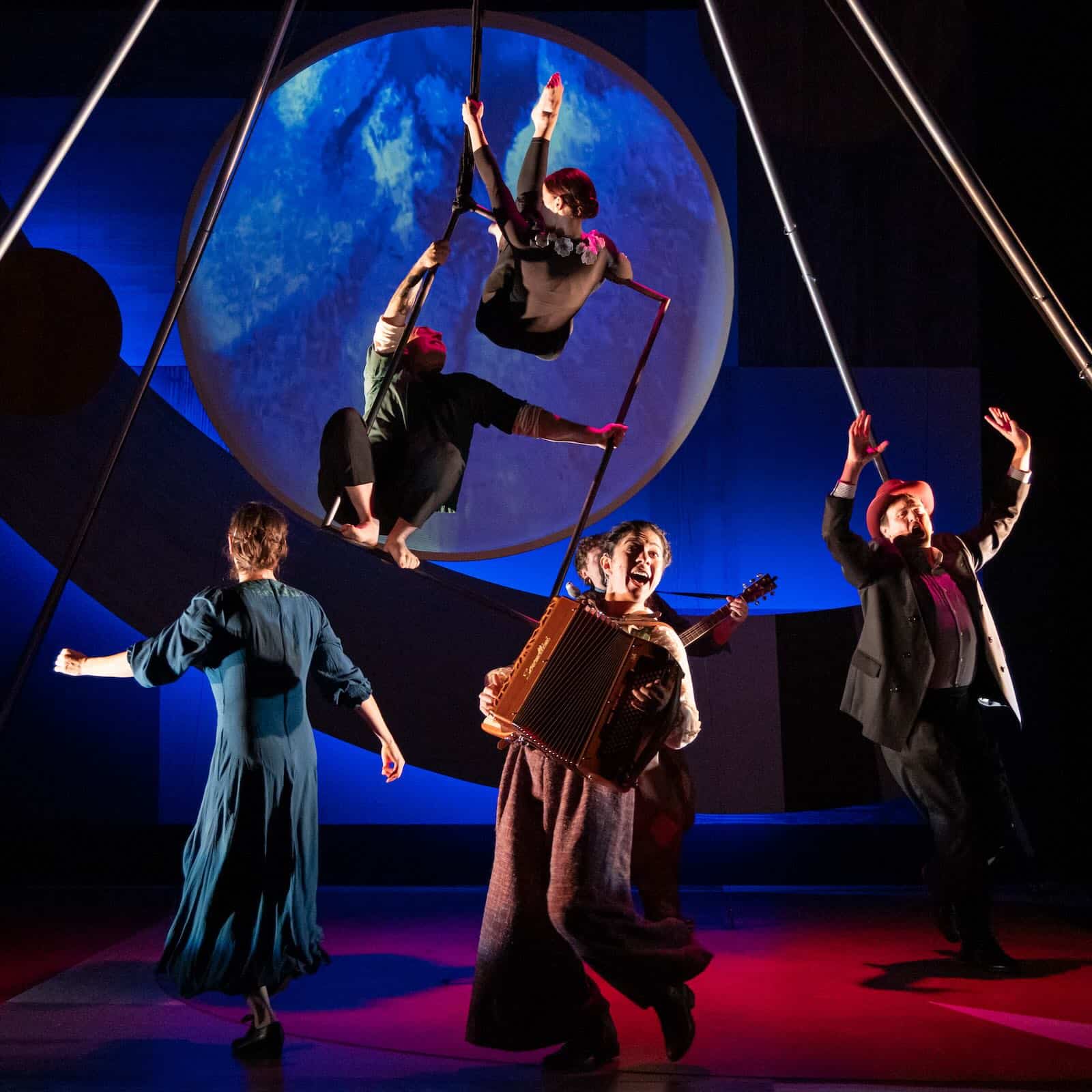
As the Chagalls’ life moves between Vitebsk, St. Petersburg, Moscow (where Marc worked as a set designer at the Moscow State Yiddish Theater in the early 1920s, inspiring Misha Kachman’s set design), Paris, and the United States, the visual elements of the play, including Tassi’s projections, Creighton’s props, and Frank Labovitz’s costumes, evoke both the often whimsical and dreamlike imagery of Marc Chagall’s paintings and the Russian Jewish world they sprang from.
Sound designer Sarah O’Halloran composed new music for Theater J’s production, performed live by Jeremy Allen Crawford and Katrina Michaels on piano, cello, accordion, guitar, mandolin, recorder, and woodblock, adding to Ian Ross’s original score. In addition to singing in Yiddish, Russian, French, and English and playing multiple instruments, Crawford and Michaels also use their instruments to create sound effects for the play and play minor roles in several scenes. Their contributions, along with Small’s and Martin’s as aerialists, make Theater J’s production feel bigger than a two-hander, while remaining intimate.
Theater J’s production of The Flying Lovers of Vitebsk tries to be many things: a portrait of a marriage, a journey through history, an elegy to a home left behind and impossible to return to, a rich and multi-layered work of art. At times, these multiple overlapping ambitions overstretch what is possible within the 90-minute runtime, and the final 20 years of the Chagalls’ lives together feel particularly compressed and rushed. Assistant director Grace Carter’s dramaturgical notes in the program, featuring Marc Chagall’s paintings, photographs of the couple, and a timeline of their life together and early 20th-century Russian and Jewish history, provide helpful grounding that audiences may not fully glean from the play itself.
Ultimately, Theater J’s production succeeds most consistently as a work of art, with every detail — from the aerials, choreography, and live music to the visuals and poetic language — carefully chosen and skillfully performed, and as a poignant tribute to Bella and Marc’s love and the war-ruined Jewish Vitebsk.
Running time: Approximately 90 minutes, without intermission.
The Flying Lovers of Vitebsk plays through November 1, 2026, presented by Theater J at the Aaron & Cecile Goldman Theater Trish Vradenburg Stage in the Edlavitch DCJCC, 1529 16th Street NW, Washington, DC. For tickets ($79–$89, with discounts for Theater J subscribers), call the box office at 202-777-3210 or purchase online.
The program for The Flying Lovers of Vitebsk is available here.
SEE ALSO:
Theater J begins season with DC premiere of ‘The Flying Lovers of Vitebsk’ (news story, September 24, 2026)