Less than two years ago, a dear friend introduced me to Better Said Than Done when they told me about the Women’s Storytelling Festival. That single recommendation sparked a journey that completely transformed my relationship with the art of spoken word.
Attending my first Women’s Storytelling Festival in 2025 was an eye-opening experience, starting with the virtual kickoff and moving to the warm, sunlight-filled afternoon showcase at the Sherwood Community Center in Fairfax. I was completely caught off guard by the visceral connection I felt. Listening to raw, intimate tales from remarkable storytellers, including Founding Executive Director Jessica Robinson herself, brought a full range of emotions: I sighed, I laughed, and I cried. It opened me to a brand-new world of art and left me feeling profoundly peaceful and connected.
Returning for my second year at the 2026 festival only cemented my love for the event. Over four days featuring more than 16 hours of phenomenal material, a diverse group of storytellers and emcees wove a rich tapestry of the female experience. From lighthearted yarns to heartbreaking memories, the festival served as a therapeutic reminder of how storytelling cultivates empathy and bridges generational and cultural divides.
My passion for the organization grew even stronger after attending their Rainbows and Unicorns – Stories of Love and Hope event in Falls Church in June. By that point, I had completely fallen in love with Better Said Than Done, its welcoming community, and the timeless art of storytelling itself. So when I heard that Jessica had been nominated for a well-deserved award, I jumped at the chance to interview her, allowing me to highlight the visionary leader behind the organization that has brought so much warmth, connection, and inspiration to my life.
Below is part of the conversation I had with Jessica Robinson, the recent recipient of the National Storytelling Network’s ORACLE Award for Distinguished National Service at the NSN Conference in Texas. This recognition highlights her dedicated work in creating platforms for underrepresented voices through the art of storytelling.
My Conversation with Better Said Than Done’s Jessica Robinson
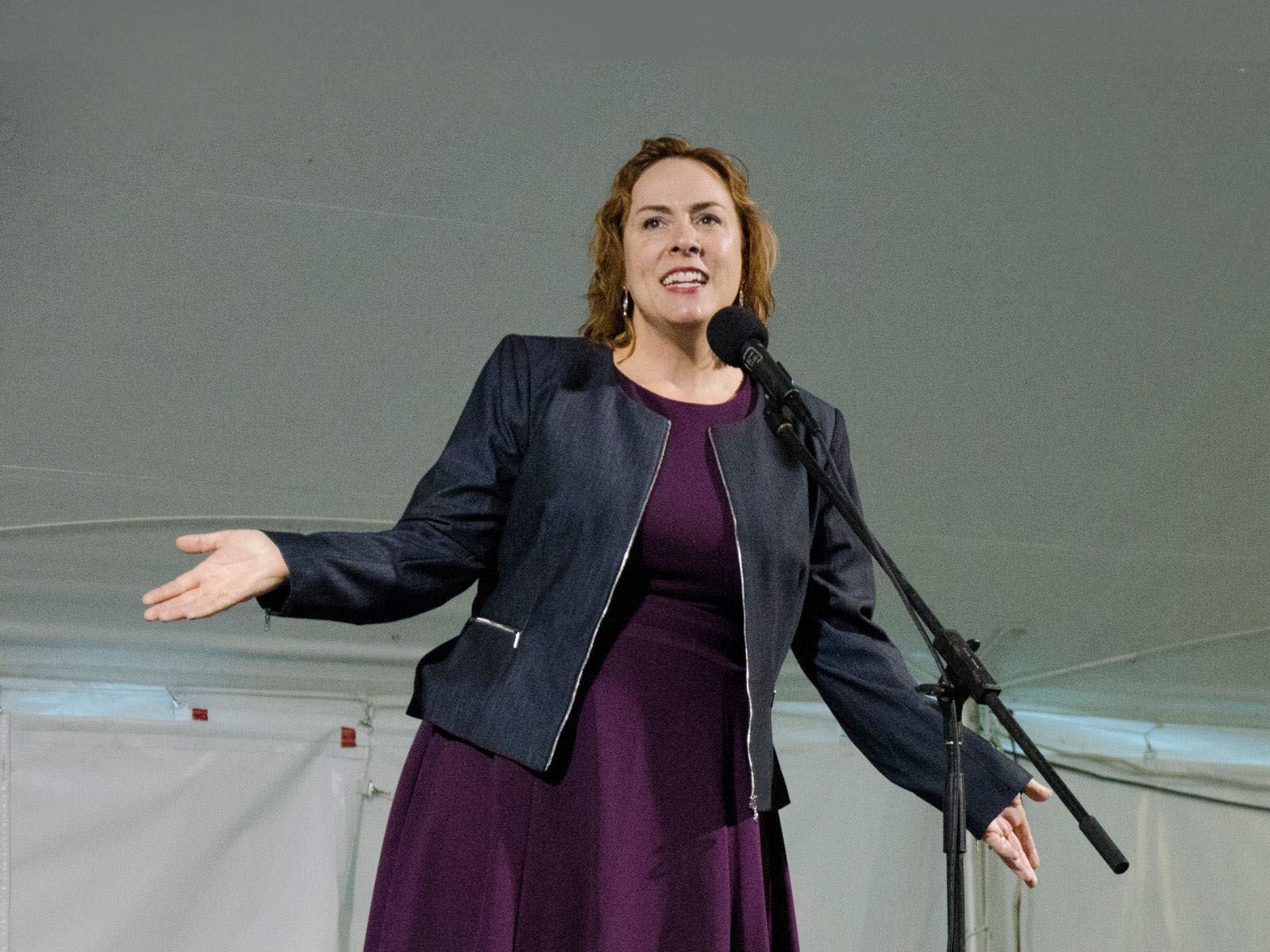
Kendall Mostafavi: How was the event in Texas? Can you tell me a little bit about the award?
Jessica Robinson: It is an annual conference, and the ORACLE Awards ceremony is held there every year and includes speeches and a concert for the storytellers. The National Storytelling Network is a really great organization. They’re very progressive, which I appreciate because our values align.
It was a heartwarming award ceremony. The person who went right before me received an award for regional service. He got up there and thanked the National Storytelling Network for embracing diversity, equity, and inclusion, noting that not many arts organizations are doing that right now.
That wasn’t my speech, but I wish it was because it was everything I was thinking. To have a whole group of people stand up and say, “This is what we believe,” and to get an award from people who are strongly committed to inclusivity and platforming diverse storytelling, was really nice.
I appreciate that they appreciate what I’m trying to do, because they’re also trying to do it.
I get it. It’s validating. How long have you been storytelling?
I told my very first story almost 20 years ago. It was in 2007 at Speak Easy DC, which is now Story District.
That’s amazing. Do you have a favorite story?
Well, the funny thing is that the very first story I told is one of them. When I was invited to perform at Jonesborough, which is a big National Storytelling Festival, I actually took that first story, made it better, and then performed it there.
So that’s a fun one. But at this point I’ve been telling for so long. I mean, I have a book that’s a collection of 25 of just my personal stories. So it’s kind of hard to say that there’s one that’s a favorite.
My first solo show would be another one. It was the first time I told a whole hour long show by myself. That’s another favorite story just because it went well and I liked the challenge.
Then in the last seven or eight years, I’ve been experimenting.
In the local storytelling world with Perfect Liars, Story Collider, The Moth, and all the other ones, everyone tells personal stories. But on the national stage, everyone tells everything. So, since going to Jonesborough, I’ve been experimenting with telling folk tales, historical stories, and myths. I’ve been really enjoying that.
Were you surprised to get this award or did you have an idea it was coming?
It was completely unexpected. The guy who nominated me was Rishi Nixon, who you saw at Rainbows and Unicorns. He told the story about the formation of rainbows at the beginning of that last show. Rishi is the outgoing president of the National Storytelling Network, and he nominated me for my work with Better Said Than Done and the Women’s Storytelling Festival. In his nominating letter, he said the award recognizes national service because Better Said Than Done’s mission aligns with the National Storytelling Network’s goal of giving diverse voices a platform and making storytelling inclusive.
With the Festival, we are trying to provide a national platform for women. Women are historically underrepresented in storytelling festivals on a national stage, so we are trying to balance the scales.
How do you go about choosing who is going to be featured in your Women’s Festival?
We have a committee consisting of most of our seven-person board. We review the applications blind to each other — though we do watch the videos. We use a 100-point scale, add the scores up, and discuss the top-ranked applicants to determine who will be featured, spotlighted, or regional tellers.
Does the board have to approve of their story before they actually perform in the festival?
No. We let people decide what story that they want to tell. We do make a disclaimer that nothing is offensive. But for the most part, we haven’t had a problem.
That was going to be my next question: Have you ever had an issue with someone being inappropriate, because people’s perspective on what is and isn’t appropriate has such a wide spectrum depending on their own experiences?
Not with people who’ve been selected for the festival. And I think it’s because if they’ve been selected they understand what we’re looking for.
In the early days, we had a lot of applications from people who were speakers or authors, not people who tell stories. It took a few years to weed out some people who didn’t understand what we were doing.
We put it out there on our website that we’re inclusive, that we have a diverse range of storytellers, and that we will not abide anyone being racist or homophobic. We’ve lost followers over the years; specifically, a couple of years ago, when I sent out an email saying diversity makes us all better and as an organization we embrace that, some of our followers unsubscribed. But those people will not apply to the Women’s Festival and aren’t the audience we’re seeking.
You mentioned doing an hour-long show, which sounds like a one-woman show to me. Would you consider that live theater, or do you view storytelling as a completely different animal? How would you distinguish the two — is it purely a difference in content?
That is part of the problem, right? What is storytelling? When I teach storytelling, I tell people that Mike Birbiglia‘s or Hasan Minhaj‘s comedy specials are storytelling shows. They are called “comedy specials” because there is more cachet and money in being a successful comedian, but what makes it a storytelling show is that they are telling a complete story from beginning to end — even if there are jokes in it.
I call my performances “solo shows” or “one-woman shows,” but what makes it a storytelling show, as opposed to The Vagina Monologues or something similar, is that I am not acting per se. I am not reading from a script; I am reading from a script in my head. I am talking directly to the audience, saying, “Here’s my story,” and it changes based on the audience’s reaction because I am playing myself, not a character. I am telling my story directly with no fourth wall. In that way, it is more like a comedy special than a play.
Unlike a play, it is reactionary and interactive. If you are in a play — even a one-woman show where you are doing a monologue — you aren’t going to change what you say if the audience yells out, because in many cases, you can’t; you aren’t allowed to change the script. But in a storytelling show, I am standing there as me.
For example, I’ve told a lot of stories where something really sad happens. I have a story that I just told at the NSN conference about my dad dying. In it, he is telling me about his early years, and in his own voice, he says something about being married to my mom: he would get home, the house was a mess, and he’d ask, “What was she doing all day? She didn’t have a job.” Everyone always laughs. When I wrote that, it was my dad’s genuine frustration about the house not being clean, but it has since become a line that I know people are going to laugh at. Things like that don’t change the story, but they change my response because I know it’s going to be funny, even though I didn’t know it would be funny when I wrote it.
When do you know that an experience you have is going to be a story? Is there a light bulb that goes off at the moment? Or do you usually have an event that you’re planning for and you go back and you ponder back in your files of memories for what to use?
Yes, both those things. You go through something and think, “This is so ridiculous, I have to tell people about it.”
But other times, someone might ask if it’s okay to tell a story about a sexual assault, and I’ll say yes, as long as there’s something to be learned from it or some growth in the story.
A lot of people with personal stories go right to the tragic, and that’s okay, but there has to be a point — growth, a lesson learned, or something the audience can take away other than “that sucked and was awful.”
Those are the stories where I stop and think, “Is this a story, or is it just a horrible thing that happened?” I’ve been doing this for almost 20 years, and I know many other storytellers — many of whom also teach — and we talk about this all the time. We discuss the idea of telling a story from your scars, not your wounds. I didn’t make that up, but you should never get on stage and work through an injury. You should be getting on stage and telling us about something you have learned, grown, or healed from, not something that is still an open wound.
Storytelling is not therapy; it is a performance. You do have to consider the audience. If you just have pain that you want to share, that is where you go to a therapist’s office. When I ask, “What is the point of the story?,” people often say, “I just want to tell a funny story.” That is fine because humor is a valid point, as long as it’s a story and not just a fart joke. Giving the audience laughter is a byproduct that counts.
Are you able to share what the theme is for the next Woman’s Storytelling Festival. Or is that a high-valued secret?
We don’t generally do themes for the Women’s Storytelling Festival. We did have a theme for last year, America 250, but I don’t really have a theme this year. I just confirmed our last storyteller an hour ago, and she was asking the same thing. I told her it’s not necessarily about having a theme; I like to think of it as stories that only women can tell. You can tell a Jack tale — that funny character who’s always messing things up — but make it about a woman, make a woman the main character, or give it a twist that comes from the experience of being female.
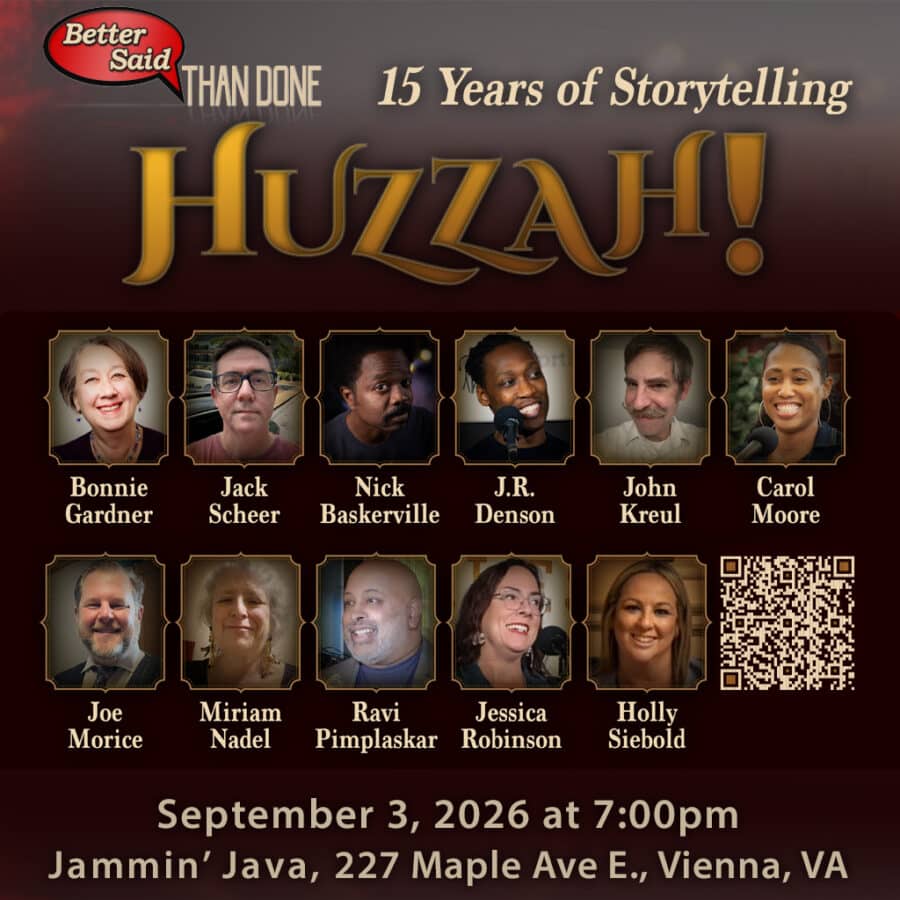
You have your 15-year anniversary coming up at Jammin’ Java. How did you pick the speakers for that event?
For our usual monthly shows, I send an email to everyone who has told a story with us in recent years, letting them know about upcoming shows, and they reach out if they’d like to perform. The problem is that there are more storytellers than we have space for; that’s the funny thing about storytelling being popular right now. There are so many storytellers who want to perform all the time, and we just don’t have enough shows. Plus, there are other groups like Tales and Ales in Loudoun County and Story Extreme in Alexandria, and there is a ton of activity in DC. Since there are only six to eight people on stage at any given time, the shows usually fill up very quickly once I send those emails. If they don’t, I put out a call in our newsletter for an open casting.
For the 15-year anniversary, we treated it a bit like casting the Women’s Festival, except obviously not restricted to women. I went to the board and asked, “This is our party; who do you want to see?” Everyone chimed in with people they wanted back.
That’s really fun. I am looking forward to it and already have my ticket.
Thank you so much for speaking with me tonight. I’ve loved getting to know more about your history and storytelling as a subject in general.
Signing Off
Getting to chat with Jessica about her storytelling experience, her many accomplishments, and her years of hard work and dedication to Better Said Than Done’s mission was nothing short of inspiring. And while that was the end of the official interview, we did proceed to talk about Better Said Than Done’s upcoming events (which I will link to below), including a Halloween-in-the-park event for kids on October 30. When I asked Jessica what kind of stories she tells for the kids, I got a private preview of a hilarious, spooky-light story that is a favorite of the little ones.
Jessica offers a clear look at the heart behind Better Said Than Done — a platform built on empathy, community, and the transformative power of authentic personal narrative. Her recognition with the National Storytelling Network’s ORACLE Award is a testament to nearly two decades of tireless work opening doors for underrepresented voices and elevating the craft of spoken word. As Better Said Than Done prepares to celebrate its milestone 15th anniversary, her passion for fostering connection through story continues to illuminate the local and national arts landscape, inviting audience members and storytellers alike into a welcoming community.
I will close with Jessica’s own words, from her acceptance speech from the National Storytelling Network’s ORACLE Award Ceremony:
When I started Better Said Than Done 15 years ago, one of our core group asked, what’s our mission? What are we in addition to being a storytelling show? What sets us apart?
Someone said “kindness.” And then everyone agreed. We’d create a storytelling community built on kindness.
Terrible branding, but great core value.
Over the years, kindness has led us to trying to create a safe space for everyone to feel welcome to share their stories and that led to inclusion, because you can’t create a safe space if it is not safe for all.
To experience this vibrant community firsthand and celebrate 15 years of extraordinary storytelling, be sure to catch Better Said Than Done’s upcoming milestone show.
Huzzah! 15 Years of Storytelling plays on September 3, 2026, produced by Better Said Than Done, performing at Jammin’ Java, located at 227 Maple Ave E., Vienna, VA. Tickets ($27 general admission, including a $7 fee) are available for purchase online or at the door. For more information about Better Said Than Done, visit their website and check out their calendar for other upcoming events.