What does it profit a man if he gains the whole world but loses his soul?
While not cited in the script, that famous question is at the heart of Stephen Sondheim’s Merrily We Roll Along, which is being given a top-notch production by Arlington’s Signature Theatre.
The soul in question is that of Franklin Shepard (Jason Gotay), a brilliant, idealistic, young composer who, in service of his fulfilled ambition for popular and financial success, loses, over a 20-year period, his connection to music, his two dearest friends, two wives, and his son.
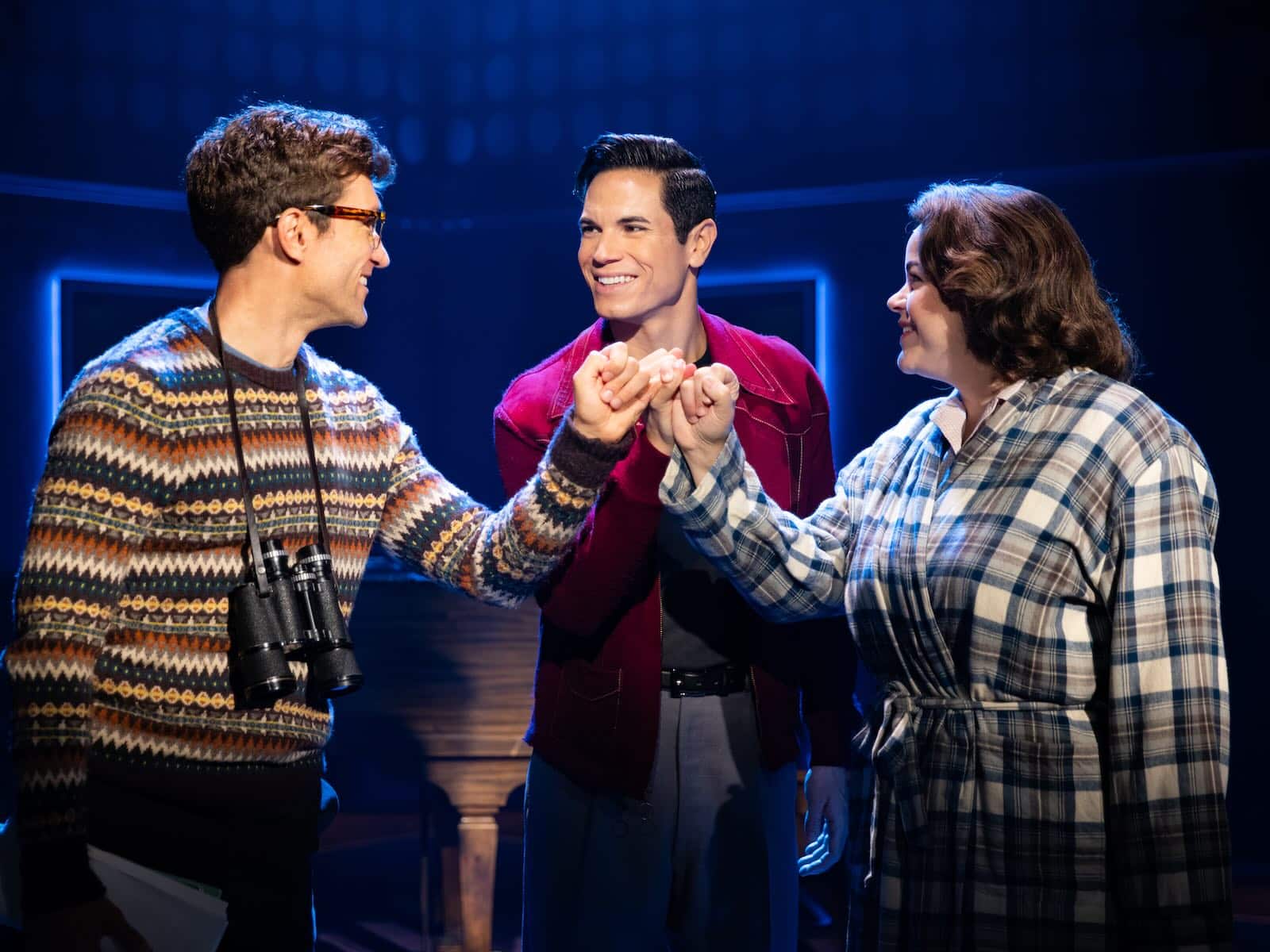
In Sondheim’s and collaborator George Furth’s famous reverse chronology, we first see Frank in 1976 at the nadir of his life. At a party celebrating Frank’s latest successful movie, his former best friend, Charley Kringis (Jake Loewenthal), is absent and cannot even be mentioned. His other longtime dear friend, Mary Flynn (Melanie Field), who in her despair has become an out-of-control alcoholic, gets drunk and makes a scene. His now visibly aging second wife, Gussie Carnegie (Maria Rizzo), is brittle and bitter as Frank is about to replace her with a younger woman. Frank admits — how sincerely isn’t clear — a degree of self-loathing, saying that he has made the same mistake over and over: saying yes when he should have said no. Gotay gives Frank a kind of uncomprehending deer-in-the-headlights look amid the wreckage.
The show revolves around Frank, a kind of hollow center of the action, always ready with a rationale or self-justification for whatever decision he makes, however destructive. Gotay — in addition to his strong vocals — makes Frank’s decisions all too plausible. He’s not someone to admire, or even like, but the portrayal makes him understandable.
How did they get to be there? Each successive scene delves further back in time to reveal how Frank’s decisions, and the actions of the others in his orbit, led to this pass. In what counts as one of the most spectacular, and most difficult, patter numbers in all of musical theater, “Franklin Shepard, Inc.,” Charley embarrasses Frank on national TV in 1973 by calling out his abandonment of composing as his movie career has flourished. In Loewenthal’s aggressive take on the number, Charley isn’t simply having a nervous breakdown. He is taking out years of growing frustration and resentment with Frank’s consistent postponement of their next project in favor of his commercially lucrative deals. There is intentionality in his madness.
Later in the show, Loewenthal effectively delivers a more lyrical number, the deceptively simple “Good Thing Going,” which, while presented as a song he and Frank are auditioning for a show Joe Josephson is to produce, is also a prescient comment on the direction of their relationship.
Mary, long hopelessly in love with Frank, tries to keep the fraying relationships among the three intact in “Like It Was” and “Old Friends.” It is to no avail. Frank has fallen under the influence of Gussie.
In Rizzo’s capable hands, Gussie has one of the most fascinating character arcs in the production. From her origin as a working-class secretary to producer Joe Josephson (James Whalen), to Josephson’s mistress, then wife, then brassy Broadway musical star, Gussie’s bottomless insecurity and ambition lead her to become a consummate manipulator. Her “Growing Up” is a masterclass in seduction as Gussie’s and Frank’s mutual attraction to success and show-biz prominence fuel their resulting affair and, ultimately, marriage.
The changes in Gussie’s life are beautifully displayed in Ivania Stack’s succession of costumes. She is in a dowdy dress as Joe’s secretary; then somewhat more upscale as Joe’s wife, then in glittery dresses as a Broadway star, in a regal red dress when she is at the height of her power, then finally in an elegant but distinctly unsexy caftan as a theatrical grand dame past her prime. Frank, meanwhile, is consistently in grays, blacks, and whites; it is up to other characters to bring color to the proceedings.
Whalen brings dignity to the often-overlooked role of Joe, who annoys Frank (similar people annoyed Sondheim in his career) by insisting that successful musicals must rely on tunes that are “hummable,” at one point exiting while humming a somewhat off-kilter bit of “Some Enchanted Evening.”
In the midst of the acrimonious divorce resulting from Frank’s affair with Gussie, Frank’s first wife, Beth (Kerstin Anderson), sings the most frequently covered song from the show, “Not a Day Goes By.” The heartbreak and bitterness are palpable. This is perhaps the best example of the “reverse reprise” technique that Sondheim employs. Later in the show (i.e., earlier in the character’s chronology), Beth and Frank sing a sweet love song version of the song, with Mary joining some lines in sadness as she sees the man she loves marrying a friend.
Beth contributes to Frank’s trajectory by deceiving him about a pregnancy and later urging him to do one more “commercial” show with Joe rather than work with Charley. Both Mary and Charley, in “Now You Know,” help persuade Frank, against his initial instincts, to go on a cruise after his divorce rather than getting back to work. Both illustrate the incremental deceptions and seemingly minor choices that shape the characters’ outcomes.
Before the principal characters’ downward path takes shape, their younger selves have the carefree fun with “Bobby and Jackie and Jack,” a lighthearted 1960 spoof of the Kennedys (the later tragedies that engulfed the Kennedy family are not mentioned — Sondheim saved that for “Something Just Broke” from Assassins). Signature’s version of the number was the best I’ve seen, including the use of a Kennedy photo album prop and an ensemble member acting as their accompanist, giving a Lenny Bernstein head toss at one point. In the late 1950s, the three leads are happily involved in the chaos of getting started in the music and theater business in “Opening Doors,” a song that Sondheim said reflected the struggles of his generation of Broadway songwriters.
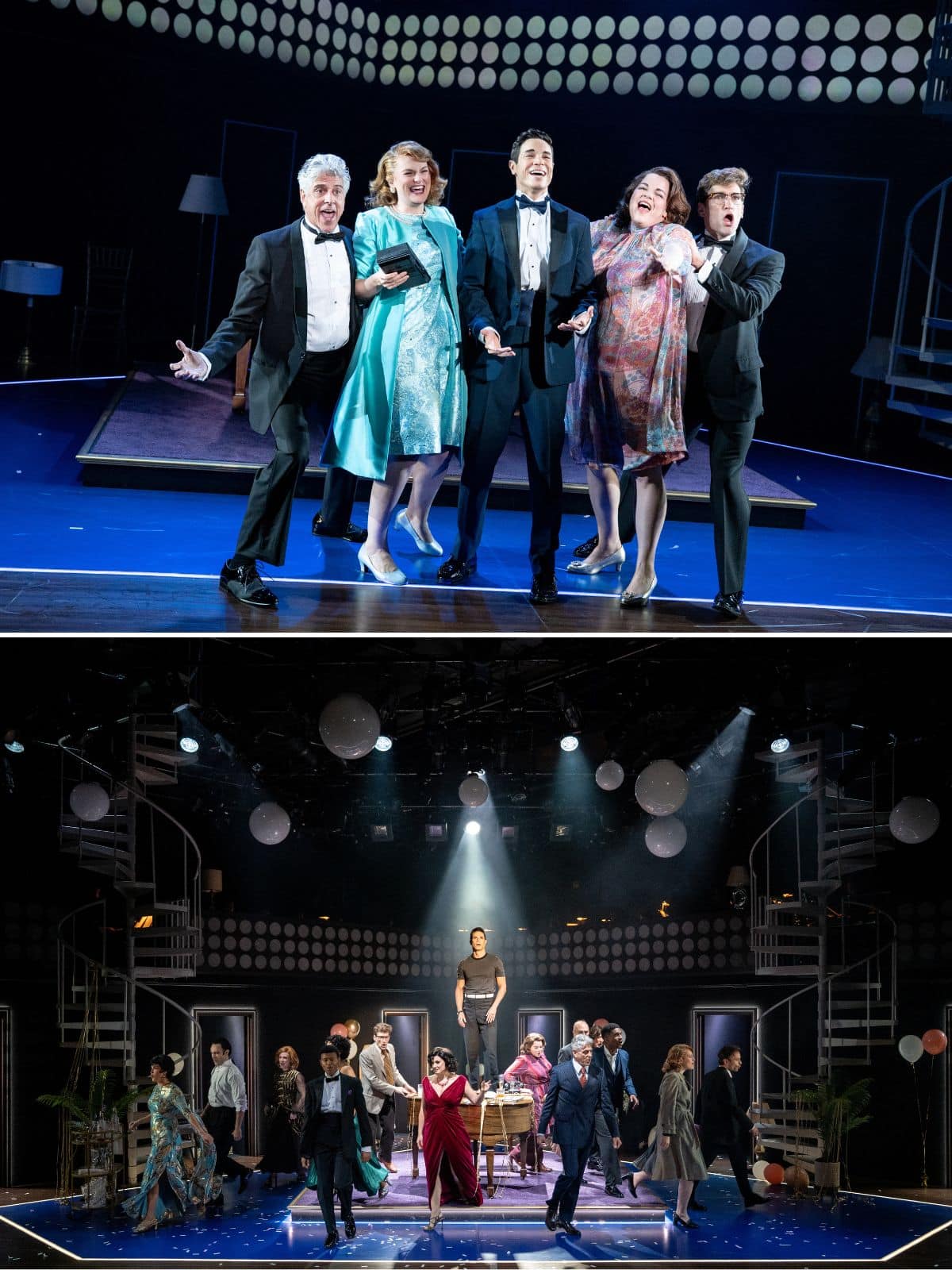
Speaking of doors, Wilson Chin’s set has six of them (which do frequently open for cast entrances and exits), arranged symmetrically, three each on each axis of the set. Symmetry, in fact, is the defining characteristic of the set, with a high spiral staircase flanking each side of the set. Center stage is a low square platform with a small turntable and a piano, the hub of much of the action. I wondered if the ordered symmetry of the setting was intended to contrast with the disorder of the characters’ lives.
Director/choreographer Matthew Gardiner follows suit, using symmetrical blocking in many scenes and frequently balanced stage pictures. When something is out of balance, you notice. For example, Gardiner makes good use of placing Mary off to the side of otherwise balanced or clustered groups of actors, emphasizing her aloneness. While not a dance show in the usual sense, Merrily is an active movement show, and Gardiner’s design keeps the major characters and ensemble moving smoothly and seamlessly. A nice touch is having actors walk backward in the show’s transitions to represent the clock winding back as the reverse chronology unfolds.
The ensemble has a great deal to do in Merrily, with many numbers involving very intricate exchanges of sung and spoken lines among characters. The actors handle these demands without a hitch. Everyone sings well and in character, and music director Jon Kalbfleisch’s 12-person band, set on an upper-level V-shaped structure about the main playing area, fills the theater with a full, rich, precise sound.
Cory Pattak’s lighting design is a part of the show beyond its role in illuminating actors. The stage is full of table and upright lamps, which form part of the background except in “The Blob” number in the second act, where they are brought into the center playing area with the ensemble. Over the stage are hung — again symmetrically — groups of large globes.
The globes get their best moment in the transition to the final scene of the show, as Frankie Jr. (Neal Gaensehals), Frank’s young son, sings — very touchingly — a verse of the title song solo while holding a blue helium balloon. The balloon ascends into the rafters as the globes are lit from within in the same blue color.
This leads to the show’s final number, “Our Time,” in which Frank, Charley, and Mary meet as a trio for the first time, on the roof of an apartment building, looking up at the night sky to catch a glimpse of Sputnik. They are young, idealistic, full of hope, full of plans to make art that will change the world. The audience knows what will become of their dreams, while, in their innocence, they do not, making the song a simultaneously uplifting and deeply sad moment.
In his book of lyrics, Finishing the Hat, Sondheim comments that Merrily was his attempt to fix Allegro, an unsuccessful Rodgers and Hammerstein show on which Sondheim served as a teenage gofer. In each show, an idealistic young man (a doctor in the case of Allegro) becomes corrupted and disillusioned, helped to his doom by an ambitious, grasping wife, and betrays his friends. The difference, Sondheim writes, is that Allegro redeems its hero, whereas Merrily leaves him “sinking into the hell he has created.” Not necessarily, in my view.
Sometimes a show, in performance, can grow beyond its creator’s intent. In the final moment of this production, after everyone else has cleared the stage, Frank sits at the piano — the only thing left onstage — and looks at a photo of him with Charley and Mary. Similarly, at the same point in the hit 2023-24 Broadway revival, Frank holds a folder with the script for a play that he and Charley never wrote. At this moment in both productions, Frank appears somewhat contemplative.
This brought to mind a book I recently came across, Falling Upward, by philosopher/theologian Richard Rohr. Rohr argues that, in the first half of life, people often establish their identity, build a career, and find security or status. Then, there’s a fall: a major failure, loss, suffering, or disillusionment. We grow more by doing things wrong than doing things right, Rohr suggests. This painful descent can let people rise into a deeper, more compassionate, and joyful understanding of life, a second half of life that can be more meaningful and genuine.
Could there be such a second half for Frank? We’ll never know, of course, but both these superb productions (the recent Broadway revival and Signature’s current production) leave at least a hint that it might just be possible.
As the actors received a well-deserved standing ovation at the show’s end, the entire company joined in a chorus of “Old Friends.” Coming after the intentional melancholy of “Our Time,” it was warm, cheerful, happy, and hummable. Joe Josephson, the producer who so annoyed Frank, would have approved.
Running Time: Two hours and 30 minutes including one 15-minute intermission.
Merrily We Roll Along plays through November 1, 2026, in the MAX Theatre at Signature Theatre, 4200 Campbell Ave, Arlington, VA. Tickets start at $47 and are available online or by calling the box office at 703 820 9771. Tickets are also available at TodayTix.
The program is online here.
(Given the degree of air conditioning in the theater, patrons may want to bring a sweater or jacket.)
SEE ALSO: Signature Theatre announces cast and creative team for ‘Merrily We Roll Along’ (news story, July 29, 2026)