By Amanda Zeitler, managing director, Theatre Prometheus
Last week I took some time to chat with Stephen Spotswood about the world premiere of his latest play, Where Dead Women Go to Dance.
Where Dead Women Go to Dance is the story of two lifelong best friends — Kim and Ellen. On the night of the play, Kim discovers that Ellen has unexpectedly died, so she does what any self-respecting witch would do — she brings her friend back to life. What follows is a heart-wrenching, yet hopeful story about the nature of friendship, mortality, and what we owe each other.

Amanda Zeitler: This is the big obvious question, but it’s one that I am always deeply interested in: What was the inspiration for this particular story?
Stephen Spotswood: The very initial inspiration is embarrassingly simple: I wanted to write a play that was a twist on a horror trope. I’d done that with In The Forest, She Grew Fangs, which used the werewolf story to talk about cycles of trauma. Zombies seemed like an excellent language in which to say something about the joys and challenges of being alive.
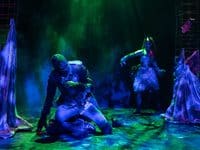
As for the actual plot, I frequently start with images. This one started with the first moment of the play — one friend dragging another’s bloody body into her kitchen. It took me a little while to figure out who they were and how they got there.
How has the story changed during your writing process? Or has it changed? What did this process look like?
I’m going to attempt a show-appropriate metaphor here.
The process is a lot like crafting a new recipe from scratch. In the first draft, you discover whether it’s palatable. If it is, the work becomes about figuring out what you add and/or take away to get the flavor where you want it.
It was pretty clear from that first draft that I was writing a love story for best friends. It’s a platonic love story, but still a deeply intimate one, and exploring what that means has been a big part of the writing process. That’s a big, robust, sweet (but not saccharine) flavor.
What wasn’t as clear was how much the play would be examining undiagnosed depression and a kind of quiet desperation that some people live with without ever talking about it. That became a more prominent ingredient over time. It adds a bitterness that hopefully makes you appreciate the love story even more.
Without spoiling anything, what’s your favorite moment in the play?
As I’m writing this, we’re just starting tech, so this answer could change after I see the full production, but there’s a moment late in the play where Kim and Ellen create something together (being super vague to avoid spoilers), and it’s simple and sweet and funny and a little gross, which kind of sums up their friendship and the play in general.
I know you’re a big music guy — are there any artists, albums, or playlists that you had on repeat while working on this script?
If I’m writing, I’m almost always listening to music. For example, as I’m answering these questions, I have the new Paris Paloma album on repeat. Strongly recommend.
I probably cycled through a lot of artists while writing the play, but I definitely know I was listening to a lot of Lucy Dacus, Julien Baker, and Phoebe Bridgers (the holy trinity of Boygenius). I’d recommend any or all, depending on what flavor of religious and/or personal trauma you have an appetite for.
If I were writing the play today, I’d probably be binging Florence and the Machine’s newest album, Everybody Scream, which is thematically very on the nose.
You have this great note in the character descriptions comparing Kim and Ellen to different cats: “If you had to describe Kim as a cat, it might be a bookstore tabby…. Like a bookstore cat, she sometimes gives the air of knowing great and secret things. Which she does.” You say that Ellen would “be the type that wanders inside and outside at will, and doesn’t seem content with either. A little too feral to be domesticated, but too soft for the alley life…. She still wants pets, but not from just anyone.” Which one do you relate to?
A little of both, but I probably lean more toward Ellen. I like to describe myself as a site-specific extrovert. I love engaging with people, and can be pretty outgoing, but only in a limited number of settings (rehearsal rooms, classrooms, theater lobbies, concerts).
This play talks a lot about magic — do you believe in magic?
Years ago, I read a comic book that described magic as the “cheat code to reality.” A way to bypass the mundane step-by-step slog of everyday existence.
I think if magic exists, it exists in the space between people, or specifically when we close that gap, through love, compassion, or the intermediary of art. In the play, the magic of Grandma Jo’s recipe brings Ellen back to life, but it’s Kim’s and Ellen’s friendship that does the heavy lifting for everything that comes after.
If audiences walk away with anything, I hope it’s that. I hope they think about their own friendships, the connections they’ve been putting off strengthening, the things they’ve left unsaid.
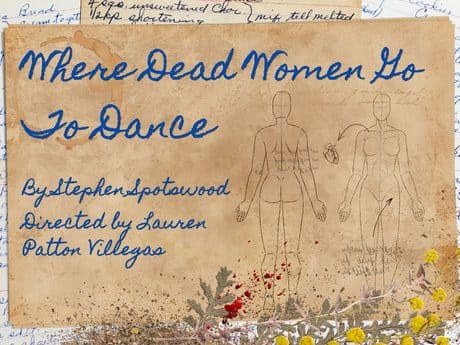
Where Dead Women Go to Dance plays September 25 to October 17, 2026, presented by Theatre Prometheus, performing at Montgomery College’s Cultural Arts Center Studio Theatre, 7995 Georgia Ave, Silver Spring, MD. Tickets are $25 general admission and available online (with student and pay-what-you-can tickets available for all performances).
Where Dead Women Go to Dance is directed by Theatre Prometheus Co-Artistic Director Lauren Patton Villegas.
SEE ALSO:
Theatre Prometheus announces cast and crew of ‘Where Dead Women Go to Dance’ (news story September 3, 2026)