
The word al-Hakawati means storyteller in Arabic.
In the legend of 1,001 Nights, Scheherazade famously saves her life by distracting her murderous husband with a new story every night. In Hannah Khalil’s Hakawatis: Women of the Arabian Nights, she receives help from an unlikely source. To provide the husband with future wives to kill after Scheherazade’s death, women have been continuously abducted and imprisoned. A group of them decides to work together like a writing team and keep her supplied with new stories. By doing so, they are able to prolong Scheherazade’s life as well as their own.
The play imagines what the existence of these women was like as they came up with their stories. This sisterhood of storytellers commiserates over their situation. When the newest, youngest, and most naive abductee shows up in their cell, the group listens to her story, tells her the truth of her situation, and then they comfort her.
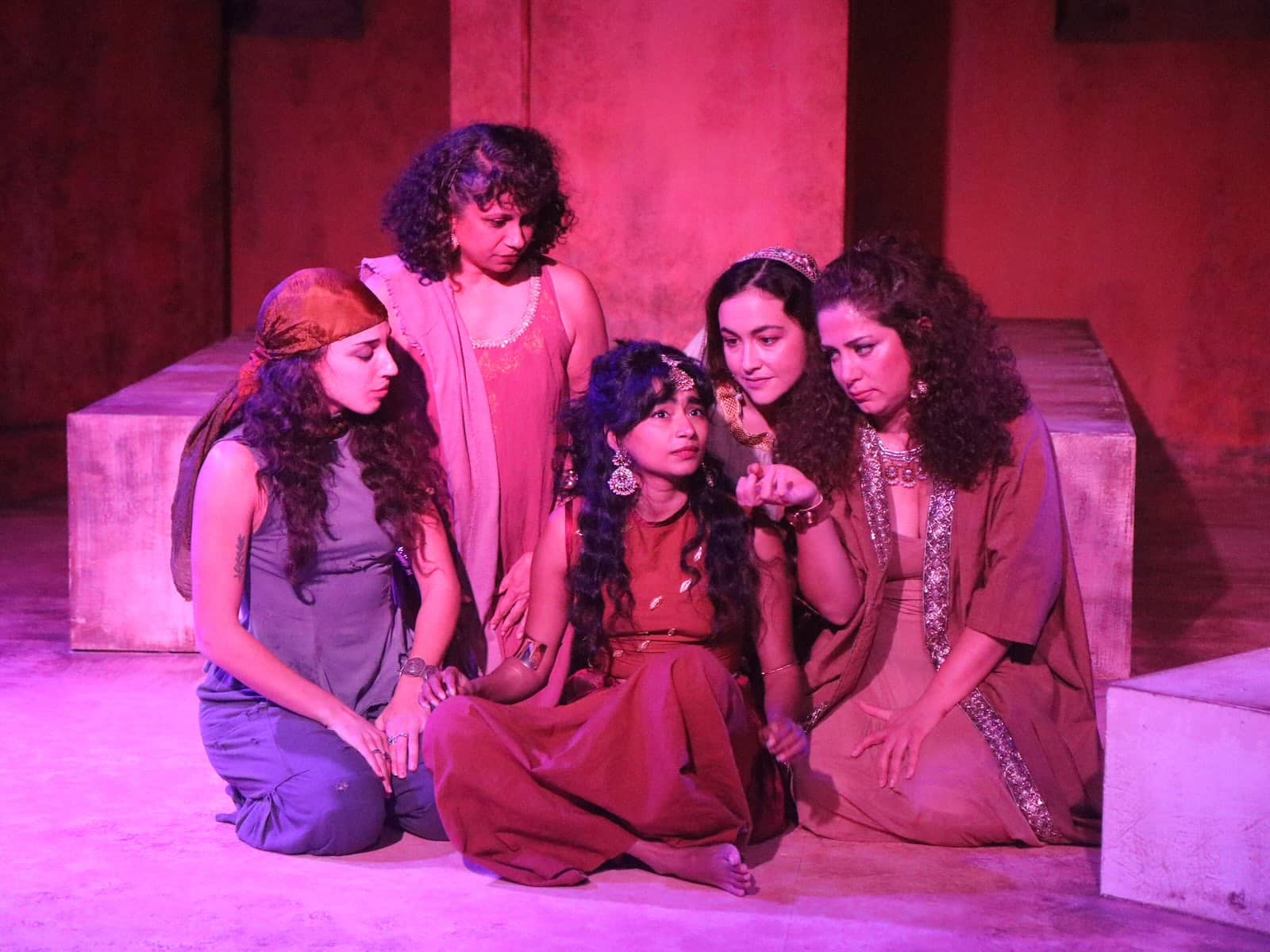
The stories that are told over the course of the play contain the cumulative argument of a culture for why and how one should live. The stories contained what Scheherazade needed to persuade her husband to spare her life.
Before a word has been spoken, the music (by navi) that fills the theater and surrounds the thick-walled, multi-windowed prison believably transports the audience to the Middle East or to Ethiopia. There are thick arches and walls, a floor with multiple storage/hiding spaces for people and things, and multiple surfaces to lie and write on. The set by Giorgos Tsappas is gorgeous; its classic carceral architecture makes both the prisoners and their captors seem small and subject to a higher power or fate. Cidney Forkpah dressed the cast in appetizing and gorgeous variations of brown, red, and chocolate that complement the walls of their prison.
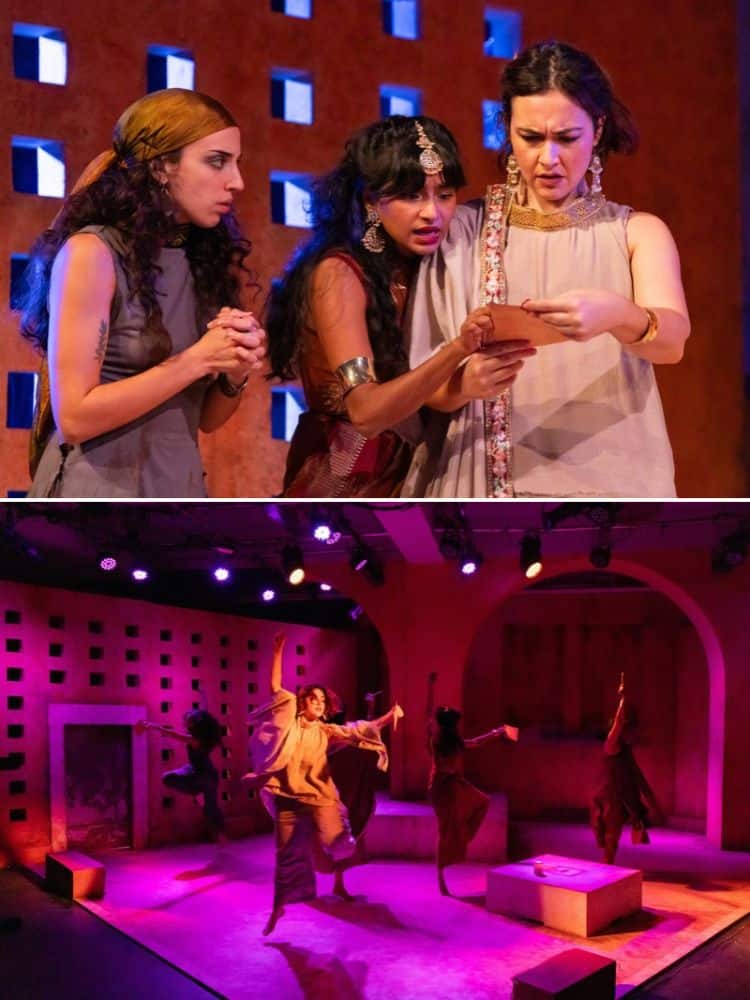
The stories that the women try out before sending them to Scheherazade are danced sometimes (energetic choreography by Robert Bowen Smith and Rex Daugherty). Sometimes they are enacted through evocative use of puppetry that is handled by the actors. Johnna Presby contributed a wide variety of delightful puppets to the production.
The passionate and forceful cast took their charge as storytellers seriously. It was frustrating, though, that sometimes what the stories meant to the characters who spoke them was not as clear as I would have liked.
But the stories were many and varied. And director Mekala Sridhar made sure that beauty and spectacle were abundant in this production.
Running Time: Approximately two hours, plus a 10-minute intermission.
Hakawatis: Women of the Arabian Nights plays through October 18, 2026, presented by Spooky Action Theater in association with Solas Nua, performing at Universalist National Memorial Church, 1810 16th St NW, Washington, DC. Performances are Thursday, Friday, and Saturday at 7:30pm, Sunday at 2 pm, plus one Wednesday performance on October 14 at 7:30pm. All tickets are General Admission and range from Pay-What-You-Can to $50. Purchase tickets online.
The UNMC is an older venue and is currently not accessible to wheelchairs.
The program for Hakawatis is online here.
Hakawatis: Women of the Arabian Nights
By Hannah Khalil, with contributions from Hanan Al-Shaykh, Suhayla El- Bushra and Sara Shaarawi, and translations by Hassan Abdulrazzak
Directed by Mekala Sridhar
CAST
Gigi Ammaroto (Zuya the warrior)
Surasree Das (Fatah the young)
Gowri Kaneswaaran (Naha the wise)
Raghad Makhlouf (Wadiha the dancer)
Laura Zee (Akila the writer)
Lilinaz Hakimi (understudy)
PRODUCTION
Mekala Sridhar: Director
Giogos Tsappas: Scenic Design
William K. D’Eugenio: Lighting Design
Cidney Forkpah: Costume Design
navi: Sound Design & Composition
Johnna Presby: Puppet & Props Designer
Robert Bowen Smith, Rex Daugherty: Co-Choreographers
Layali Aljirafi: Choreography Consultant
Grace Gradriguez: Production Stage Manager
Sheree Pickett: Assistant Stage Manager
Franklin Ruiz: Technical Director
Anderson Molina: Production Manager
SEE ALSO:
Spooky Action Theater opens 2026/27 season with ‘Hakawatis: Women of the Arabian Nights’ (news story, July 30, 2026)