
One-woman shows can be tricky. It’s not just the weight of carrying a full evening on one pair of shoulders; it’s the inevitable scrutiny placed on the written premise of the show. Years ago, I watched The Belle of Amherst, where the character of Emily Dickinson addressed the audience of the over-1,000-seat Longacre Theatre on Broadway and invited us to tea. Now, Miss Dickinson was known to value her privacy and, even with friends, was not one to prattle on about herself. To my mind, the premise was flawed and ruined for me the performance of the inimitable Julie Harris. On the other hand, some years later the solo vehicle about Gertrude Stein captured brilliantly the larger-than-life character who did indeed like to “hold forth” and undoubtedly made herself the center of her every artistic salon gathering in Paris. The title of the show — Gertrude Stein, Gertrude Stein, Gertrude Stein — said it all! What would a solo show about the fascinating and very complicated Mexican artist Frida Kahlo take as its starting point?
Frida…A Self Portrait is a work by writer-performer Vanessa Severo, several years in the making, and clearly an act of devotion as well as self-scrutiny, seeking the intersection of Severo’s art and life with her subject. It is presented this month by Shakespeare Theatre Company.
The premise is both confession and, I would say, hallucination. Both are achieved admirably.
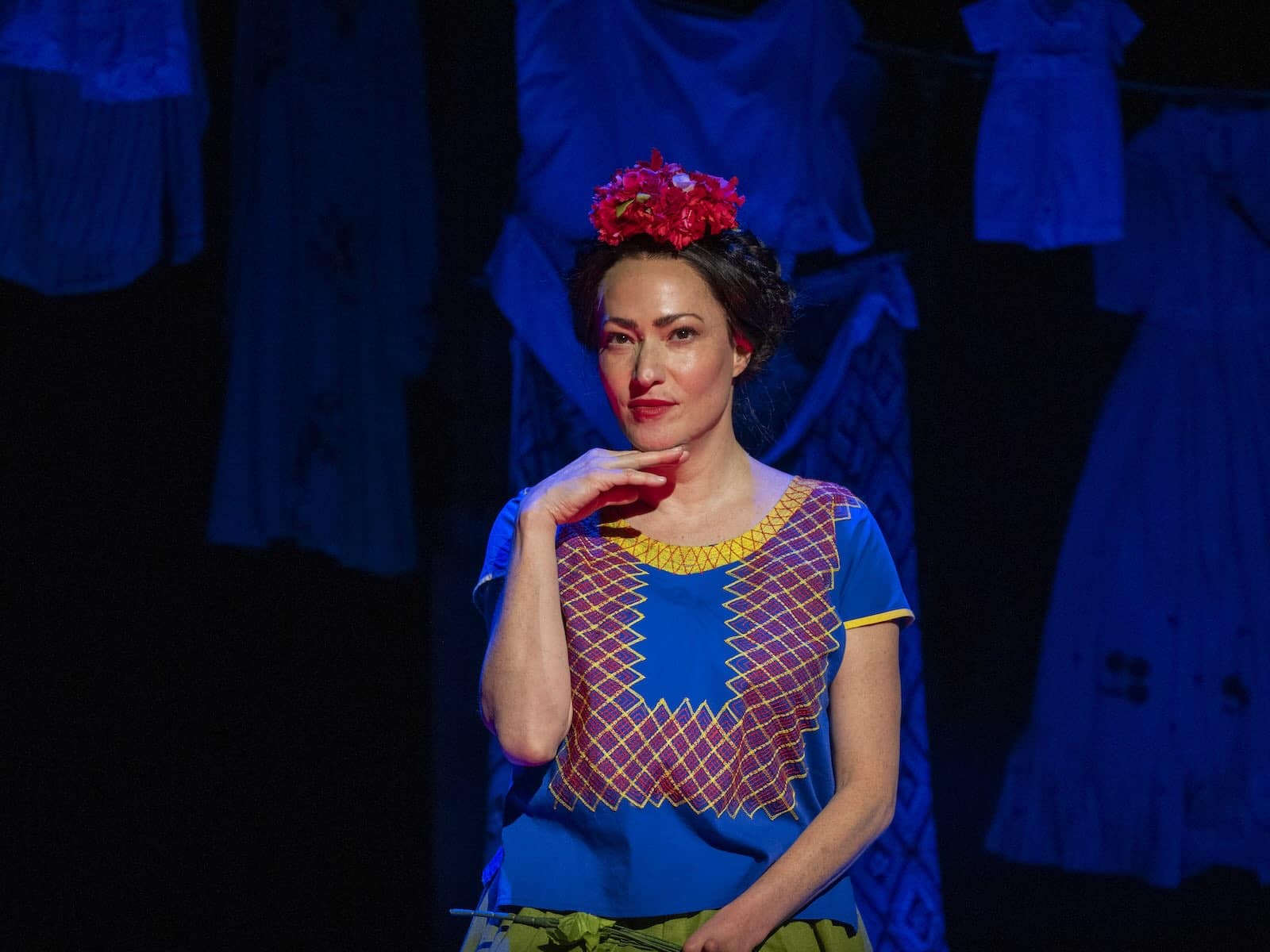
Confession because, at the top of the show, Frida Kahlo receives a visitor, a journalist who has made a pilgrimage to Kahlo’s home (La Casa Azul) to write an article for Architectural Digest. But first, he must stand in as confessor to the woman’s passionate anguish and rage. The actress gives this imagined character substance through the intensity of her focus, placing him in her sights on different downstage diagonals as she alternately interrogates, berates, and flatters him. She spares neither him nor the audience the ferocity that can suddenly be unleashed by this woman.
The hallucinatory aspect that infuses the story is also well-conceived and staged. Director Joanie Schultz partners Severo’s vision admirably, using as their starting point the bedroom of the painter’s beloved La Casa Azul during the final period of Kahlo’s life when she was mostly bedridden and dealing with constant pain, only briefly alleviated by self-administered popping of pain-killing pills and injected morphine. Scenic designer Jacqueline Penrod has created a brilliant framing device in a massive four-poster bed, its headboard along the upstage wall, and its frame and legs hung down from the ceiling so that it acts as a mirror image to the artist’s intense longings and imaginative flights into memory. Rachel Cady’s lighting design heightens the changing moods and pivots from defining physical space to following Kahlo into interior psychological exploration by drawing tight circles of intense white light.
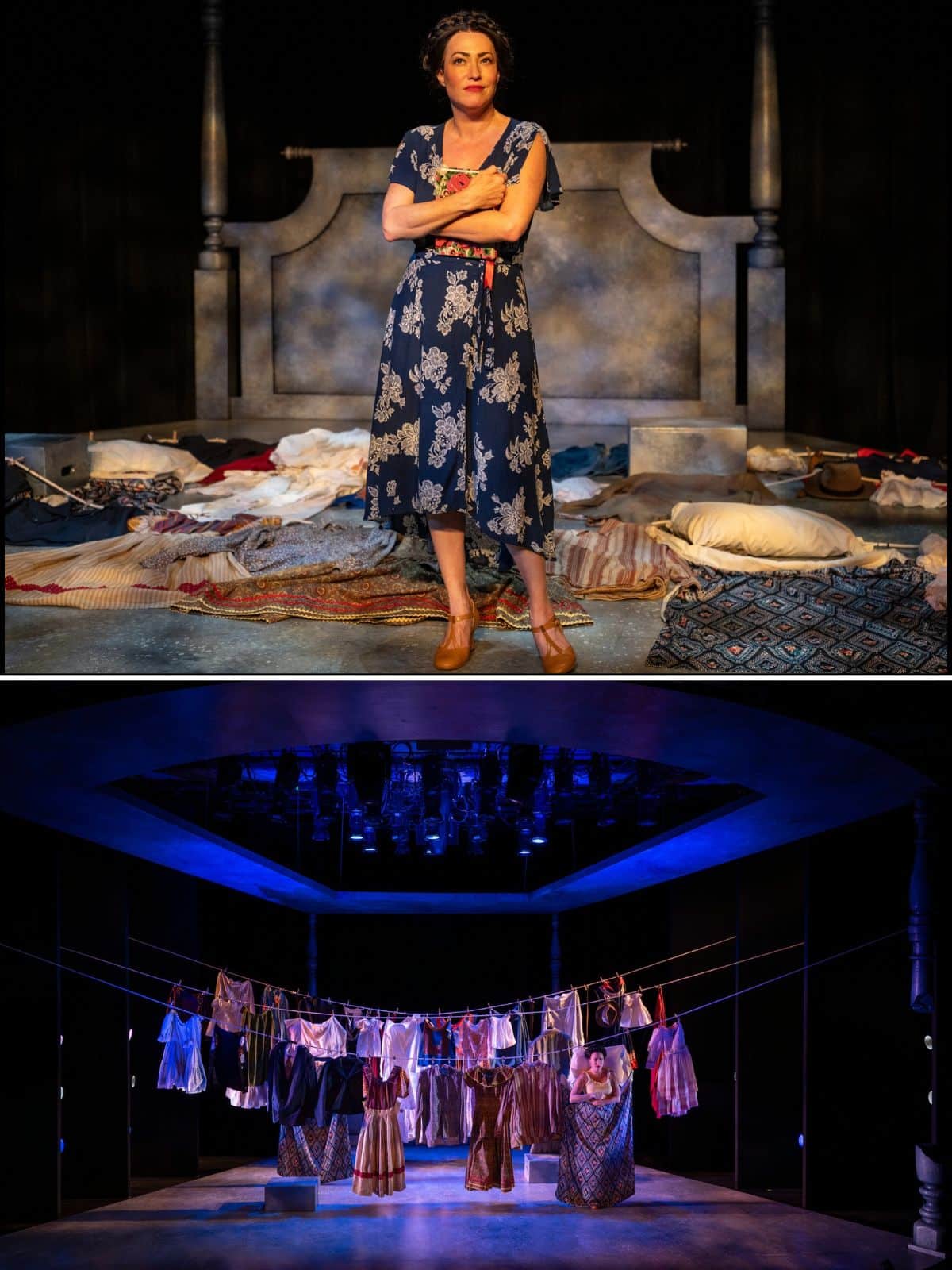
When we first see the stage, piles of rags seem strewn across the playing space. But the rags are pulled taut and raised to reveal clotheslines of laundry, adding another layer to the storytelling as the performer pulls them around like a blanket or steps into them to embody different characters, fashion styles, and identities Kahlo tried on in her rich and complicated life. Now the actress jumps onto a box, catching the clothesline, which offers both the mustache and jacket of her father, a stern German who bellowed at Frida as a young girl stricken by polio, forcing her through excruciating exercises to make her strong.
In another scene, Severo slips her right arm into an oversized jacket, and suddenly her arm and shoulder embody her husband, the colossal muralist Diego Rivera himself, while, in classic mime art form, it’s as if he cradles her head and strokes her face. Most touching of all is when she pulls diminutive infant clothes from the line, and one by one hugs them to her belly, then folds them and discards them, signifying the multiple tragic miscarriages her character endured.
Severo is a gifted physical actress with strong credentials across the movement spectrum, including certification in the Japanese Suzuki method and experience as both a dancer and choreographer. In this show, she uses both bold gestures and full-body expressiveness to convey the emotional range and depths of Kahlo. She is not afraid to show Kahlo’s struggle with pain, disability, and even ugliness if she can mine the truth. Severo even breaks the fourth wall to share a little about her own disability and medical journey. At more than one point, she dares the journalist and audience members not to look away but to take the time to really see the full person. This was surely Frida’s supreme gift as a painter.
Like her subject, Severo presents as a flawed artist. Certain missteps make the piece still feel in places unfinished. One such moment is when she breaks into an Argentine tango, culturally inappropriate, I might suggest, and, according to Mexican friends in the audience, veering into the disrespectful. Severo’s crude dismissal of Diego in the end seemed like an all-too-modern assessment and rejection of a clearly dominating man, but a complicated and centrally passionate relationship for them both.
Nevertheless, this is a work not to be missed.
Running Time: Approximately 75 minutes, no intermission
Frida…A Self Portrait plays through November 8, 2026, presented by Shakespeare Theatre Company at the Klein Theatre, 450 7th Street NW, Washington, DC. Tickets are available online, by calling the Box Office at 202-547-1122, or at TodayTix.
Frida…A Self Portrait
Written and performed by Vanessa Severo
Directed by Joanie Schultz
Scenic Designer: Jacqueline Penrod, Costume Designer: Katherine Davis, Lighting Designer: Rachael Cady, Sound Designer & Composer: Thomas Dixon
The Asides program is online here.