Walking into DAR Constitution Hall, I am struck once again by the boldness of Francesca Zambello’s vision, continuing to move Washington National Opera forward, from its decoupling from the John F. Kennedy Center and going solo as an organization to reimagining this season how to present “grand opera” entirely in Constitution Hall. Gone is the proscenium and with it the machinery, bells, and whistles to manifest extraordinary scene changes. Gone too is the orchestra pit in front and half-hidden down under the pretty spectacle above; rather, the orchestra is in plain view behind the singers. The “Revolutionary Stage,” as WNO is calling it, thrusts out into the audience, which surrounds and cradles the action on three sides, bringing everyone in to feel closer and part of the story. There is even an encirclement of cabaret tables, creating an inviting, informal atmosphere. Opera for the People.
Composer John Adams’ Nixon in China holds a singular place in modern operatic repertoire. Musically, its pulsating score is neither conventionally minimalist nor jangling with atonal dissonance, but it engages with metrical variety while pushing the story forward. The story follows what history often refers to as “the week that changed the world” in President Richard Nixon’s February 1972 visit to China. It deals with both the very public arena of state dinners and carefully crafted, if awkward, diplomatic negotiations juxtaposed with private moments stolen in hotel bedrooms. Most of all, in hindsight, it gives us a window into the psychology of a president who was obsessed with his image as it played out in the media. As we are witnessing the last act of another president, similarly obsessed, this opera seems to resonate especially as an American opera and, maybe especially, as an opera for Washington audiences.
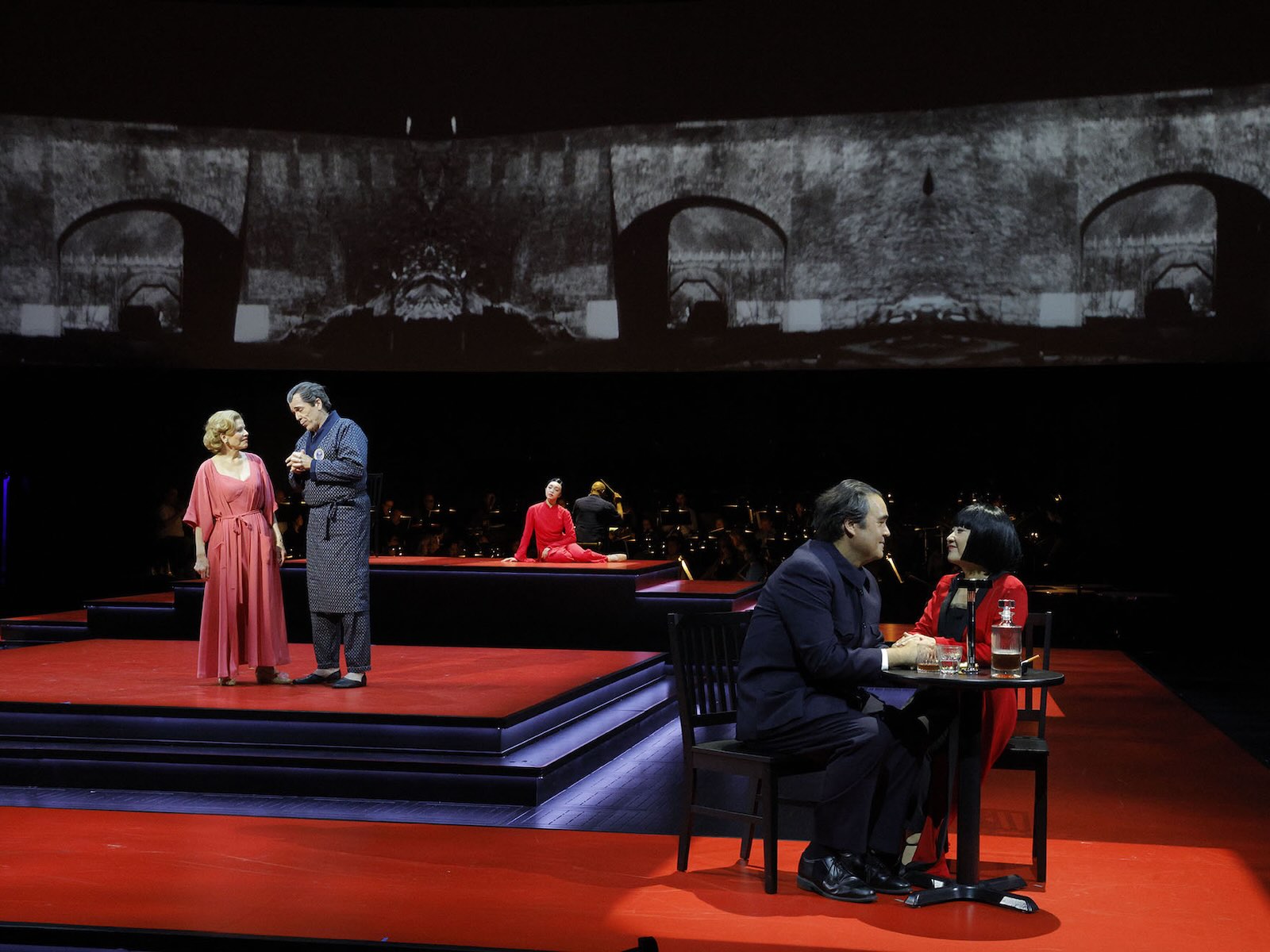
Set designer Alexander V. Nichols has created for this thrust stage a series of interlocking squares, stairs, and runways, all in Chinese-dragon red. Director Elkhanah Pulitzer uses the sleek playing area admirably, keeping the singers moving so that all sides of the wrap-around audience might benefit. Simple chairs and tables are whisked on and off as needed. The dominating scenic elements are projections, designed by Bill Morrison, assembled from archival news media and private footage, and not only featured in giant triptych fashion upstage but projected from all sides onto a silk box suspended center stage.
The singing, while not given luscious, memorable arias, is of high standards indeed. John Matthew Myers’ strong tenor voice as leader Mao Tse-Tung was outstanding, and I found Joo Won Kang’s interpretation of Chou En-Lai moving, especially his ruminating contemplation in the final act. Kathleen Kim as Madame Mao used her agile high soprano to be seductive at times and suitably formidable at others. I have been a fan of Thomas Hampson for years. As Nixon, on opening night, he did not start out with the dominating sound I remembered, but nonetheless, I loved his opening number, “News,” and, as the evening wore on, I warmed to his interpretation, especially in Nixon’s private scenes with Pat.
Clearly, the star of the evening was Renée Fleming as Pat Nixon. Her voice still shines with its signature warm luster, and her diction is impeccable. She conveys complexity in this character: shy and retiring in public, as First Ladies were traditionally taught to be, but then strongly reacting to unkindness in others, and tender, clearly still holding passionate feelings for her husband when alone. In several scenes, she was seated as an observer to proceedings or presentations. I marveled at her attentive presence. She seems a generous player with her colleagues.
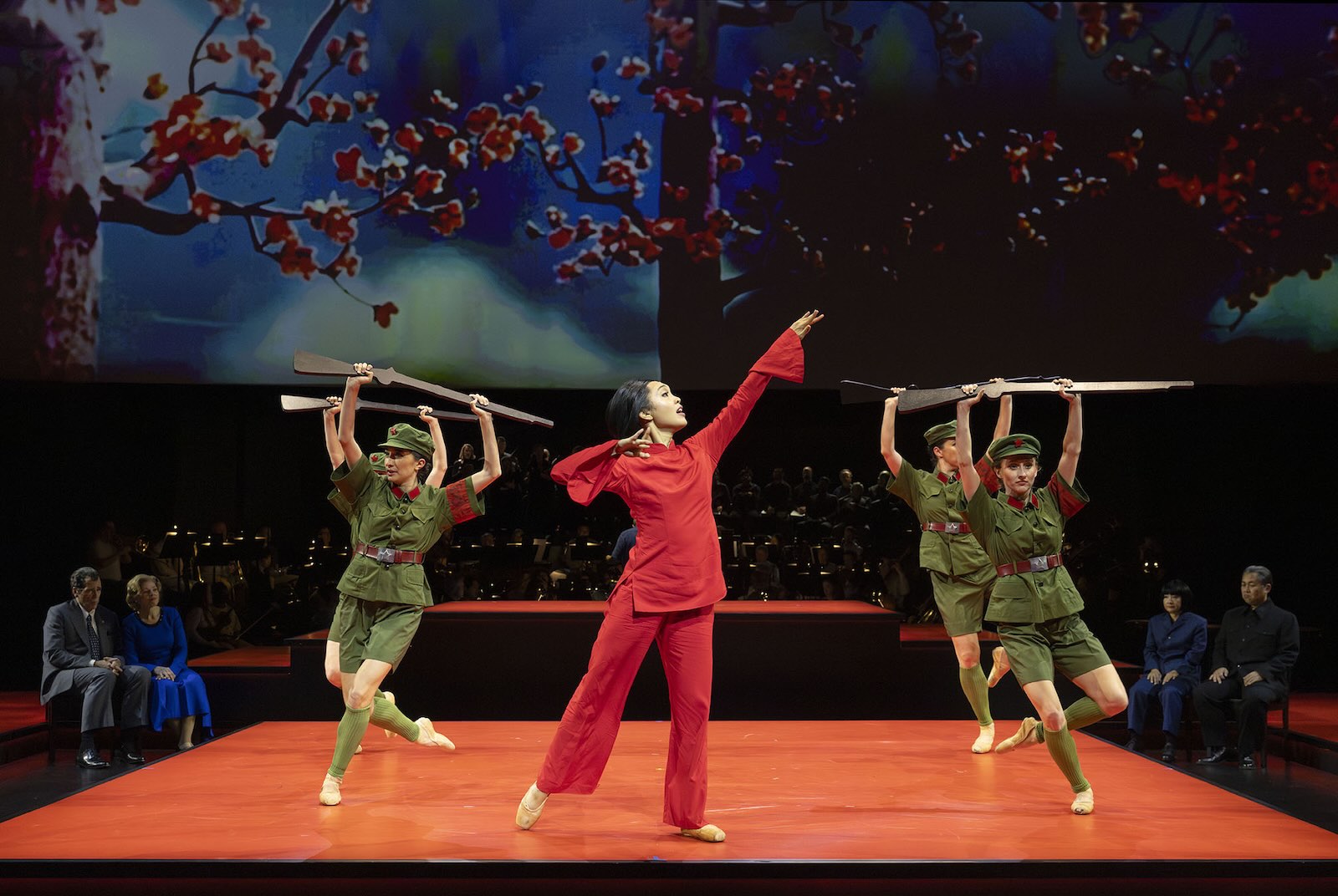
In Act II, Madame Mao’s ballet captured the flavor of Chinese Revolutionary-style dance, and, though the score made it a trifle long for Western audiences today, choreographer Jessica Lang took a fresh approach beautifully realized by the dancers, especially soloists Kayla Mei-Wan Thomas and Jaryd Farcon.
In the final Act III, as things wind down, Chou voices the question on everyone’s mind looking back, “Was anything we did good?” It is a question we must certainly ponder today.
Adams’ opera has stood the test of time since its early days of development by a very young Peter Sellars directing and a cast that included James Maddalena as Nixon and tenor Sandy Sylvan as Chou En Lai. This production is beautifully realized.
Running Time: Two hours and 45 minutes, including a 25-minute intermission.
Nixon in China plays November 19 and 21, 2026, presented by Washington National Opera, performing at DAR Constitution Hall, 1776 D Street NW, Washington, DC. Purchase tickets ($57.60–$329, including fees) online via Ticketmaster.
Sung in English with projected English and Mandarin titles.
The Washington National Opera fall season digital program is here.
Nixon in China
Composer: John Adams
Librettist: Alice Goodman
Elkhanah Pulitzer, Director; Robert Spano, Conductor; Jessica Lang, Choreographer; Alexander V. Nichols, Set Designer; Duane Schuler, Lighting Designer; Bill Morriso, Projection Designer; Mark Grey, Sound Designer; Elisabeth Scott, Costume Designer
With: Renée Fleming, Thomas Hampson, Kathleen Kim, John Matthew Myers, Joo Won Kang, Robert Pomakov, Veronica Siebert, Anna Maria Vacca, Celecia McKinley, Kayla Mei-Wan Thomas, Jaryd Farcon, and the Washington National Opera Orchestra and Chorus and the Opera Corps Dancers
SEE ALSO:
WNO reinvigorates ‘Madama Butterfly’ at DAR Constitution Hall (review by Gina Jun, November 9, 2026)
Washington National Opera announces 2026/27 season (news story, May 25, 2026)