
Washington National Opera’s production of Nixon in China is an intimate adaptation of a celebrated modernist opera. With music by John Adams and libretto by Alice Goodman, the 1987 three-act opera imagines President Richard Nixon and his wife Pat’s famous 1972 visit to China and meetings with Chairman Mao Tse-Tung and Premier Chou En-Lai. Directed by Elkhanah Pulitzer and conducted by Robert Spano, it features unusual, at times hypnotic music, talented singing and acting, and acrobatic dancing.
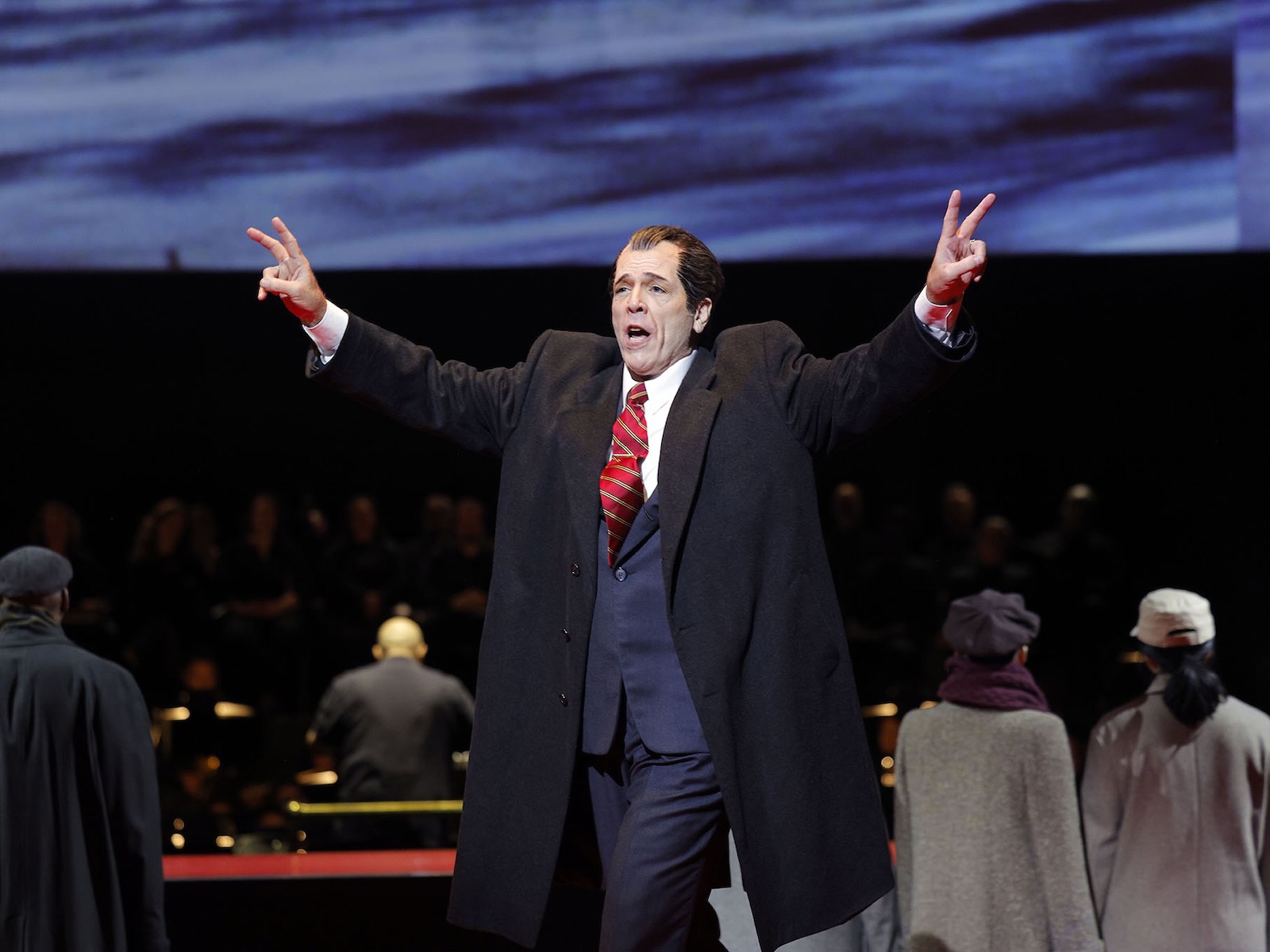
Thomas Hampson plays Nixon with great complexity. His opening aria, “News is a kind of mystery,” is filled with hope for his visit. At the opening-night banquet, he praises his hosts for the magnificent feast, eager for their two countries to come together in peace. He even admits that he was wrong to oppose China. Later, mired in the depressing details, he remembers when, in World War II, he “should have died,” and when he made a burger stand for his fellow soldiers. His paranoia comes through as well, snarling about “rats chewing through the sheets.” His back-and-forth with Chairman Mao (John Matthew Myers) feels both joshing, hoping China wouldn’t have to suffer if a Democrat won the upcoming election, and profound, responding to Mao’s provocative pronouncements on history, even while shaking his head.
John Matthew Myers brings a heavy awareness to Chairman Mao. He sings of deep truths, such as “the patriots begin, followed by the profiteers” and aggressive statements like “history is a sow.” He seems more of an ancient philosopher-king than a 20th-century political leader, yet also knows about the stock market and wonders about the possible result if China were to enter it. Initially sickly, he is escorted and surrounded by his three female secretaries (Veronica Siebert, Anna Maria Vacca, and Cecelia McKinley), who keep people away from him even as he sways, and serve as a chorus, repeating his phrases. Later, he joyfully dances, swaying and dipping Mao’s wife, Chiang Ch’ing (Kathleen Kim). Even then he is filled with melancholy, remembering the battles during the Revolution.
Renee Fleming brings a sincerity to Pat Nixon. In an aria, she sings of treating “each day like it’s Christmas,” and of not wanting trivialities. Feeling contemplative, she offers many wishes for the world, including “may investors continue to speculate further.” Later, attending a ballet, she lays Nixon’s coat over a young dancer (Kayla Mei-Wan Thomas) who has been tortured and implores the hero (Jaryd Farcon) to help her. Her response is both touching and comic.
Kathleen Kim plays Chiang Ch’ing with revolutionary fervor. She takes the stage after the ballet to sing of her role in China’s struggle, praising her husband’s Little Red Book. Later, she “leads” the orchestra in big-band-like music, dancing and holding close to Mao. Even then, she remembers the brutalities and sacrifices of the revolution.
Joo Won Kang brings a gravitas to Premier Chou En-Lai. He makes pessimistic, profound statements like “We saw our parents’ nakedness; it will take rivers to wash them away.” He offers hard truths rather than easy platitudes.
Robert Pomakov brings a quiet thoughtfulness to Secretary of State Henry Kissinger. He tells Mao he teaches all four volumes of the Chairman’s works at Harvard. Otherwise, he is generally silent, offering unheard suggestions to Nixon when perplexed by Mao’s sayings. In the ballet, he plays a brutal landlord, beating a peasant with his cane and having her tortured.
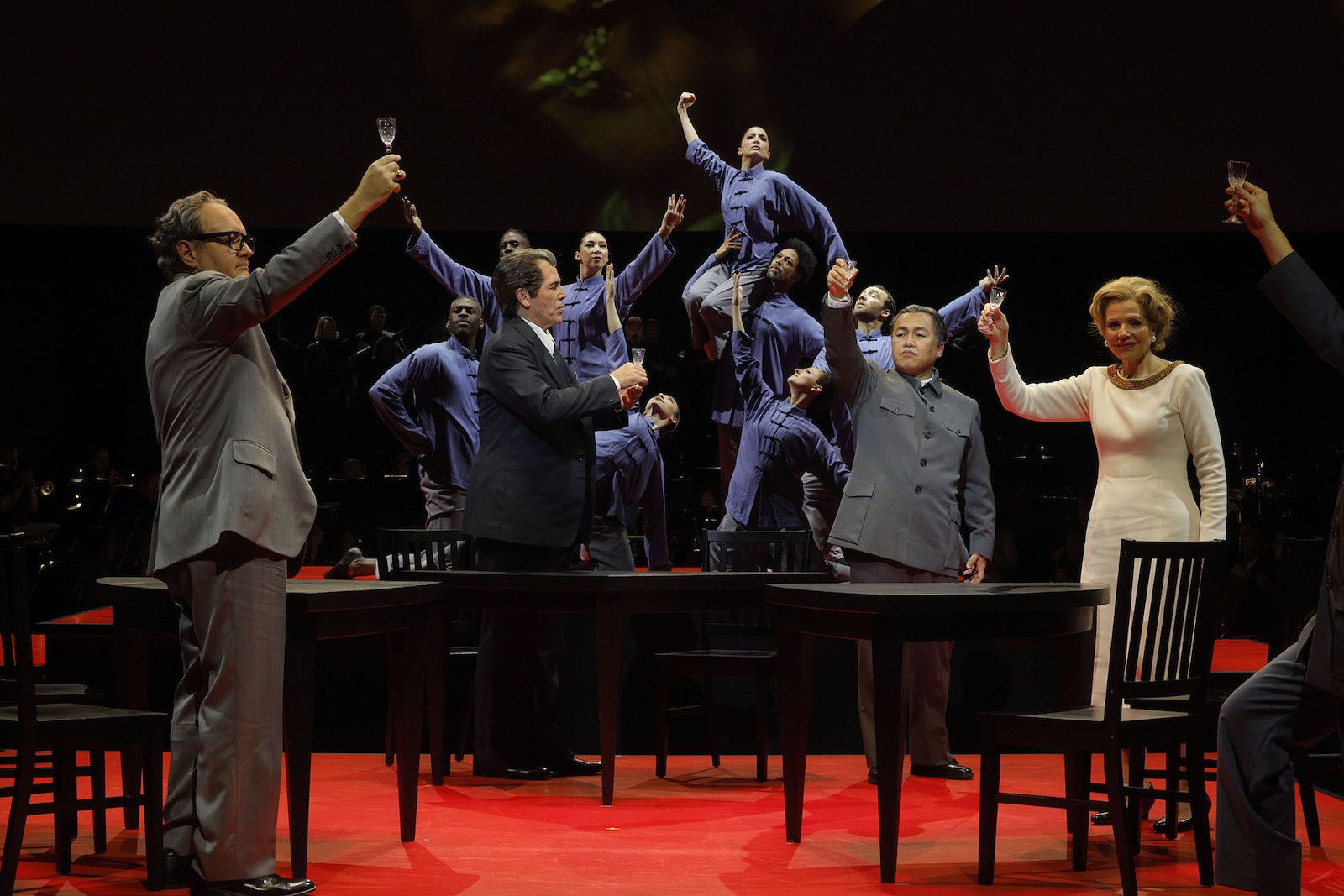
Kayla Me-Wan Thomas and Jaryd Farcon, along with the Washington National Opera Corps Dancers (Dwayne Brown, Kateryna Derechyna, Alyssa Manguiat, Chivas Marchant-Buckman, Antonio Montalvo, Giana Parlin, Sophia Schwinghammer, and Jamal Story) re-enact the ballet The Red Detachment of Women, which the Nixons attended during their visit. Thomas plays the abused peasant, lifted by the other dancers and twisting in contortions until crawling on the stage. Farcon plays the soldier who rescues her, spinning and leaping. The Corps Dancers play the landlord’s thugs and other soldiers.
Set designer Alexander V. Nichols has created a minimalist set: a red square framed by a low red wall. At the back, steps lead to a raised platform. Hanging overhead the square is a large cube, on which projection designer Bill Morrison throws video and photos of the trip to China; the projections also appear on screens in the far back, behind the orchestra, and in one scene, within the square itself. While certainly inventive and intended to immerse the audience in the setting, these projections sometimes feel distracting, interrupting the onstage intimacy. This is especially true of the projections in the square, which show clips of the real Pat Nixon meeting patients, students, and pigs, but hide Fleming herself.
Lighting designer Duane Schuler shines a bright light on the performers at several moments, like a lengthy camera flash. Toward the end, as the performers fall into sleepy reminiscing, lights highlight each couple while keeping the rest of the stage dark. Costume designer Elisabeth Scott recreates the era and the two cultures, with simple suits for Nixon and Kissinger and tastefully colorful dresses for Pat, while the Chinese characters wear green, gray, and blue jumpsuits. Interestingly, both Kissinger and Premier Chou are in gray. Chiang Ch’ing wears a red-and-black nightgown.
Choreographer Jessica Lang creates beautiful, powerful movements in the ballet, with lifts, twirls, extensions, carrying of figures, and difficult contortions. The dancing between the Maos and the Nixons is surprisingly graceful and sensual. Director Elkhanah Pulitzer has the performers move around the stage, both together and separately, allowing for natural soliloquies, duets, and choruses. They highlight the libretto’s poetry and rhythms. Conductor Robert Spano leads the Washington National Opera Orchestra and Chorus beautifully, bringing out the music’s dissonance and repetition, which is entrancing but also creates a sense of anxiety for even seemingly peaceful scenes. Nixon in China blends politics, philosophy, and the complexities of two of the 20th century’s most controversial figures, with curious music, captivating singing, and powerful dancing. Only two performances remain, so go see it.
Running Time: Two hours and 45 minutes, including a 25-minute intermission.
Nixon in China plays November 19 and 21, 2026, presented by Washington National Opera, performing at DAR Constitution Hall, 1776 D Street NW, Washington, DC. Purchase tickets ($57.60–$329, including fees) online via Ticketmaster.
Sung in English with projected English and Mandarin titles.
The Washington National Opera fall season digital program is here.
Nixon in China
Composer: John Adams
Librettist: Alice Goodman
Elkhanah Pulitzer, Director; Robert Spano, Conductor; Jessica Lang, Choreographer; Alexander V. Nichols, Set Designer; Duane Schuler, Lighting Designer; Bill Morriso, Projection Designer; Mark Grey, Sound Designer; Elisabeth Scott, Costume Designer
With: Renée Fleming, Thomas Hampson, Kathleen Kim, John Matthew Myers, Joo Won Kang, Robert Pomakov, Veronica Siebert, Anna Maria Vacca, Celecia McKinley, Kayla Mei-Wan Thomas, Jaryd Farcon, and the Washington National Opera Orchestra and Chorus and the Opera Corps Dancers
SEE ALSO:
WNO’s beautifully realized ‘Nixon in China’ at DAR Constitution Hall (review by Susan Galbraith, November 15, 2026)
WNO reinvigorates ‘Madama Butterfly’ at DAR Constitution Hall (review by Gina Jun, November 9, 2026)
Washington National Opera announces 2026/27 season (news story, May 25, 2026)