
Tony Award winner Bill Irwin is known for his virtuosic physical comedy and contemporary clowning. The actor, whose accolades extend from a star turn in Broadway’s Who’s Afraid of Virginia Woolf to playing Mr. Noodle on Sesame Street, has also had a lifelong fascination with absurdist 20th-century playwright Samuel Beckett.
Now, Shakespeare Theatre Company (STC) presents Bill Irwin’s On Beckett, a solo work conceived and performed by Irwin in which he shares his devotion to Beckett in perfect Bill Irwin style: through the mind of an actor and the heart of a clown. Over the course of 90 minutes, Irwin regales audiences with stories and excerpts from Beckett’s works, employing a pared-down yet playful style that seems deliciously in line with Beckett’s vision for modern theater. The evening is simply sublime.
Presented at STC’s intimate Klein Theatre, On Beckett rolls out as if a magician invited you backstage and promised to show you the secrets of his tricks — and the more this magician rolls up his sleeves and shows you what to look for, the more enchanting his work becomes.
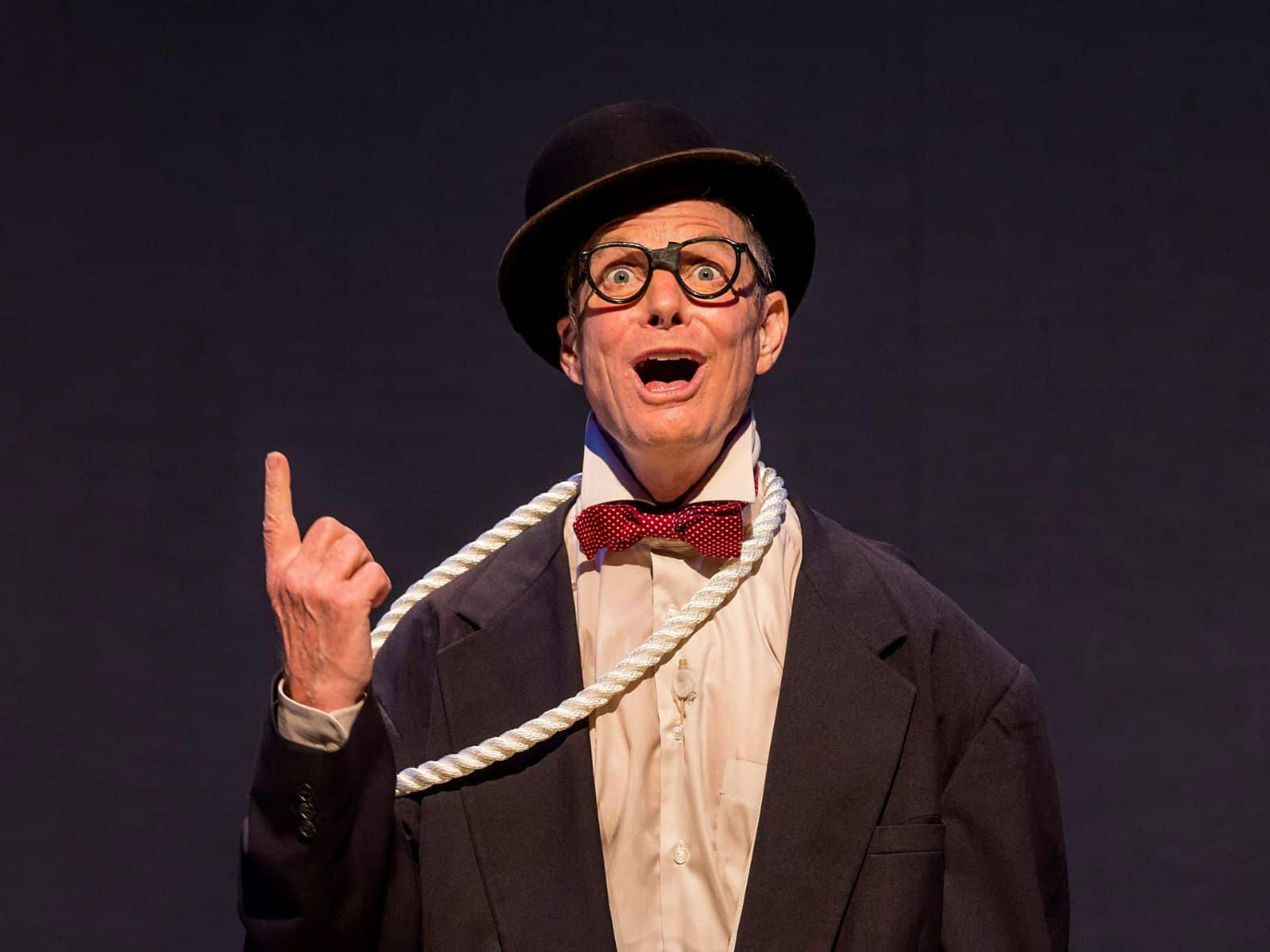
Irwin tells us at the outset how he has organized the evening: “I’ll do a piece of text and then comment on it.” (He draws a lot from Beckett’s early non-dramatic Texts for Nothing.) “And even if you’re not a fan of Beckett,” he adds, “the whole thing won’t be too long, and I’ll get you out soon enough.” Audience members in the packed theater roar their approval. We all settle in and fall under the spell of this gentle but masterful storyteller. And we get to know Beckett in new ways.
Bowler hats featured prominently in Beckett’s most famous play, Waiting for Godot, and Irwin makes a case that they are essential to playing Beckett. Irwin shows us how a bowler hat’s personality helps shape an accent and a “type,” and how it defines a character’s physical posture and rhythm. He demonstrates that donning baggy pants helps an actor “cross the threshold” and fully embody a Beckett character (Martha Hally, costume consultant). Irwin calls pratfalls like getting tied up or putting on a jacket “clown schtick.” Great clown that he is, Irwin makes the physicality look easy.
The evening unfolds on a sparsely decorated stage, with a bowler hat placed at the far end of a bench, stage left, while the only other set piece, a podium, sits stage right (scenic design by Charlie Corcoran). One of my favorite moments of the evening is when Irwin confesses that, even in his devoted relationship to Beckett, as in all intimate long-term relationships, there is a push-pull dynamic. The moment is tailor-made for Irwin to demonstrate the physical comedy he is known for. Blending precise movement and vaudeville timing, Irwin crosses toward the podium, explaining how he’d find reasons to give Beckett a rest. Each time, his feet and legs, seemingly of their own volition, would perform in classic mime fashion “being pulled,” sliding and gliding back toward stage left and that bowler.
In other moments, Irwin interrogates the legacy of Beckett’s works, noting that Beckett’s plays are frequently categorized as “plays where nothing happens” and labeled with academic terms like “alienation” and existentialism.” Irwin cautions that reducing Beckett’s work in this way takes the lifeblood out of his work. Instead, Irwin shows that violence is present in Beckett’s plays and that they are indeed political. He performs the climactic monologue of Lucky from Waiting for Godot most stunningly. The character seems no more than a beast of burden, enslaved to the tyrannical, whip-bearing Pozzo, when at a central moment the luckless fellow is ordered to think, and what follows is a dazzling monologue, a stunning tour de force for any actor.
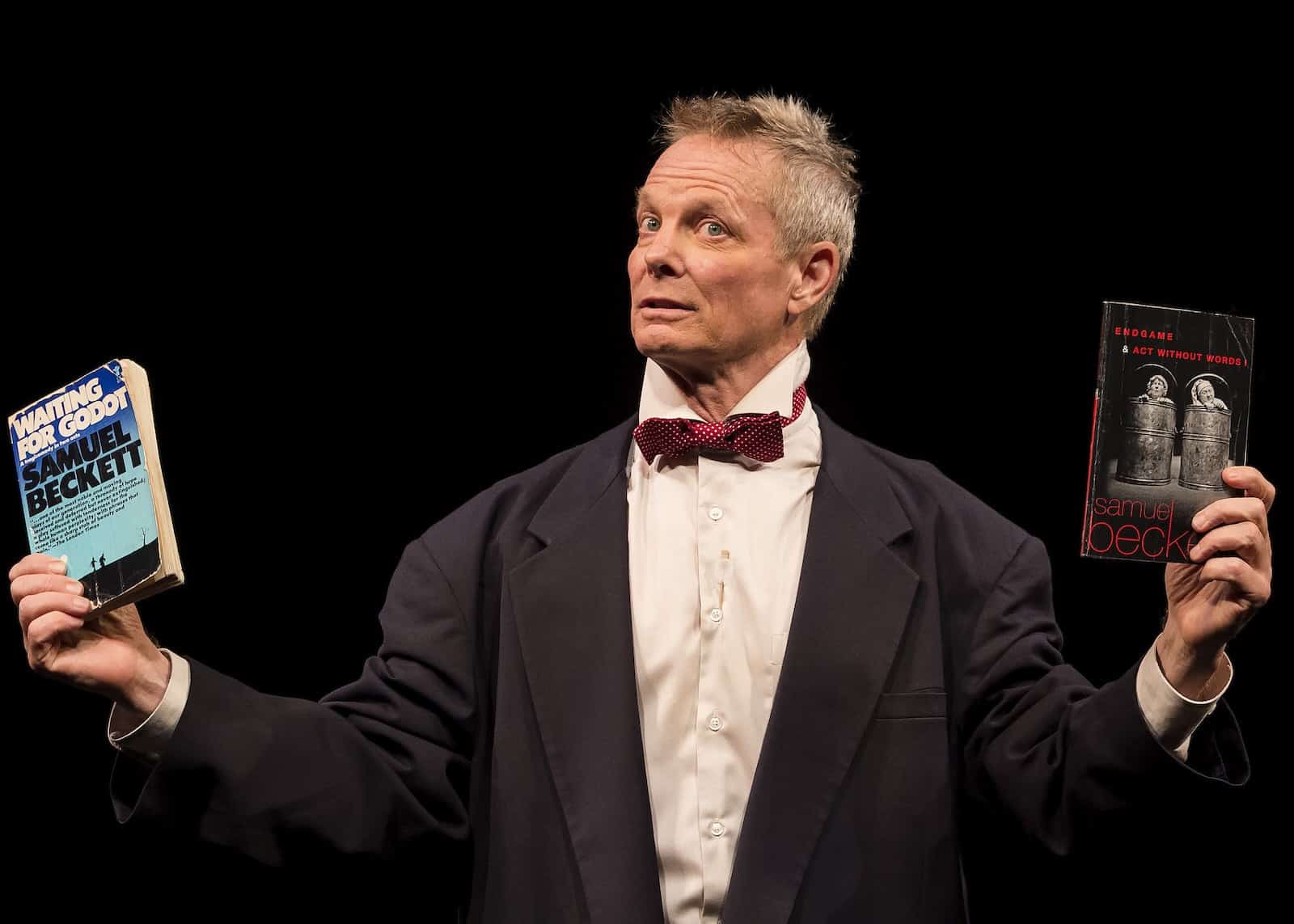
In Irwin’s hands, the evening becomes a master class on acting Beckett. You don’t dare paraphrase Beckett or so much as change an article in delivering Beckett. (The playwright knew just what he wanted and also knew his texts backward and forward — in more than one language — and, in his own direction of his plays, brought more than one actor to tears demanding word-for-word fidelity.)
Beckett’s works have been consistently produced across the globe since Waiting for Godot ushered in modern theater in 1953. There are currently three professional productions in DC (the other two being Happy Days and Krapp’s Last Tape). On Beckett, above all, must not be missed. It’s a master act from a master actor and world-class clown. Who else could serve Beckett so well?
And I’ll add a postscript “shoutout” to STC Artistic Director Simon Godwin: On opening night, Godwin set the stage for Irwin by reciting Shakespeare’s Sonnet #65, stressing Shakespeare and Beckett’s shared obsession with time as a destructive force. In doing so, he created an upbeat, playful vibe around the event, bringing warmth to this season of cold and darkness in ways theater does best, rejuvenating us and showing that we, like Beckett, are full of passion.
Running Time: 80 minutes, with no intermission
On Beckett plays through March 15, 2026, presented by Shakespeare Theatre Company at the Michael R. Klein Theatre, 450 7th Street NW, Washington, DC. Purchase tickets ($39–$198) online. Tickets are also available on TodayTix.
The STC Asides program is online here.
On Becket
An Irish Repertory Theatre production, produced by Octopus Theatricals
Creator & Performer: Bill Irwin
Scenic Designer: Charlie Corcoran
Costume Consultant: Martha Hally
Lighting Designer: Michael Gottlieb
Sound Designer: M. Florian Staab