A classroom presentation begins with a poem: a declaration of identity, lineage, and pride, only to be cut short by a teacher who “doesn’t understand.” In that rupture, Dinner Note finds its pulse. What unfolds is not just a family drama but an intergenerational reckoning in which language, history, and love collide at the dinner table.
Written by Rhonda Cochran and directed by Michelle Banks, Dinner Note follows JR (Antawn Wanliss), a Black Deaf high school student eager to present a creative project on Deaf history that centers Black Deaf contributions and Black American Sign Language (BASL). When his teacher, Mr. Watson (Nicholas Hohrman), interrupts and later discourages the direction of his work, JR is left grappling with a familiar but deeply personal question: whose history is allowed to be told? The conflict moves from the classroom to the home, where JR’s parents, Leena (Candace Jones) and Myron (Aarron Loggins), draw on their own vastly different upbringings to help him navigate his anger and find his power.
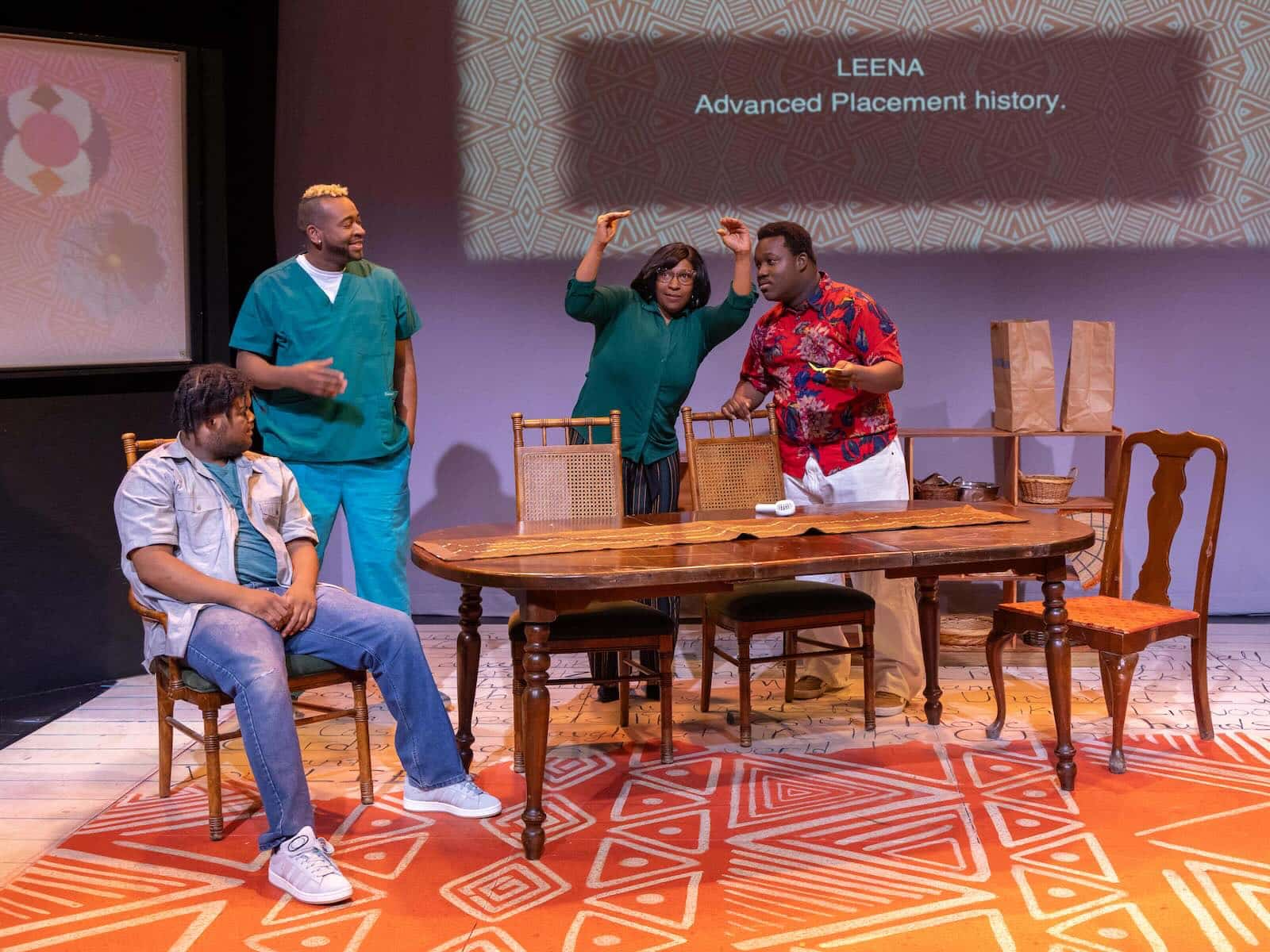
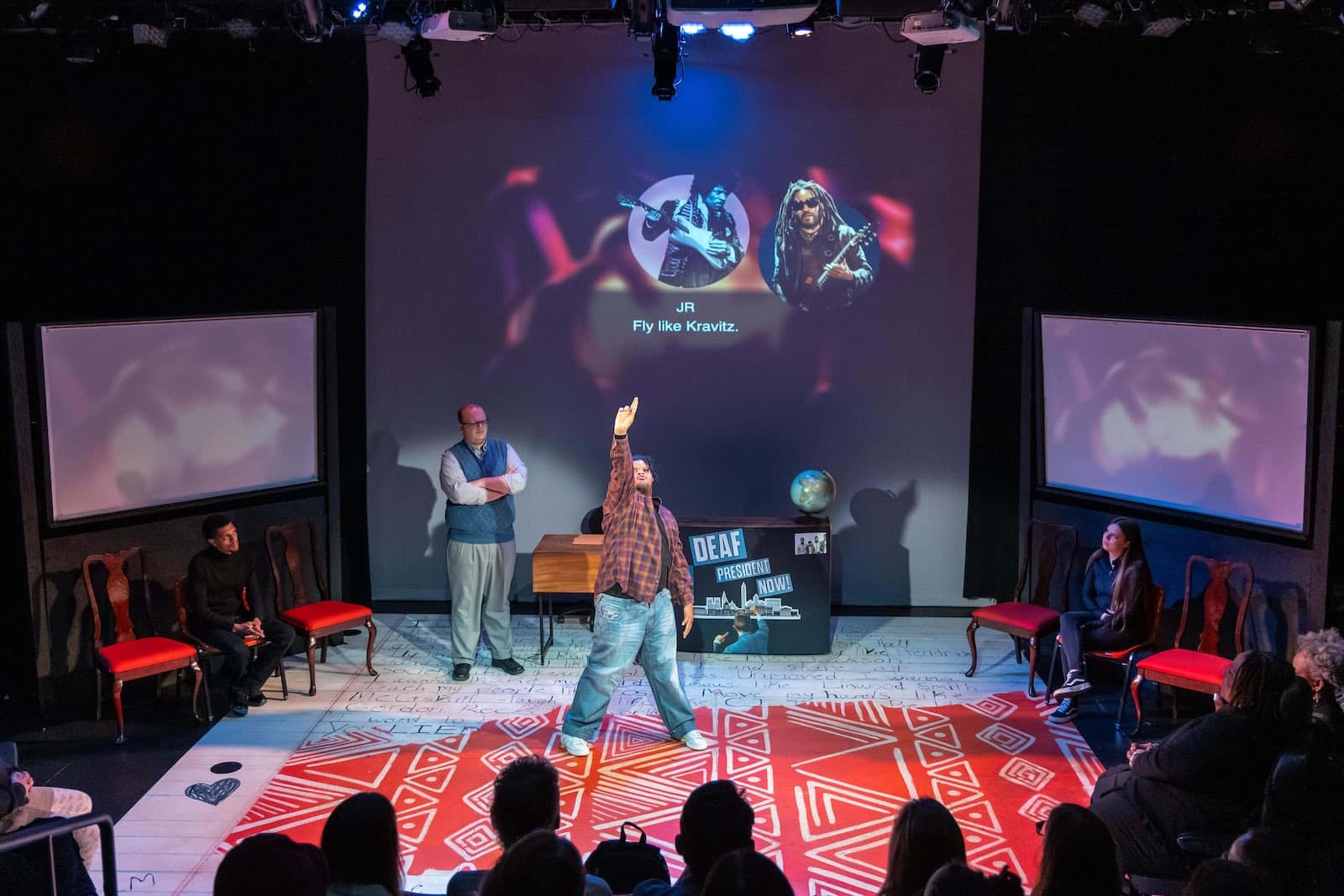
For this premiere, the Eastman Studio Black Box Theatre was transformed with striking intentionality: the floor itself resembles a sheet of paper scrawled with bold, handwritten phrases, grounding the narrative in the act of writing (and rewriting) history. Projections of Black community life and Seattle imagery create a visual dialogue. Later, mirrored panels reflect the audience back at itself, a simple yet effective gesture that implicates viewers in the conversation unfolding onstage.
The performances carry the production with remarkable cohesion. The actor portraying JR brings a heightened expressiveness that contrasts sharply with the restrained, almost rigid physicality of Mr. Watson. This distinction is not merely stylistic; it underscores the cultural and emotional disconnect at the heart of their conflict. JR’s opening poem invokes a broader Black artistic tradition, blending rhythm, gesture, and embodiment into something that feels both deeply personal and historically rooted.
Equally compelling is the dynamic between Leena and Myron. Their chemistry anchors the play, balancing humor and gravity with ease. Leena’s sharp wit and maternal protectiveness provide some of the production’s most comedic beats, while Myron’s warmth and storytelling lend emotional depth. A standout moment comes during Myron’s recollection of a childhood encounter with racial violence, staged through a minimal but effective transformation: the addition of a hat signals a shift into his younger self, illustrating how past trauma remains ever-present.
The supporting ensemble, including Nana Akohene Owusu Ansah as Uncle Carl, Candace Broadnax as Aunt Murphy, and Triallen Washington as Cousin James, enhances the sense of communal texture. The Sunday dinner scene was brimming with energy. Interlapping conversations, playful teasing, and shared cultural references created a sense of familiarity. These moments of Black joy were vital, offering a counterbalance to the play’s heavier themes. Even seemingly small details like the humor surrounding generational slang or the affectionate ribbing between cousins contributed to a portrait of a family that is not defined solely by struggle.
If the production occasionally leans into didacticism, particularly in its more overtly “edutainment” moments during the dinner-table discussions, it does so with purpose. The play is unapologetically invested in teaching — not just its characters, but its audience. References to historical figures, legal milestones, and contemporary scholarship are woven into the dialogue, emphasizing the importance of generational storytelling. While some exchanges feel more expository than organic, they rarely detract from the emotional throughline. Meanwhile, the soundtrack, featuring artists such as Tupac Shakur and Boyz II Men, situates the story within a broader Black cultural continuum.
At its core, Dinner Note is concerned with inheritance: what is passed down, what is erased, and what must be fought to preserve. The tension between Leena and Myron’s differing experiences offers a nuanced exploration of how identity is formed at the intersection of race and Deafness. Their son stands at that intersection, tasked with carrying forward a history that is still being contested.
By the play’s conclusion, the question is no longer whether JR will change his project, but whether the systems around him are capable of change at all. The answer remains unresolved, but the production leaves its audience with something more enduring: a reminder that identity, once claimed, is not easily silenced.
Running Time: Two hours with a 10-minute intermission
Dinner Note plays through April 5, 2026, presented by Gallaudet University and Visionaries of the Creative Arts, performing in the Eastman Blackbox Studio Theatre (adjacent to the Elstad Auditorium) on the campus of Gallaudet University, 800 Florida Ave. NE, Washington, DC. Tickets (general admission: $20, student: $10) are available online or by contacting theatre.tickets@gallaudet.edu.
Performances are in Black Sign Language (BASL) and American Sign Language (ASL), with open captioning.
Dinner Note
A co-production by Visionaries of the Creative Arts (VOCA) and Gallaudet University Performing Arts (GUPA)
Written by Rhonda Cochran
Directed by Michelle Banks