At the time of his death at the age of 78, legendary American playwright and novelist Thornton Wilder (1897-1975) – the only writer with the distinction of having won the Pulitzer Prize for both drama (Our Town and The Skin of Our Teeth) and fiction (The Bridge of San Luis Rey) – left his final play unfinished, with more than 300 pages of his handwritten drafts preserved in The Thornton Wilder Collection at Yale University’s Beinecke Rare Book and Manuscript Library. With the permission of the Wilder Family, playwright Kirk Lynn researched, adapted, and completed the work, some 75 years after it was begun (in 1948), then put aside (in 1954). Following its world premiere at Houston’s The Alley Theatre in 2024, that long-unseen play, Thornton Wilder’s The Emporium, is now making its NYC debut with Classic Stage Company.

Directed by Rob Melrose, who also helmed the Houston production, the story takes us through the life of John, an orphan who ran away a dozen times, was taken in by a farmer and his wife, then left the farm (where he was treated by the switch-wielding farmer as an unpaid worker) to begin a new life in the big city. His hope is to find a position at The Emporium, a mysterious department store to which he learns he may be connected. It’s a business that doesn’t compensate its employees, burns the applications it receives, and is on the decline, while its thriving competitor Craigie’s – where he gets a job and an opportunity for advancement – offers everything The Emporium doesn’t. On his journey, John meets, falls in love with, and moves into a room in the same boarding house as The Emporium’s devoted mainstay Laurencia, who won’t leave her work there to go with him. The result is another of the major goodbyes on the list of nine that, it is said, is the largest number we can endure till the end of our lives, which the characters check off one by one on a blackboard.
In keeping with Wilder’s signature elements, the show opens with a Narrator, giving information about the playwright and his incomplete work in first-person direct address to the audience. It’s one of the many breaks through the fourth wall, along with a multitude of other devices traditionally used by Wilder, including audience participation (among other things, we’re asked to baa like a sheep, to hiss, and to shine our cellphone lights in the dark theater to create the sense of a star-filled sky), interactions with the cast (passing out candy for us to unwrap and customer complaint cards to fill out, which are also incinerated), and, here, a vote during intermission as to whether or not we would like to hear the prologue, described and outlined by Wilder, but not written by him (it wasn’t included at the beginning of the performance, we’re told, since it would be a spoiler in its discussion of the play’s central metaphor). At the performance I attended, we did (though it’s not a given; the script provides an alternate scene if the vote goes against the prologue).
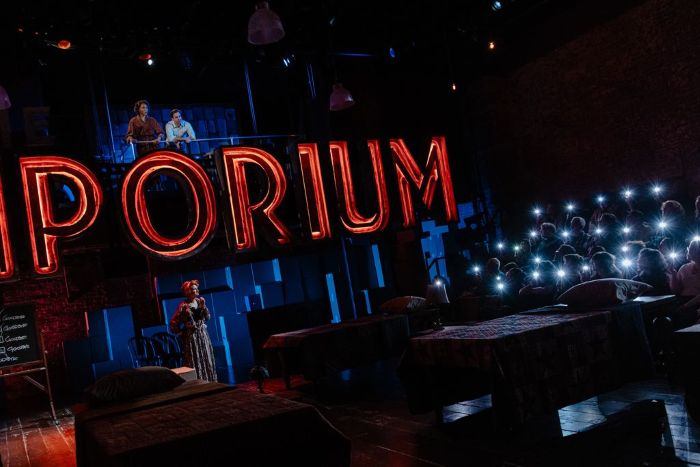
Under the expert direction of Melrose, a cast of seven, some appearing in multiple roles, embraces the spirit of Wilder, his prime era of the 1930s-50s, and his timeless existentialist themes of the complexities of human life, its elusive meaning, and our quest to understand it. They move around the stage, through the aisles, to the audience, up and down the bi-level set, and back and forth between the changing locales, characters, time, and tones, from everyday mundane reality to absurdist humor and metaphysical ponderings, with the recurrent presence of a baby in a basket that is carried around by John, representing both the innocent young orphan and Everyman making their way through the world.
Joe Tapper takes the lead as John (and the informative Narrator of the opening), captivating in the delivery of the questions he has, his drive to get ahead in his career, his desire to have a life with Laurencia, and his unwillingness to use a last name that means nothing to him, since his origins are unknown (like the genesis of humankind). Cassia Thompson provides a calm and collected counterpart as his love-interest Laurencia, dedicated to The Emporium despite its problems, and softly but firmly resolved in the decisions she makes. The chameleonic Candy Buckley and Derek Smith flawlessly transition into a roster of key characters connected to John’s story, representing a wide array of people, imbuing each figure with a distinctive voice, age, attitude, status, and bearing, while bringing the laughs, drama, and enigma of life, with which Wilder’s plays are occupied. Rounding out the cast are Mahira Kakkar (Mrs. Frisbee), Eva Kaminsky (Miss Coley), and Patrick Kerr (Mr. Benjamin), who appear throughout the show as fully engaged and responsive members of the audience, retired department store workers, and a trinity of viewers/overseers of John’s journey.
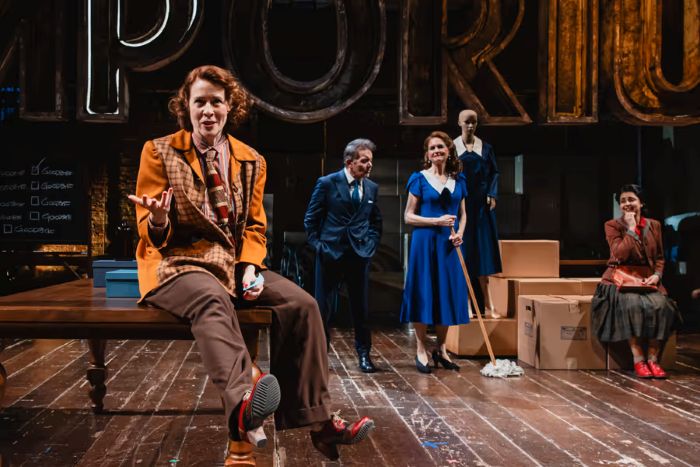
An evocative artistic design supports both the quotidian realities and the overarching mysteries addressed in the play. The set (by Walt Spangler, and props supervision by Anya Kutner), with a monumental neon sign of THE EMPORIUM looming over the space, employs long wooden tables and chairs that transition easily from the library and its neat stacks of Wilder’s papers to the farm, with the roll-in of a section of white picket fencing, the boarding house, with pillows and quilts placed on the tables-turned-beds, and the department stores, replete with mannequins, merchandise, and packed-up cardboard boxes. The locales of the scenes are enhanced with changes in the lighting and its colors (by Cat Tate Starmer) and expressive sound (by Darron L West) that suit the realistic, cosmic, and Kafkaesque moods. And the period-style costumes (by Alejo Vietti) and wigs (by Charles G. LaPointe) capture the fashions of the times and the distinctive looks and personalities of the characters, often leaving the fine actors unrecognizable as they switch from one to the next.
In the end, Thornton Wilder’s The Emporium leaves us with a universal message: We might not always get what we want in this often-incomprehensible cycle of life, but we should keep striving, and even if we don’t achieve all of our goals, we should appreciate what we do have, before our final goodbye.
Running Time: Approximately two hours and 10 minutes, including an intermission.
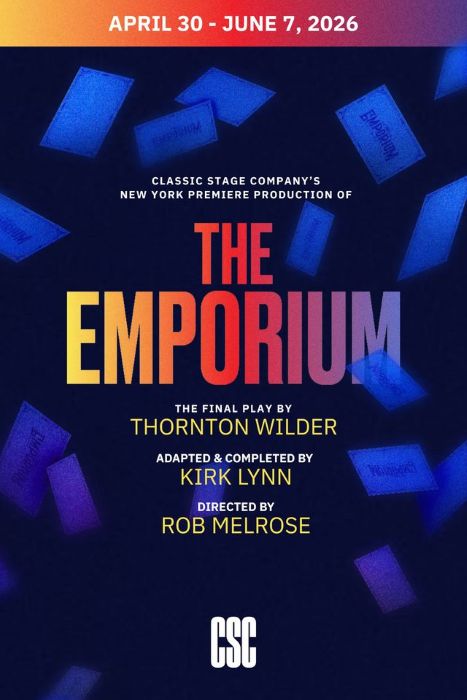
Thornton Wilder’s The Emporium plays through Sunday, June 7, 2026, at Classic Stage Company, 136 East 13th Street, NYC. For tickets (priced at $46-136, including fees), go online, or find discount tickets at TodayTix.