
Someone someday could write a darn good book about all the ingenious theater work conceived during COVID. That was when stages went dark, faces got masked, and audiences and artists dared not gather in person. Amazingly, that didn’t stop some determinedly imaginative creators from finding ways to keep telling their stories and connecting with folks in new genres, notably digitally but also by other unconventional means. I was reminded of this underappreciated burst of originality when two delightful pieces of live theater recently opened in DC, each conceived under and in response to COVID’s constraints and each shifting the form and feeling of live performance.
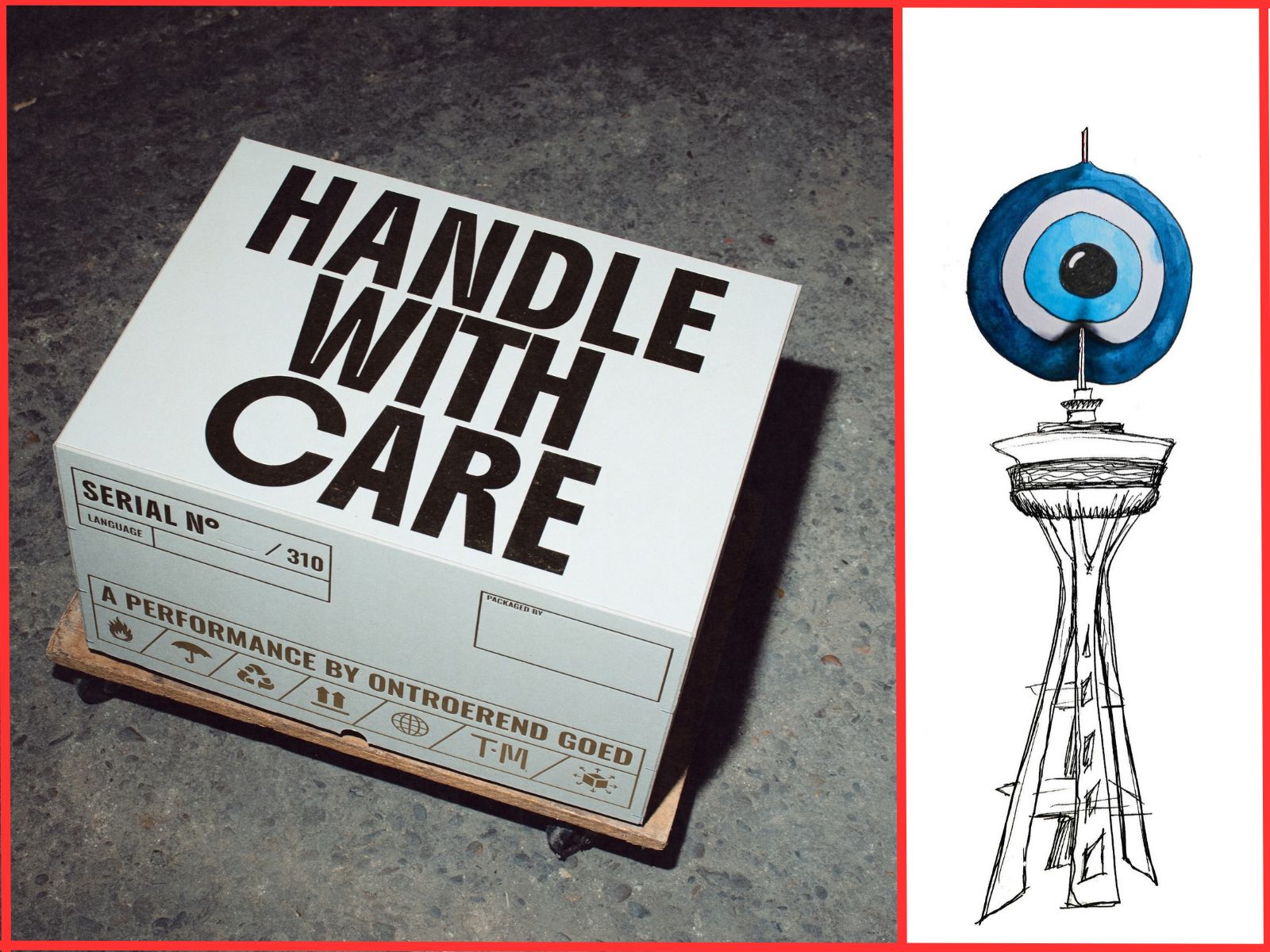
Handle With Care: where the audience becomes the performance
Handle With Care — an absolutely astonishing audience-participation experience — is running in Studio Theatre’s fourth-floor Stage 4 only through October 25. The concept — basically a shipping box packed with props and texts that prompt the audience into doing their own multi-scene theater thing — was created by and imported from a Belgian performance collective named Ontroerend Goed. The company’s tagline for the production is precise: “No actors. No technicians. Just a box. And you.” The concept has become a huge success, the company says, with hundreds of productions in 16 countries and 10 languages.
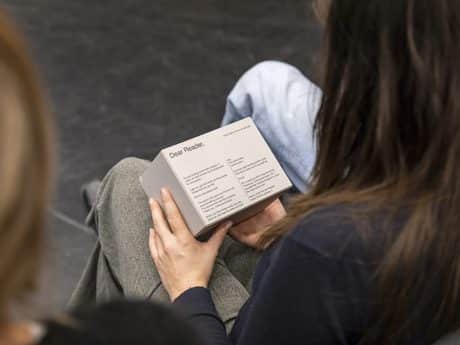
Ticket sales at Studio are capped at 45 seats per performance, and the audience at the one I attended was remarkably up for whatever the heck was to come. Ushered into the black-walled, simply lit space and seated in risers, some began nervously cracking jokes as we waited, and waited, for something to happen. Eventually, one brave soul broke the uneventfulness, opened the conspicuous box at center stage, and took out something like a letter, reading it in silence as though we were not meant to know what it said. Our curiosity whetted, a curated sequence of self-guided instructions soon followed, removed from the box as directed and read by random audience members, nearly all of whom entered the playing space and did what was told. “Everything you do is theatre,” we were advised by an unfurled banner. “You are the performance.” (I won’t disclose more details, as that would spoil the surprise.)
I was struck by how the audience steadily became more alive and involved, as if spontaneously. By the end, the audience, previously strangers to one another, was as sociable, collaborative, and communal as any I’ve ever been part of in my theatergoing. It felt like an impromptu grown-up party game, or like art-making as a fun mixer, except perhaps with some purpose beyond play that we were left to surmise and ponder on our own.
I was most impressed by how the project’s backstory materialized and what it was meant to make happen. What the company calls “theater performance in a box” was directly inspired by the prolonged pandemic social isolation and the awkward challenge of reconnecting with people (who can forget?). “We all felt that those digital connections we made then didn’t bring us closer together,” said Ontroerend Goed’s Alexander Devriendt. In response, the creators set out to design a performance that would foster connectivity and togetherness among folks: The company stripped away all trappings of live theater except a box full of props and printed prompts.
I’ve often heard theatermakers say that what theater, as an art form, does best is create community. Handle With Care does so on the fly by thinking way outside the box.
Oedipus in Seattle: where two unrehearsed, unscripted actors are ear-prompted to play out a story
The other work of unconventional, post-pandemic theater I took in recently was Oedipus in Seattle, a hilariously of-the-moment performance piece conceived by playwright Savannah Reich. Independently produced by Chad Dexter Kinsman, it ran for three performances, October 10 to 12, in a gallery space called Studio 1469 at the end of a signageless alley in Columbia Heights.
Reich, in her author’s note, was eloquent about what COVID had to do with the work:
Like a lot of us, I spent large parts of 2020 in my apartment, thinking that theater probably didn’t exist anymore. A play script is a blueprint for a future event, and I simply could no longer imagine the future….
This is the play that I wrote when I couldn’t imagine writing a play.
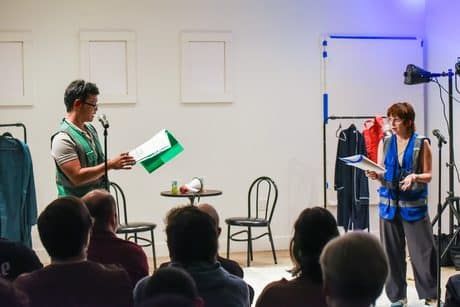
Reich’s Oedipus in Seattle has no rehearsals. A different pair of actors performs each show, by winging it. They hear prerecorded prompts on headphones and are directed to read aloud on two stand mics from designated scripts, answer questions, and work with preset costume pieces and props. Part of the fun from the audience’s POV is that sometimes we too hear the prerecorded voice (it’s like a female god mic), and sometimes only the actors do. The sound design and original music by Douglas Vento, combined with uncredited lighting effects and scenic projection of a rocky seashore, created a surreal aural and visual world in the bare white-walled space. Plus, the talent was terrific.
The night I saw Oedipus in Seattle, celebrated DC actors Kimberly Gilbert and Jacob Yeh gamely carried the show, and the audience had a hoot. Everything that happened was a surprise to everyone — save for brief autobiographical monologues each actor had been asked to prep.
The storyline, such as it was, was a loopy mashup of the ancient Sophocles tragedy and the 1993 Tom Hanks–Meg Ryan flick. I can’t say I followed exactly what the one had to do with the other — comic scenelets reminiscent of each source alternated — except that there seemed to be some theme-sharing about destiny and fate. Or whatever. This was not an occasion for highbrow lit crit; this was for everyone a free-for-all evening of on-the-spot play.
_____
It initially occurred to me to reflect on and compare these two novel theater experiences because they’d both been conceived in response to COVID-era isolation. In one, a creative team devised instructions for the audience; in the other, a playwright composed instructions for the actors; in both, the experience became uniquely alive and vibrantly engaging; in neither did much resemble conventional theater.
And now I wonder: Is there perhaps a lesson here about the resilience of imagination in adversity? Or a message about the essential value of live theater? Or a prompt to embrace even more ingenuity in form and content? Or a promo for less passivity and more participation? Or ____ ? (Fill in the blank and say it to someone sometime.)
Running time for each production: About an hour with no intermission.
Handle With Care runs through October 25, 2026, in Studio Theatre’s fourth-floor Stage 4, 1501 14th Street NW, Washington, DC. For more information and to purchase tickets ($37, with discounts available), call the Box Office at 202.332.3300 or go online,
Oedipus in Seattle ran October 10, 11, and 12, 2026, at Studio 1469, 1469 Harvard St NW, Washington, DC. (Entrance is via the alley off 15th Street between Harvard Street and Columbia Road.)
Handle With Care
CONCEPT & CREATION: Alexander Devriendt, Karolien De Bleser, Samir Veen, Leonore Spee & Charlotte De Bruyne
DESIGN: Nick Mattan & Edouard Devriendt
ENGLISH TRANSLATIONS: Samir Veen
EDITOR ENGLISH: Tiffer Hutchings
VOICES: Karolien De Bleser, Leonore Spee, Samir Veen, Charlotte De Bruyne, Aurélie Lannoy, Alexander Devriendt, i.a.
PRODUCTION TEAM: Lynn Van den Bergh, Leda Decleyre, Willie-Marie Hermans & Hannes Pieters
PRODUCTION: Ontroerend Goed
Oedipus in Seattle
By Savannah Reich
Sound Design and Original Music by Douglas Vento
PRODUCING TEAM
Producer: Chad Dexter Kinsman
Stage Manager: Justine Morris
Technical Director: Taylor Stewart
CAST
Dylan Arredondo
Kimberly Gilbert
James J. Johnson
Erika Rose
Martina Schabron
Jacob Yeh
Understudies: Joel Brady, Mollie Greenberg James, and Jeffrey Stanley
SEE ALSO:
Fringe hit ‘Oedipus in Seattle’ comes to DC for one weekend only (news story, September 24, 2026)