Triune Entertainment’s production of DreamWorks’ The Prince of Egypt delivers an emotional retelling of the Exodus story, balancing spectacle with sincere storytelling. While the musical carries the weight of its animated predecessor, the stage adaptation proves that the material can succeed in a theatrical setting when approached with reverence and imagination. Composer Stephen Schwartz (Wicked, Godspell, Pippin) reunited with book writer Philip LaZebnik to rework the award-winning film into a two-act structure for the stage. Triune Entertainment is the first in the Washington, DC, region to produce the newly adapted production.
Audiences are likely already familiar with at least one depiction of Moses, whether it be Charlton Heston from the film The Ten Commandments, Larry the Cucumber from VeggieTales, or DreamWorks’ The Prince of Egypt. Moses is a prime example of God calling unlikely people to become leaders, as Moses was referred to as being “slow of speech and slow of tongue” (Exodus 4:10), and he often struggled with his calling and frequently argued with God. Nonetheless, God used Moses to lead the Hebrews out of their enslavement in Egypt.
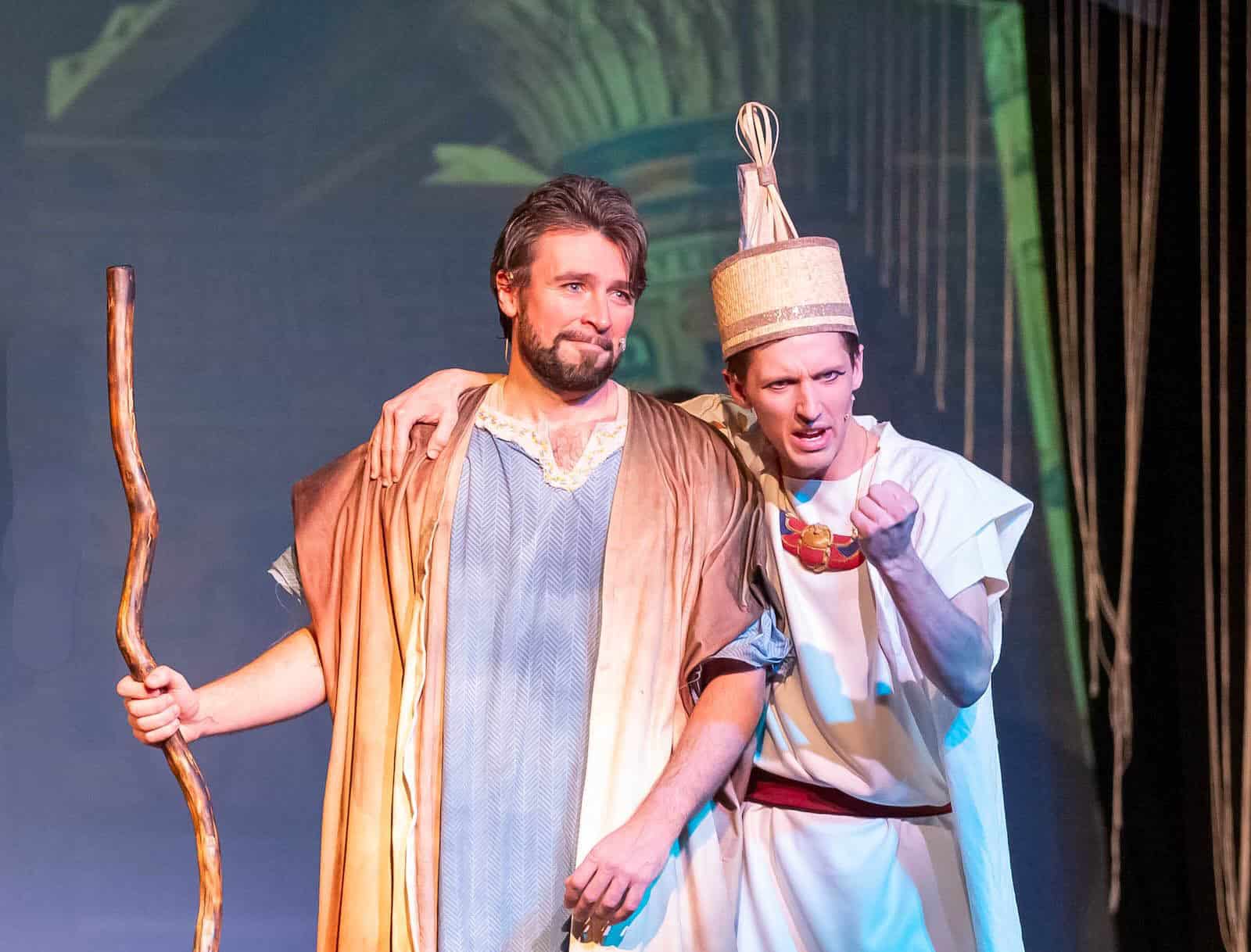
From the opening moments, the staging uses theatrical creativity to evoke locations rather than overwhelm with literal realism. Scenic transitions are fluid, allowing the narrative to move briskly from palace intrigue to spiritual awakening. Costume design by Amber Kiffney also plays a strong role in shaping the show’s atmosphere, shifting from the opulence of Egypt’s court to the warm earth tones as Moses begins to confront his identity and destiny.
At the heart of the story is the relationship between Moses and Ramses. The actors portray their brotherhood with warmth and camaraderie, which makes their eventual ideological divide far more tragic. Andreas Moffett as Moses commands the stage with his impressive vocals and warmth. The role requires both vulnerability and authority, and his performance navigates the balance effectively. Luke Tessier as Ramses demonstrates a full range of acting with his character arc from loving brother to conflicted Pharoah. Rather than presenting the characters as a simple protagonist and antagonist, the staging shows them to be sympathetic figures caught in circumstances larger than themselves.
The musical’s score remains its greatest strength and the talented cast rises to the monumental task. The standouts of the night for me were “Deliver Us” led by Katy Benko Miner as Yocheved and “Through Heaven’s Eyes” led by Paul Correll as Jethro, both supported by an ensemble that understands the power of collective storytelling. The best-known song of the show is the inspirational “When You Believe” led by Jessica Foy Long as Miriam and Jennalee Allen as Tzipporah. Long and Allen’s performances are consistently moving throughout the story, but their powerful voices are on full display in this number. The choral sections in particular are expertly performed, with credit to music director Catie Moore and vocal section leaders Mandy Viles, Katy Benko Miner, Paul Correll, and Doug White.

The large ensemble is utilized to great effect, both as large crowds and as smaller troupes throughout the piece. Large crowd sequences are choreographed with clarity and purpose, helping maintain narrative focus even during the musical’s most visually busy moments. Instead of becoming chaotic, these scenes reinforce the story’s scale while still directing attention to the characters driving the action. My favorite aspect of this production is the moments designed by choreographer Christie Dubnansky featuring the dance corps of Ava Botros (dance captain), Katya Colebank, Lilly Glass, Simone Beth’el Hume, Hilary Pierce, Tj-Yuxin Song, Gabrielle Tessier, and Eric Alexander Wolpert. The troupe created several beautiful visual storytelling moments, including the chariot race through the market, the burning bush, and the parting of the Red Sea.
One of the most challenging elements of staging The Prince of Egypt is portraying its biblical miracles. Without revealing any spoilers, Triune approaches these moments with ingenuity, and the result is very effective, helping preserve a sense of wonder without breaking the audience’s suspension of disbelief.
Triune Entertainment’s The Prince of Egypt succeeds because it treats its source material with sincerity rather than spectacle. Director Matt Moore proves that the story’s power lies not just in its miracles, but in its exploration of identity, faith, leadership, and brotherhood. The result is an ambitious community-driven production that captures the heart of a story that continues to resonate for generations to come.
The Prince of Egypt plays through March 22, 2026, presented by Triune Entertainment, performing at Journey Theater, 4175 Bludau Dr, Warrenton, VA. Tickets ($25 for adults, $22 for students and seniors) can be purchased online.
Cast and creative credits are online here (scroll down).
The Prince of Egypt
Music & Lyrics by Stephen Schwartz
Book by Philip LaZebnik
CAST
Moses: Andreas Moffett
Ramses: Luke Tessier
Tzipporah: Jennalee Allen
Miriam: Jessica Foy Long
Nefetari: Jennifer Ayers
Jethro: Paul Correll
Tuya: Renee De Ponte
Seti: Brad Broemmel
Hotep: Sean Pflueger
Yocheved: Katy Benko Miner
Aaron: Joseph Allen
Keturah: Caroline Gaitonde
Leah: Lydia Gaitonde
Young Miriam: Camille Edwards
Hebrew Soloist: Lucy Underwood
Dance Captain: Ava Botros
Young Moses: Simon Wolpert
Dance Ensemble: Katya Colebank, Caroline Gaitonde, Lilly Glass, Simone Hume, Hilary Pierce
Vocal Ensemble: Robert DeBroeck, Presley Miner, James Moore, Marlee Ratcliff, Lucy Underwood, Sarah Pesce, Mandy Viles, Lucia Mattson, Doug White|
World Builders: Eric Black, Elijah Kiffney, Val Kuperman