
An orthodontist with personal-boundary issues, a gentleman hooker cosplaying as an angel, and a butch queer nun with a rough past and a broad tender streak are just three of the unexpected ingredients helping inflate the surprisingly hearty solo soufflé that is A Good Day to Me Not to You. Does that make the 90-minute proceedings feel a trifle overstuffed? To be sure, and we haven’t even gotten to the business with the bag lady who lobs the caustic greeting that gives the show its title.
Ultimately, it’s a generous, Thanksgiving-ish kind of overstuffing, though, and writer Lameece Issaq proves inventive enough with the seasonings — performer Constance Zaytoun blends them assuredly, with a mordant flair that’s a kind of spice in its own right — to elicit more startled chuckles than exasperated eye-rolls as the show serves up plate after unpredictable plate.
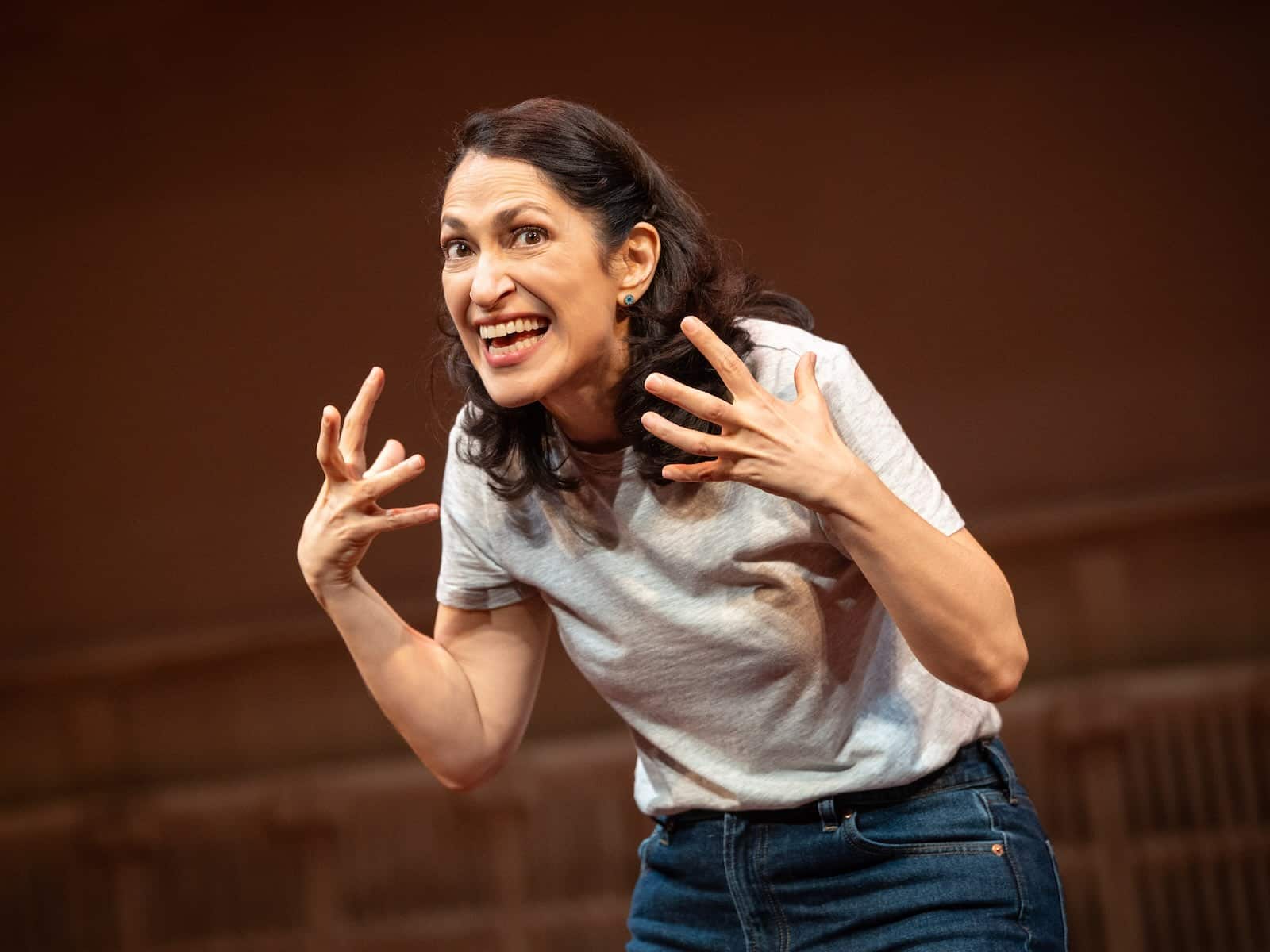
Issaq’s amusingly quicksilver if ultimately quite sober story revolves around a hard-luck New Yorker who’ll go formally unnamed — though she identifies herself anecdotally as “Meecie,” suggesting at least a few autobiographical underpinnings. Indeed, an author’s note indicates that at least one real-life incident inspired a pungent onstage episode involving “a spiritual infection in my intestines,” and Issaq herself starred in the show’s initial 2023 production at the historic off-Broadway Connelly Theatre besides.
Whatever its real-world roots, “Meecie” is in this play a pet name adopted by a 5-year-old nephew for the central character — fortysomething, Lebanese-Palestinian by heritage, out of work for convoluted and colorful reasons rooted in an oddly powerful dental obsession, and reduced to renting a shared-bathroom flat in a Manhattan housing complex run by a struggling order of Catholic nuns.
I did mention feeling slightly overfed, yes?
In any case, the St. Agnes Residence is “like a college dorm wrapped around a halfway house tucked into a tenement, embraced by a chapel,” the narrator explains to the audience, to whom the show is directly addressed when Zaytoun isn’t flipping into and out of character as the story’s dozen-odd inhabitants. On the other hand, the rent, on the Upper West Side no less, is a mere $400 a month. At that rate, Meecie figures a volatile bag lady or two — and the plaster saints standing watch at every corner — represent burdens even an irreligious New Yorker can bear.
St. Agnes — “our little Aggie,” as one of the good sisters of her order refers to her — turns out to be the patron of both virgins and sexual-assault victims, which will supply a few narrative guideposts, and yes, Meecie’s individual story will involve both questions of fertility and instances of violation.
They’re not the obvious ones, though, and they’re both framed and resolved in a manner novel enough that Issaq’s deftly shaded character study never feels over-familiar — an accomplishment, honestly, in a theater landscape littered with 90-minute one-handers engineered to be easily and affordably produced.
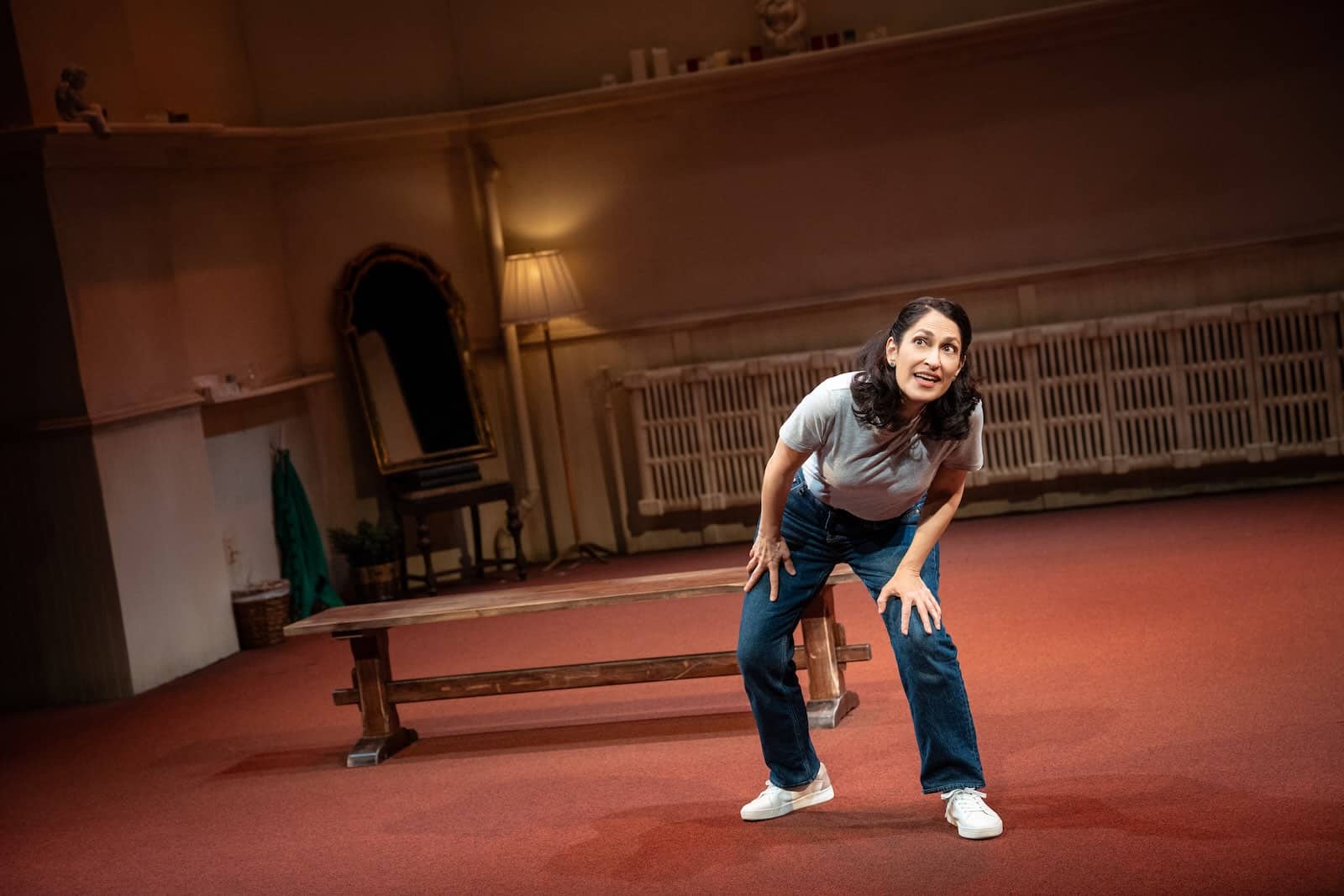
It’s all staged in the 200-seat Kogod Cradle on a Peiyi Wong set that would feel generous at half its size — it appears that the creative team has essentially rebuilt the bare stage of the Connelly, including its enormous off-kilter radiator, within the Cradle, where it wrestles mightily with the space’s uniquely warm intimacy. Waterwell artistic director Lee Sunday Evans, who directed both the original production of A Good Day to Me … and the Broadway-hopeful musical adaptation of A Wrinkle in Time here, in Arena’s Kreeger Theater, is the show’s largely careful shepherd, though she’s permitted a touch more fuss than necessary here and there.
That’s particularly evident in the over-busy lighting, designed by Mextly Couzin in what’s presumably an effort to help clarify the story’s constant leaps among places and personages. Rather than clarifying the proceedings, though, the frequent and unsubtle changes intrude on them. In allowing the lighting plot to draw so much attention to itself, Evans allows it to bog Issaq’s storytelling down at least twice too often.
To return to that storytelling: It can be a touch over-busy. But the too-muchness I kept noticing ultimately registers less as careless overseasoning than about a kind of creative boil-over, less like overreach than unbridled enthusiasm that needs more discipline. Issaq’s is clearly a lively imagination, and if Meecie the character does in fact share DNA with Lameece the author, the latter seems like she’d make superb dinner-party company.
Where there’s mention of birth in the theater, there’s almost always the specter of death, so much so that I’ve begun to think of the linkage in terms of “Chekhov’s bassinet” or some such morbid image. This playwright certainly dares to venture into that fraught territory, and not just with mention of Meecie’s sister, who died giving birth to that well-beloved nephew.
The boldness of what Issaq attempts in this regard, and the strange grace with which she and Zaytoun navigate her choices and find their way back toward something like light, will deliver satisfying emotional heft in the evening’s final moments. In future productions, an edit as fearless as that central impulse could well transform a singular example of a well-worn theatrical form into a genuinely stellar one.
Running Time: Approximately 85 minutes with no intermission.
A Good Day to Me Not to You plays through May 3, 2026, in the Arlene and Robert Kogod Cradle at Arena Stage at the Mead Center for American Theater, 1101 Sixth St SW, Washington, DC. Tickets ($75–$99) can be purchased online, by calling the box office at 202-488-3300, or at TodayTix.
The Waterwell Production of
A Good Day to Me Not to You
By Lameece Issaq
Directed by Lee Sunday Evans
The program for A Good Day to Me Not to You is online here.
SEE ALSO:
Arena Stage announces star and creative team for ‘A Good Day to Me Not to You (news story, March 16, 2026)
The DCTA Writers’ Fund is a dedicated pool of funding that supports the expansion of our writer coverage across the DMV region. Thanks to the generosity behind this fund, DC Theater Arts is able to bring on additional writers this year — deepening the capacity and quality of our coverage of work on stages across Washington, Maryland, and Virginia. We are grateful for this investment in arts journalism and in the writers who make our coverage possible. If you would like to support theater journalism in our region, click here.



. )