There are times when a production takes you into the essence of a Shakespeare play and effects a transformation. The emotion beneath the well-known words becomes clear in an entirely new way. That is what happens in Faction of Fools’ Much Ado About Nothing. Director Natalie Cutcher and her merry band of artists bring us a Much Ado that is both passionate and comic. Shakespeare and Commedia dell’arte, like Beatrice and Benedick, turn out to be a match made in heaven.
The time: now. The place: the luxurious Sicilian hotel called Bella Figura. Our host is Leonato (Matthew Pauli). A group of soldiers are coming home from war: Don Pedro (Co-Artistic Director Francesca Chilcote), Claudio (Lorenzo Miguel), and his best friend Benedick (Danny Puente Cackley).
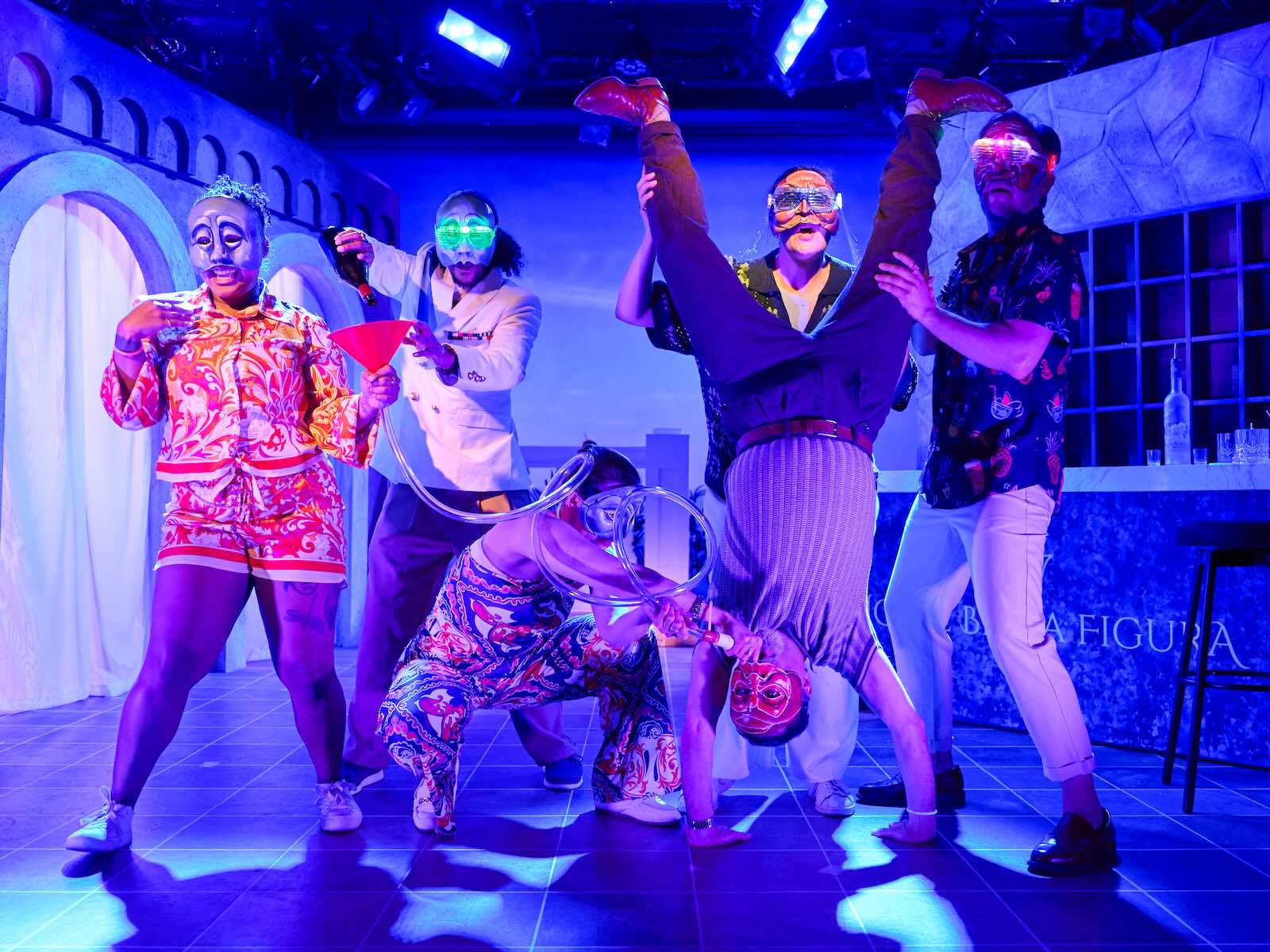
The script, adapted by director Natalie Cutcher, Matthew R. Wilson, and Co-Artistic Director Kathryn Zoerb, has been cut and rearranged to focus on key characters and their emotions. Long, obscure metaphors are out. Tight, streamlined structure is in. The abbreviated script also allows the small cast of six to each play multiple characters. Cutcher’s precise direction brings every comedic beat to the fore.
Leonato’s daughter Hero (Jasmine Proctor) and Miguel’s Claudio meet cute, to the tune of “Nessun Dorma” from the opera Turandot (1926), a posthumous hit for Italian composer Giacomo Puccini. (The superb sound design is by Kenny Neal.)
As the play’s first central couple, Claudio and Hero, Proctor and Miguel play love scenes suffused with charm. Their contrasting storyline is that of warring lovers Beatrice (Mary Myers) and Benedick (Cackley), who conduct their complicated relationship with wrenching emotional honesty. Their first two lines are among the most famous in Shakespeare:
BEATRICE: I wonder that you will still be talking, Signior Benedick. Nobody marks you.
BENEDICK: What, my dear Lady Disdain! Are you yet living?
Both profess to hate the opposite sex, while irresistibly drawn to one another. Carl Jung is said to have originated the concept “that which we resist, persists.” It is their defenses, along with their wit, that make the pair so compelling.
The stylized and masked physicality of commedia seems to free the actors. Myers, now playing the villain Don John, holds her hands like paws. When she intones, “I cannot hide what I am,” she becomes terrifying. Don Pedro (Chilcote), Claudio (Miguel), Leonato (Pauli), and Hero (Proctor) form a glorious tableau when they launch their romantic plot to bring Beatrice and Benedick together:
DON PEDRO: I will teach you how to humour your cousin, that she shall fall in love with Benedick; and I, with your two helps, will so practise on Benedick that, in spite of his quick wit and his queasy stomach, he shall fall in love with Beatrice. If we can do this, Cupid is no longer an archer: his glory shall be ours, for we are the only love-gods!
Beatrice and Benedick’s scenes remain mostly intact in the adapted script, including their great monologues. Chilcote as Margaret, Hero’s “waiting woman,” shines in the opening scene, as she brandishes a blue cup and saucer in a synchronized dance, and when she flirts with Borachio. Her female Don Pedro wields her authority with aplomb.
Matthew Pauli is a marvel as master constable Dogberry (with a winsome Scottish accent) and as Verges, his assistant (a puppet that Pauli carries and voices in several scenes). His malapropisms (for example, confusing “redemption” with “damnation”) are as endearing as ever, though not all of Shakespeare’s originals survive in the abridged text. The Watch (Miguel and Myers) dance nimbly with flashlights. The strains of Amilcare Ponchielli’s “Dance of the Hours” (1876) — many of us will know it better as the novelty song “Hello Muddah, Hello Faddah!” (“Here I am at Camp Grenada!”) (1963) — accompany them on patrol.
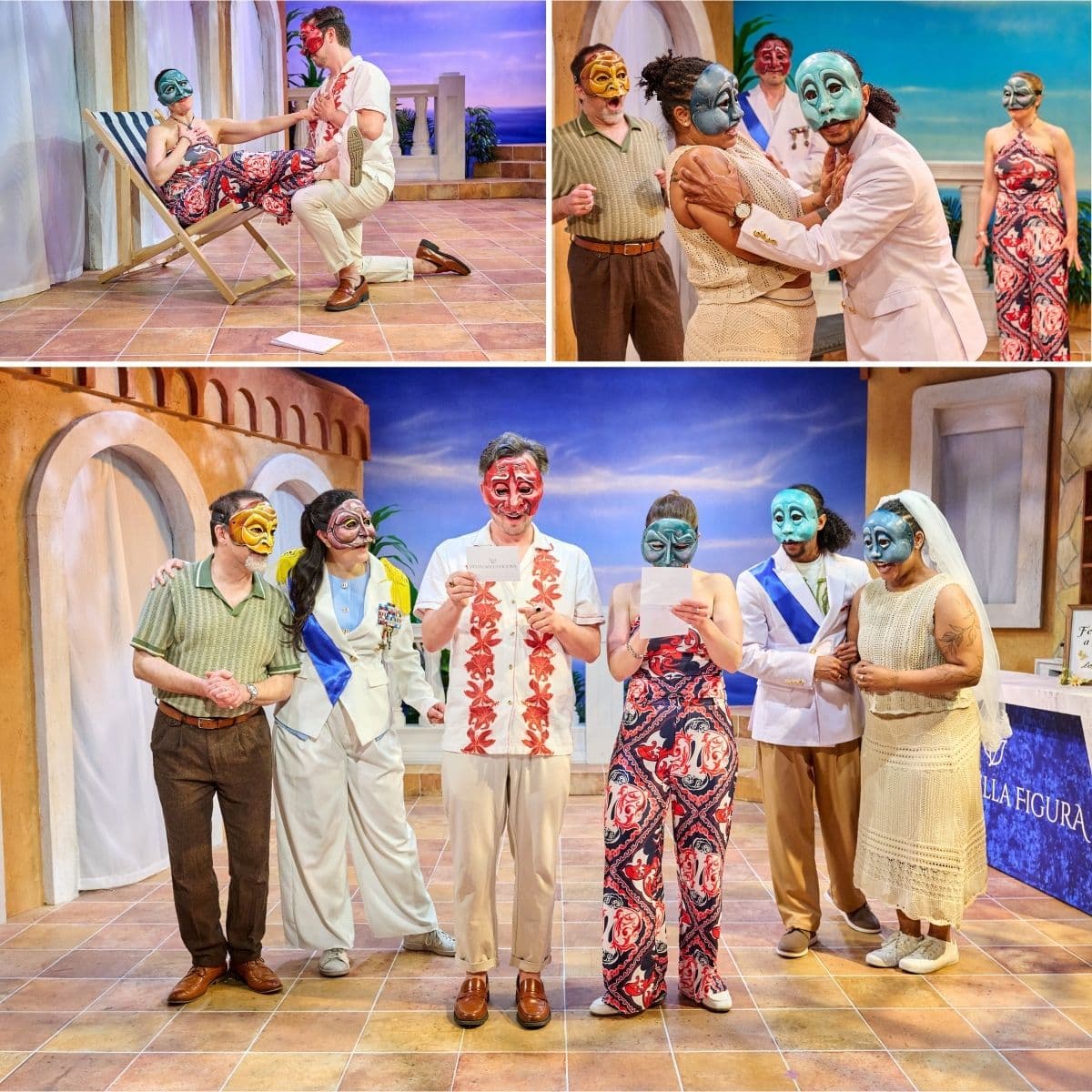
Scenic designer Johnny Weissgerber’s set is handsome, with three entrances on stage right and a backdrop of Sicilian cliffs and sky. Costumes designed by Cidney Forkpah have a relaxed, resort feeling — Beatrice is in attractive loungewear, while at one juncture Benedick wears what looks like a Hawaiian shirt. Dogberry and the Watch sport tiny Italian Tricolor flags on their crisp, white uniforms.
Lighting by William K. D’Eugenio is strikingly colorful and varied. During one of the dances, the cast, with strings of lights on their caps, hand tiny lights back and forth. In another, one cast member does a headstand. The commedia masks are by Tara Cariaso of Waxing Moon Masks. The props — all befitting the Riviera vibe — are by Katherine Offutt Ross.
The music, selected by Kenny Neal, is closely attuned to the text. It is largely Italian opera, with a few exceptions (Bizet and Delibes). There are many classic favorites; Benedick’s theme is, fittingly, “La Donna e Mobile” from Verdi’s Rigoletto (1851). The wedding scene includes the “Grand March” from Verdi’s Aida (1871). Don John’s evil moments are accompanied by the “Dies Irae” from Verdi’s Requiem (Messa da Requiem, 1874).
One purpose of commedia, an Italian art form that emerged in the 16th century, was to critique society by lifting up the marginalized and mocking authority. Applying the principles of commedia to Much Ado underscores an implicit critique of the hypocrisy of gender stereotypes. Beatrice wishes she were a man so she could kill Claudio. There is shame, too — for Hero when she is accused of being “wanton” and disloyal. Social pressure is everywhere, and so is gossip. Money, though not central, is certainly a factor. Claudio, before he declares himself, makes sure that Hero is Leonato’s heir. By showcasing classic tropes like “enemies to lovers,” cruel realities like the shame women endure when they are deemed immoral, and the influence of the community on relationships, this production links the themes of the original play to the complexities of today.
There is, certainly, the persistent presence of an imperfect world. But above all, this Much Ado radiates the joy of performance.
Running Time: Two hours, with one 10-minute intermission.
Much Ado About Nothing plays through May 2, 2026, presented by Faction of Fools Theatre Company performing in the black box theater inside the Capitol Hill Arts Workshop at 545 7th Street SE, Washington, DC. Tickets are on a sliding scale ($27, market rate; $37, “pay it forward”; $17, lower income/child) and can be purchased at the door and online.
Family-friendly, contains some PG-13 humor.
Much Ado About Nothing
By William Shakespeare
Directed by Natalie Cutcher
Script adapted by Natalie Cutcher, Matthew R. Wilson, and Kathryn Zoerb
CAST
Benedick/Conrad: Danny Puente Cackley
Don Pedro/Margaret/Friar: Francesca Chilcote
Claudio/Messenger/Watch: Lorenzo Miguel
Beatrice/Don John/Watch: Mary Myers
Leonato/Dogberry/Verges: Matthew Pauli
Hero/Borachio: Jasmine Proctor
Beatrice/Hero Understudy: Isabelle Jennings Pickering
Benedick/Leonato Understudy: Seth Langer
Don Pedro/Claudio Understudy: Arika Thames