Prior to the play, there is music. It fills the halls, restrooms, and, of course, the theater: a soundtrack spanning the likes of Mahalia Jackson, Shirley Caesar, Stevie Wonder, Public Enemy, Marvin Gaye, Kendrick, and James Brown.
Songs such as “Say It Loud — I’m Black and I’m Proud” and “Fight the Power” seem like fun theses for the night to come (sound design by Kathy Ruvena), but then comes Nina Simone’s protest anthem “Mississippi Goddam,” a song she first sang at Carnegie Hall in 1964, three years after Purlie Victorious: A Non-Confederate Romp Through the Cotton Patch premiered on Broadway.
The song was inspired in part by the 1963 tragedy in what was then called Bombingham, Alabama. In September of that year, four little Black girls were killed in a church explosion by Amerikan terrorists.
“Mississippi Goddam” played up to the lyric “I’ve even stopped believing in prayer,” then the music cut. The show was starting and my mind racing.
That line felt like a warning shot. But it was a misdirection, the first of many.
Playwright (and legend) Ossie Davis explicitly stated that Purlie is not a protest play. Which then begs the question: well, what is it? And to answer, I reference another song, partly popularized by Miss Simone: Purlie is a balm.
This gem of a play escapes simple sensemaking. It subverts expectations again and again, especially under the colorful direction of Studio favorite Psalmayene 24.
Purlie Victorious debuted in 1961, the year my mother was born. And even more special, I had the privilege of attending this production with my mom’s elementary school teacher, who had first seen the play decades ago (where, she can’t remember).
Sixty-five years later, it feels just as timely in Studio’s revival.
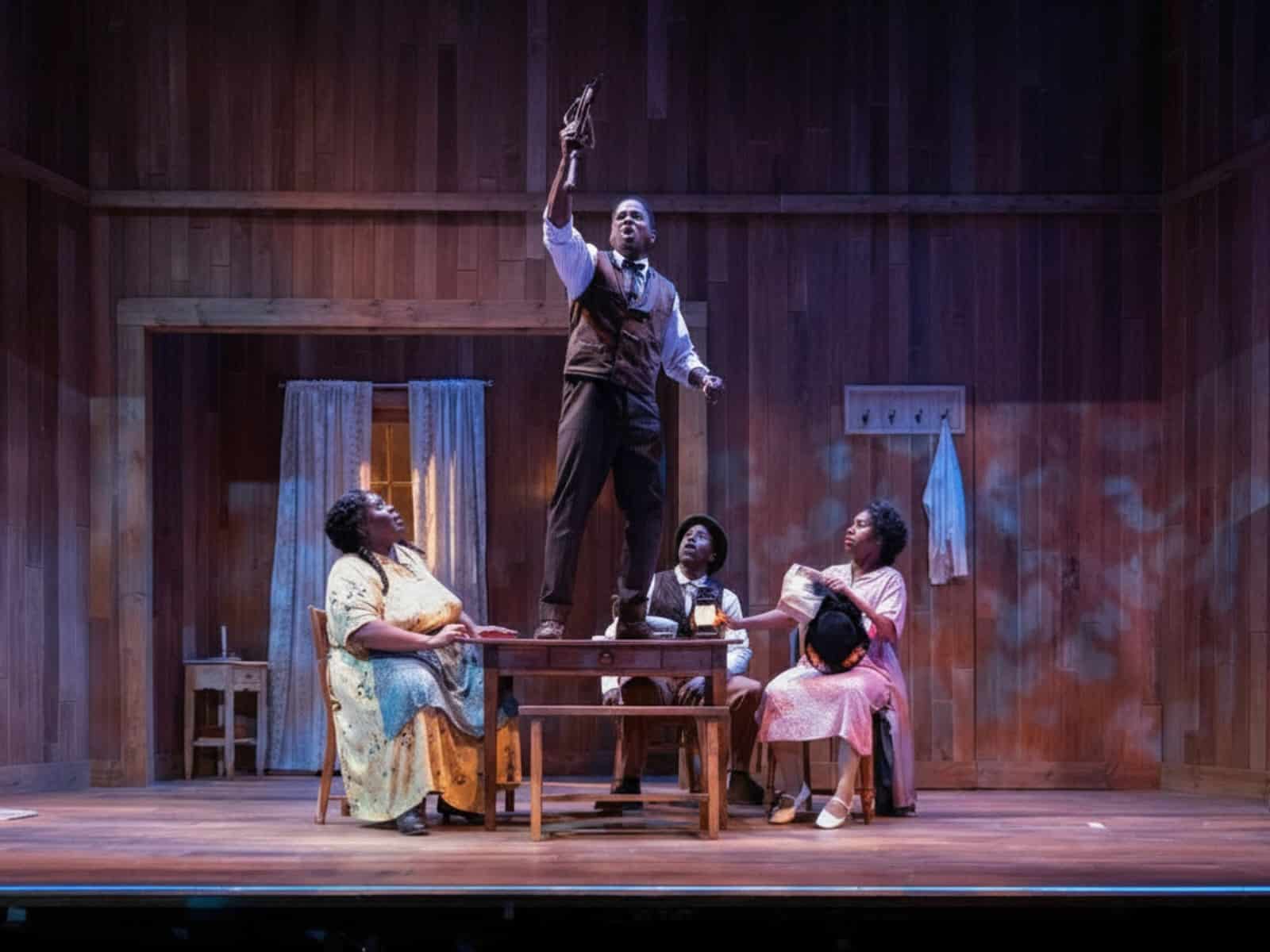
The set (Alexander Woodward) is sparse, and the stage curtain is open, so audiences can see what it is from the time we walk in. It is a humble shack made up of all different kinds of wood. The place is plain, quiet, clean, and most of all unassuming — it plays the background well.
Set in Jim Crow Georgia (circa the late 1950s), this place serves as the headquarters for several of the play’s Black characters, half of whom are still sharecroppers and stay on a cotton plantation owned by Ol’ Cap’n Cotchipee (Stephen Patrick Martin).
But Purlie Victorious Judson (Warner Miller) don’t work for nobody, especially not Ol’ Cap’n. Mr. Victorious is a traveling preacher who has returned home to reclaim what is owed to him and his family. In a way, he is seeking reparations, and he’ll be damned if he don’t get them. His scheme involves Lutibelle Gussie Mae Jenkins (Danaya Esperanza), a lady he found during his travels. He also recruits his sister-in-law Missy Judson (Kelli Blackwell) and brother Gitlow Judson (Jason Bowen) to help in his quest.
Off rip, Purlie makes it clear that he is in the business of freedom: a concept each character conceives differently. And largely speaking, achieving freedom is contingent on Ol Cap’n Cotchipee believing a lie or, rather, myth.
Within minutes, it becomes clear that this whole thing is over the top, as each member of the talented ensemble represents a trope of sorts. Each character plays out as cartoonish, to the point where Purlie asks plainly, “What kind of a Negro are you!”
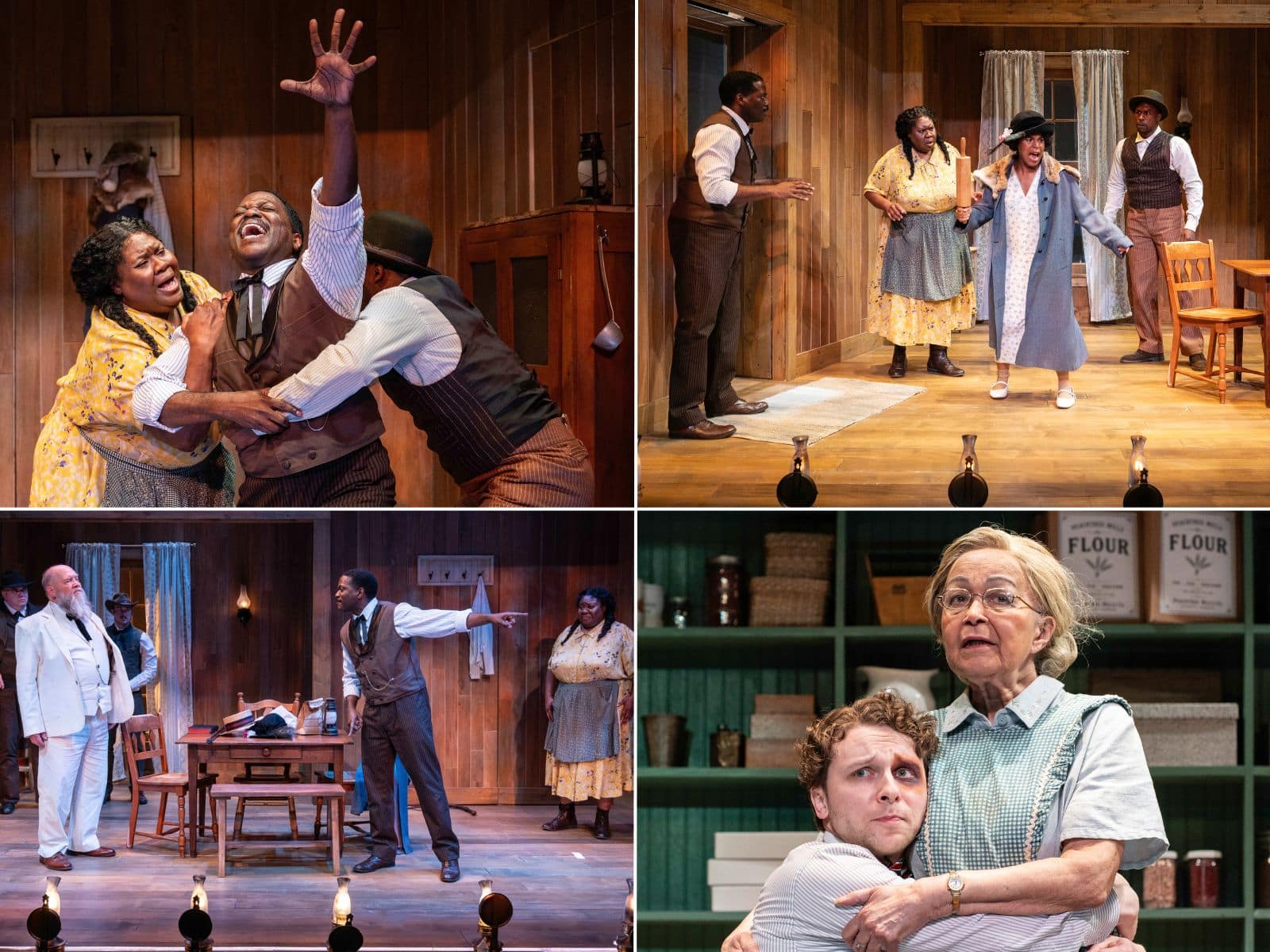
Keen audiences who are privy to Black history will recognize the following stereotypes:
Lutiebelle is a self-described “sleep-in” who is constantly lost; Purlie is able to stimulate her faith and sexual desire, but never her intellect. Aunt Missy performs domestic tasks every day from 4 AM onward, offers advice, and is happy to stay just where she at. (Both characters wear wigs that would make Tyler Perry laugh — costume design by Cidney Forkpah, wig design by Larry Peterson.)
Gitlow just wants to pick cotton and sing Negro spirituals; in fact, he gleefully breaks productivity records and wears his best clothes to pick cotton (because cotton iz white and mus be respected). Note: these characters become more complex later.
When writing the play, Mr. Davis conceptualized the Cottonpatch as a place “existing only in memory,” so it is treated as an exhibit, similar to how racism is treated as historical exhibits in the satire The Colored Museum by George C. Wolfe, a play Psalmayene 24 directed two seasons ago at Studio.
This production also proves itself to be in on the joke, using plenty of metatheatrical techniques along the way. (During scene transitions, four stagehands dress in denim overalls and a plaid shirt complete with pigtails.)
The play finds its groove in scene two, which plays out like a classic race melodrama on a gorgeous teal-themed set. A Black mother figure, Idella Landy (Lizan Mitchell), cares for Cap’n’s son Charlie (John Sygar), who got beat up for supporting racial integration.
Actors Mitchell and Sygar achieve excellent chemistry, finding ground in a ludicrous script.
Of the cast, Mitchell’s Idella feels the most lived in. She breathes life into her role, delicately capturing what it must have meant to be a Black surrogate mother responsible for rearing a white child.
When Cap’n enters, he brandishes three weapons: a gun, a bullwhip, and a cane. He even lifts his son’s face with his bullwhip. His son, Charlie, is the last of the Cotchipee bloodline, a seemingly dying breed. Cap’n despises non-Confederate activities and detests his son’s progressive behavior.
There’s great comedy work being done (especially by Sygar’s Charlie), and the play works best when it makes use of its entire ensemble, such as in a moment of absolute chaos that occurs in the second half.
Director Psalmayene 24 is no stranger to race satire: he revels in it, leaning into the piece’s humor and extracting it for all its worth. The production is comedic, self-aware, and extremely farcical. It is largely successful, but at times overdone.
There is an air of self-awareness, be it breaking the fourth wall or a subtextual wink to the audience. In one moment, Purlie, when alone with Gitlow, goes full minstrel: he smiles, bucks his eyes, tap-dances, and pantomimes jazz hands while talking in a dimwitted voice (à la Stepin Fetchit).
There is a color lighting cue built into this sequence (lighting design by Colin K. Bills), as if to tell audience members (especially those who are non-Black), “Yes, we know. This is the joke. We can and do joke like that among ourselves.”
The production boasts high-energy performances and bold creative decisions, but rarely does it pause to ground itself in emotion, not even during densely traumatic scenes — depending on who you ask, this may be a welcome feat, but it cuts what could have served as emotional beats.
At one point in the story, a Black woman discloses being sexually assaulted by a white man, and even this moment is played for laughs, with actors crawling on knees and running laps around tables.
It seems the company’s intent is to deflate racism, its power and credence — to take agency and reclaim what has haunted us — but in doing so, by downplaying these moments of truth and lived realities, something may have been lost in this interpretation of the text.
The production has several elements worth praising: its stacked cast, beautiful set reveals, and high-octane clown work.
But probably most of all is its ability to predict, or to speak to, where we are now during the 250th anniversary of our country. The production poses pertinent evergreen questions of reclamation, ownership, duty, obligation, and struggle.
The main question is, how do we go about getting free?
Purlie is willing to do anything, say anything, and go anywhere if it means he will get his people free.
He is a very “by any means necessary” character, and he is not the only one. The people in this play employ each and every tactic to get what’s theirs, including but not limited to deception, sex, intellect, humor, violence, and nonviolence.
In that way, Purlie Victorious presents a kind of alternative to the philosophy of “Good Trouble” as seen in Young John Lewis: Prodigy of Protest, Psalmayene 24’s original musical, which had a wildly successful run at Mosaic Theater and closed just earlier this month.
The straight-play version of Purlie Victorious sat dormant for 60 years (there are also film and musical versions) until it was revived on Broadway in 2023, after being championed by Broadway star Leslie Odom Jr. When it first opened in the ’60s, the play was met with mixed reviews. Some of Davis’ contemporaries liked it, others didn’t, criticizing the play’s humor. I’d like to think Mr. Davis would appreciate this revival.
Though (or maybe even because) the play is a farce, there are moments that feel prescient, such as Purlie’s monologue about our need to uphold the Constitution, or Cap’n being flattered with a fake plaque à la Donald Drumpf accepting the FIFA Peace Prize.
This play and several dare I say other “forgotten” plays (I dislike that term) by Black writers deemed ahead of their time, including luminaries such as Alice Childress, Adrienne Kennedy, and Zora Neale Hurston, are back en vogue and being programmed across the country. This is a good thing.
Purlie Victorious is well worth your attention. It is compelling from beginning to end. Purlie’s optimism is contagious, and this play reminds us that nothing happens by accident. That one’s effort plays a key role in getting things done, even when the tactics may seem moot and pointless.
Purlie, as a character, may have flaws, downfalls, and misfires, but he has a dream.
Some dreams are taken more seriously than others — there are those we laugh at and others we don’t, but Purlie’s dream is worth no less than Dr. King’s, neither is that of Gitlow, Missy, or, for that matter, Ol’ Cap’n Cotchipee’s.
There is honor in trying to fight for the future(s) we want to see. Ideally, we will all fight for one that serves the greater collective.
Running Time: One hour and 50 minutes with no intermission.
EXTENDED: Purlie Victorious plays through June 28, 2026, in the Victor Shargai Theatre at Studio Theatre, 1501 14th Street NW, Washington, DC. For tickets ($55–$117, with discounts available), go online, call the box office at 202-332-3300, email boxoffice@studiotheatre.org, or visit TodayTix. Studio Theater offers discounts for first responders, military servicepeople, students, young people, educators, senior citizens, and others, as well as rush tickets. For discounts, contact the box office or visit here for more information.
Note: The production offers designated Black Out Night performances on Thursday, June 4, and Friday, June 19. A Black Out Night is “the purposeful creation of an environment in which an all-black-identifying audience can experience and discuss an event in the performing arts, film, and cultural spaces—free from the white gaze.”
The program for Purlie Victorious is online here.
Purlie Victorious
By Ossie Davis
Directed by Psalmayene 24
SEE ALSO:
Studio Theatre announces cast for ‘Purlie Victorious’ (news story, April 20, 2026)
Ablaze with talent, ‘The Colored Museum’ at Studio Theatre plays against type (review by John Stoltenberg, July 9, 2024)
Stirring ‘Young John Lewis’ holds up a mirror at Mosaic Theater (review by Teniola Ayoola, March 31, 2026)
Why ‘Young John Lewis’ is the great work of art our nation needs right now (review by John Stoltenberg, April 22, 2026)