Moral courage on the national stage is in conspicuously short supply at the moment. Far more prominent in our daily news cycle are bellicose sadism, craven sycophancy, bottomless avarice, venomous bigotry — to name but a few too-familiar deficiencies of moral fiber. As characterological qualities go, we are witnessing a public calamity. A cult of moral vacuity is rapidly unmaking whatever greatness our country has left. So it is that we can now gratefully welcome the new musical Young John Lewis: Prodigy of Protest — a great work of art about a history-making life lived honorably on behalf of the humanity of others.
If ever a show was a civic conscience game-changer, this one is it. And if ever a departed social justice icon had a message America needs most right now — radical change through peace, not violence — it is John Lewis, remembered as “the conscience of the nation.”
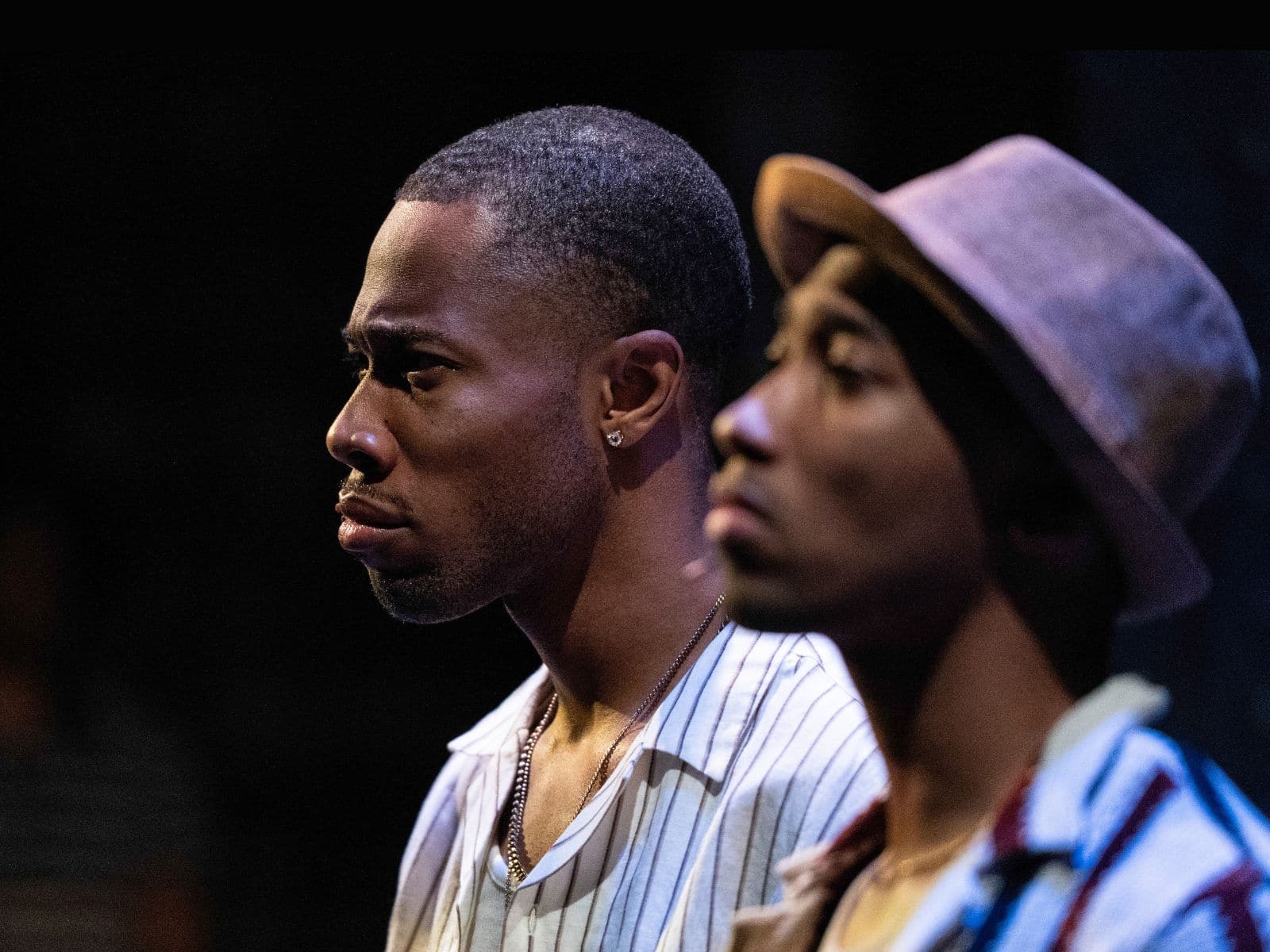
Book and lyrics writer Psalmayene 24 has created for his main character a heart-stopping storyline that tracks Young John’s life from age 15 to 28. It is framed historically between two racist killings: the lynching of Emmett Till in 1955 and the assassination of the Rev. Martin Luther King Jr. in 1968. In scenes depicting the intervening years — including the murder of Medgar Evers, the church bombing that killed four little girls, Lewis’s brutal beating by state troopers on the Edmund Pettus Bridge in Selma — we see Young John grow step by step into the stature for which he is revered.
The ensemble of ten starts off with a preshow dance party with live music. The mood is upbeat and fun, as though everyone can join in. The subsequent show is as entertaining, spiritedly performed, and theatrically engaging as can be, set to multiple musical styles by composer Kokayi. Simultaneously, the show serves as a practicum in moral courage and a primer on social justice activism. This is dramaturgy rare on the American stage.
Psalm’s most brilliant stroke of imagination, in a show chockablock with it, is the introduction of the character Emmet Till (“I was killed today,” he says bluntly). Emmet appears to Young John as a ghost and to us as a lively teen who eggs on Young John to avenge his murder (“Gotta do something,” sings the ensemble. “What are you gonna do?” Emmet challenges Young John. “Righteously fight” is Young John’s reply.)
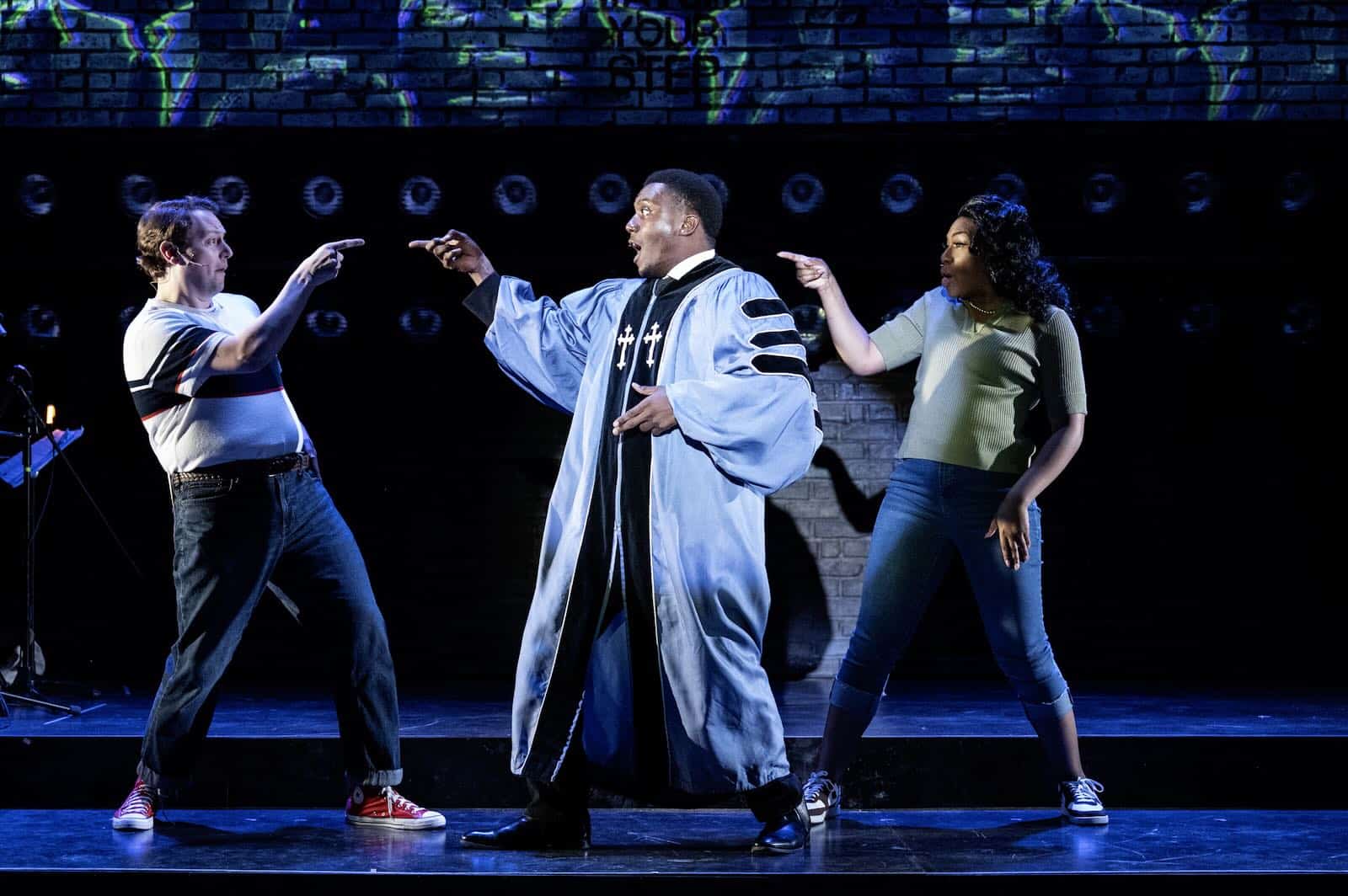
Young John hears The Reverend Doctor King on the radio preaching a message about using “principles of the Social Gospel to benefit humankind.” Inspired, Young John writes to him, the Reverend Doctor invites him to visit, and they connect as political mentor and mentee on a foundation of values that was to defy segregation and realign the meaning of America. This onstage relationship makes a key point about a kind of intergenerational modeling and upbuilding of character that was once recognized as an important part of growing up for young people but appears to have been lost. Young John Lewis vividly foregrounds what needs to be refound.
The show sets up the complex intramovement tension in political theory and practice between violence and nonviolence in the boy-boy byplay between Emmet and Young John, and later as a riveting rap battle between Young John and Stokely Carmichael. The tension thus becomes a personally urgent question for Young John, one anyone can relate to, and his refrain “What do I do now?” becomes a pointed motif that functions in the show as a mental takeaway like a hummable tune. This is not theater merely for spectators. This is a scenario that means to motivate its audience to join its protagonist in making “good trouble.”
“We miss leaders like John Lewis right now,” said Reginald L. Douglas, Mosaic’s artistic director and director of Young John Lewis. Indeed, we miss public figures whose sense of self does not derive from how many people they put down today and by how many followers felt vicariously validated by the derogation. That’s the kind of character that now prevails from the very pinnacle of our country’s governance. Young John Lewis dramatizes the formative years of someone whose character was completely the opposite. John Lewis is an exemplar of someone whose sense of self derives from a commitment to uplifting others.
That is why this musical is so essential. And that is why this show must go on across the land.
Running Time: One hour and 40 minutes with no intermission.
Young John Lewis: Prodigy of Protest plays through May 3, 2026, presented by Mosaic Theater Company, performing at Atlas Performing Arts Center, 1333 H Street NE, Washington, DC. Tickets ($42–$70) are available online or through the box office, (202) 399-7993 or boxoffice@atlasarts.org. Information about discounts is here. Tickets are also available through TodayTix.
The program for Young John Lewis: Prodigy of Protest is online here.
Young John Lewis: Prodigy of Protest
Book and Lyrics by Psalmayene 24
Music by Kokayi
Directed by Reginald L. Douglas
Choreographed & Associate Directed by Tony Thomas
SEE ALSO:
Stirring ‘Young John Lewis’ holds up a mirror at Mosaic Theater (review by Teniola Ayoola, March 31, 2026)
Mosaic Theater Company presents ‘Young John Lewis: Prodigy of Protest’ (news story, February 22, 2026)
New hip-hop musical at Mosaic reveals John Lewis before he became a legend (interview with playwright Psalmayene 24 and director Reginald L. Douglas by Teniola Ayoola, January 27, 2026)
Mosaic Theater Company launches ‘Young John Lewis’ reflection series (news story, October 9, 2025)