It is no mean feat to take a musical based on a 150-year-old book and make it both traditional and fresh. Little Women: The Musical, now playing at Creative Cauldron, pulls it off with grace and glee.
Louisa May Alcott’s Little Women was a surprise bestseller from the moment it was published in 1868. The autobiographical novel, based on the lives of herself and her three sisters growing up in Concord, Massachusetts, during and after the Civil War, is, self-referentially, the origin story of the work itself, portraying how its protagonist, Jo March, came to write that very book. Alcott was drawn more to swashbuckling, melodramatic adventure stories than portraits of domestic life, and she herself found her own novel boring. But it was seized on by girls around the nation, not used to seeing themselves portrayed as authors of their own lives, rather than just dutiful wives and mothers. While Alcott doesn’t denigrate the importance of domesticity, lauding it in the characters of Meg and Marmee, she concentrates more on girls’ right to fulfill their own dreams, rather than just their duties. This concept of female agency is one of the things that has kept the novel relevant generation after generation, cherished and returned to by legions of readers, filmmakers, and playwrights.
The musical version, with music by Jason Howland, lyrics by Mindi Dickstein, and book by Allan Knee, played 137 performances on Broadway. Audiences can now enjoy the thoroughly charming professional production at Creative Cauldron in Falls Church.
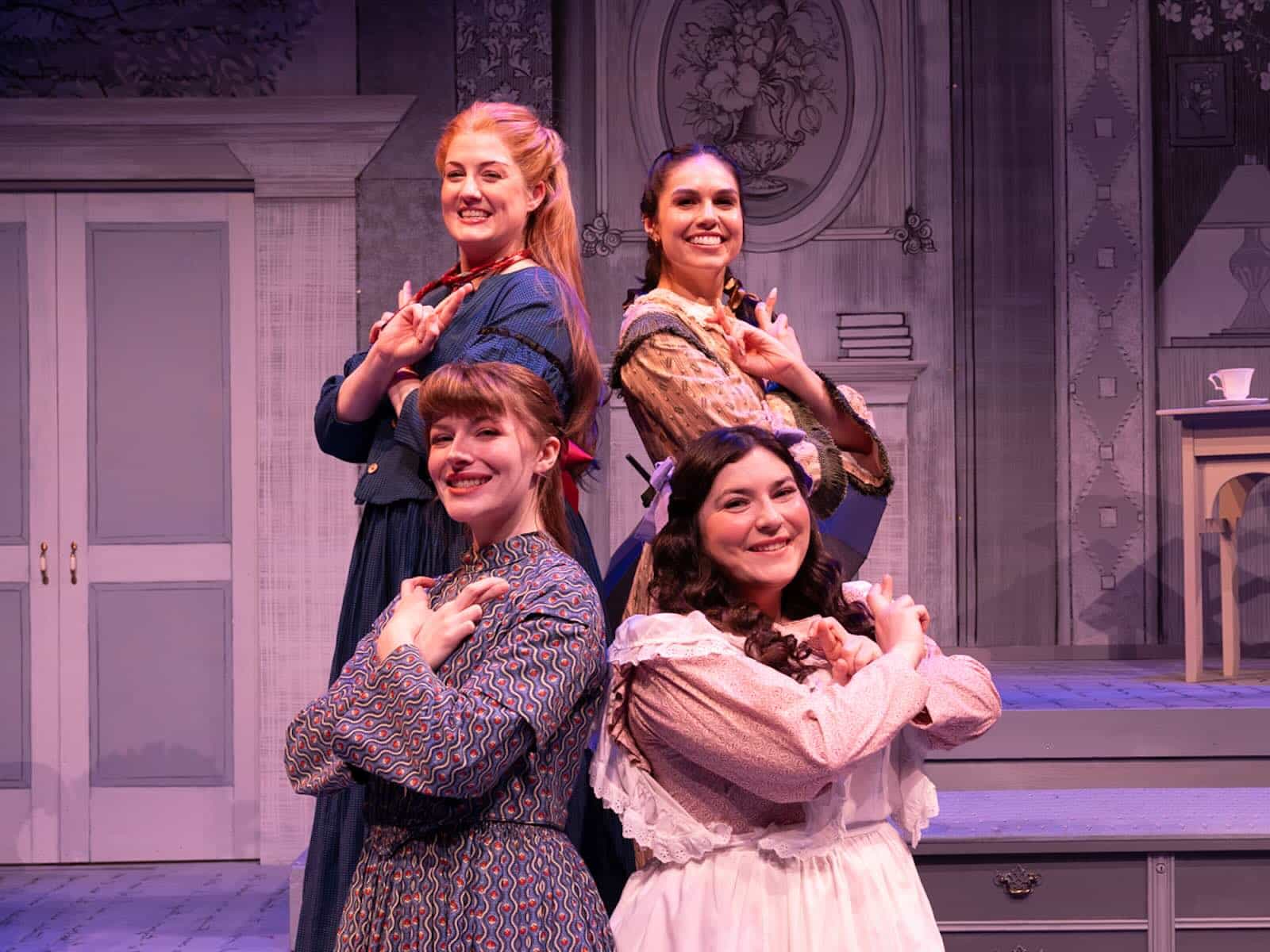
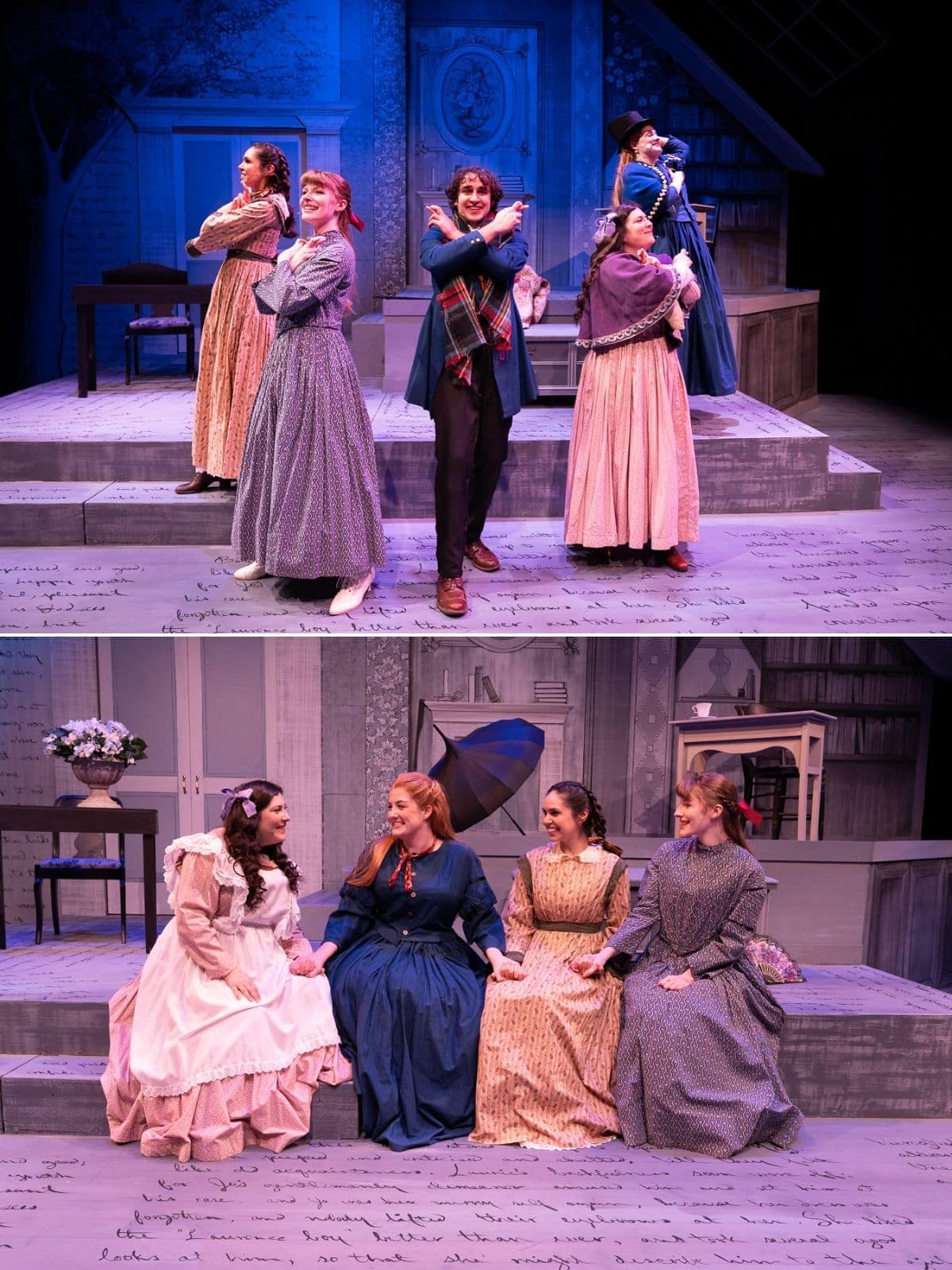
The first thing you notice on entering the small, black-box theater is the set by scenic design artist Margie Jervis. Indeed, it is hard to tear your eyes from it, for the entire stage looks like a collage of illustrations from the book’s first edition. Gentle strokes of paint cover every surface, giving it a feel halfway between an engraving and a pencil sketch. There are beautiful impressions of wallpaper, printed borders, trees and flowers, but everything is fresh, not stuffy or old-fashioned. All this detail would be overwhelming if Jervis had not rendered it in soothing blue-gray tones that set off Tessa Grippaudo’s colorful, lush, and period-appropriate costumes (lantern sleeves, lovely!). And over all this, even on the floor, is superimposed handwriting from Alcott’s manuscript, making you feel like you are inside the novel, which, given the nature of the story, is very apt.
In front of this backdrop sit platforms that director Laura Connors Hull uses to delineate different scenes or to let the cast run wild during fantasy sequences. She distributes the actors well in the space, so the audience on all three sides can always see an actor’s face. (The one exception is when the actor is positioned facing upstage in front of the center aisle, blocking the view from the adjacent seats. Occasionally, the actor steps up into the aisle, which works better.) The stage is small, and the cast uses it fully, making the audience feel they are part of the action. Choreographer Suzy Alden also makes the most of the space, especially in the charming number “Delighted,” complete with fluttering fans. Creative Cauldron is very enthusiastic about their new sound and mic system, which, while it seems almost unnecessary when the actors are so close, does help their softer moments carry above the backing track. Music director Bharati Soman blends all the fine voices well, although the sopranos’ more operatic tones occasionally break through the harmony.
When the story opens with the mother and four daughters lamenting their father’s absence during the Civil War and their lack of money for Christmas, there is a danger that it might veer toward the maudlin. But the cast quickly dispels that possibility. From the moment they begin participating in Jo’s rip-roaring “Operatic Tragedy,” their spirit and humor are infectious. This extends to the Musical Theatre Ensemble, made up of students from Creative Cauldron’s classes (Madeline Corley, Whit Jenkins, Marie Solander, Jason Gonzales, Emma Lynch, Ely Tarrant, and Tatiana Lund). They charmingly fill roles as servants, skaters, dancers, and even trolls and trees.
As in Alcott’s novel, the men are not the most complex characters, but these actors — Adian Chapman (Professor Bhaer), Michael McGovern (Mr. Laurence), David Schoonover (John Brooke), and Jason Zuckerman (Laurie) — make them individuals. They sometimes seem perplexed by the strong women in the story but accept them as their equals.
But Little Women centers, as it should, on the women.
Audrey Baker commands the stage in her roles of imperious Aunt March and garrulous Mrs. Kirk. Although Aunt March is supposed to be the voice of disapproving society hindering Jo’s dreams, Baker plays up the humor in the character.
Carolyn Burke (Marmee) combines strength, vulnerability, and authenticity in her solos “Here Alone” and “Days of Plenty.” She captures the sense of humor, intelligence, and tenderness that she passed down to her daughters.
Odette Gutierrez del Arroyo plays Beth, the peacemaking sister, with all the sweetness she deserves, without ever becoming cloying. Her illness in the second act, portrayed through makeup and movement, is genuinely affecting.
Gretchen Midgley Kaylor’s Amy looks at the beginning like she is going to be a villain, and portrays petulance well. But her underlying love for her sisters shines through her selfish snobbishness.
As Meg, Shelby Young has perhaps the most difficult job, bringing to life the most traditional character, who wants only to fall in love and get married. But Young’s warmth and the spirit she brings to Jo’s stories invigorate her portrayal, and her soaring soprano is gorgeous.
As Alcott’s alter ego, Jo, the pillar that holds up the play, Kylie Clare Truby truly pulls it all together. She has a marvelous capacity to convey mixed emotions, such as the wary delight with which she welcomes Laurie’s friendship. And her comedy shines in almost every scene. The role is grueling — Jo runs through a huge gamut of emotions, is onstage almost constantly, and sings in all but five of 17 songs — but Truby’s energy never flags, making the role look easy and fun. She is a delight throughout.
One of the most refreshing things about Little Women is that it lacks a villain. There are vicissitudes of life — separation, loneliness, disappointment, even death. But Little Women is the story of girls striving to fulfill their dreams, however traditional or ambitious they may be. And watching them succeed is sweetly satisfying.
Little Women at Creative Cauldron combines tradition and feminism into a feast for the eye, the ear, and the heart. Don’t miss it.
Running Time: Approximately two hours and 30 minutes, including intermission.
Little Women: The Musical plays through June 7, 2026, at Creative Cauldron Stage, 27 E Broad St, Falls Church, VA. Performances are on Thursdays, Fridays, and Saturdays at 7:30 PM and Sundays at 2:00 PM. Refer to the specific schedule of performances and purchase tickets online. Ticket prices range from $25 for students to $40 (tier two) and $50 (tier one) for adults, with group discounts available.
View the program for the production here.
Little Women: The Musical
Directed by Laura Connors Hull
Music by Jason Howland
Lyrics by Mindi Dickstein
Book by Allan Knee