UPDATE: Hadestown: The Musical will be available to rent or buy digitally on major streaming and video-on-demand platforms beginning August 25, 2026.
Since their respective inceptions, television and film have been trying to bring the performing arts to the masses. Much of television in the 1950s was just live theater with cameras pointed at it. Filmed versions of Broadway productions, including Pippin, Into the Woods, and Cats, have been released on home video. And in the 2010s, network television presented a succession of star-studded live television events of popular musicals (The Sound of Music, The Wiz, Jesus Christ Superstar, etc.). The UK’s National Theatre Live, among others, regularly releases highly polished, professionally produced films of staged productions. And perhaps the biggest example is Hamilton: An American Musical, released to stream on Disney+ in 2020, followed later by a short run in movie theaters.
This year, we are treated to another theatrical release of an award-winning stage production: Hadestown: The Musical. Have filmmakers finally cracked the code on how best to represent the live theater experience?
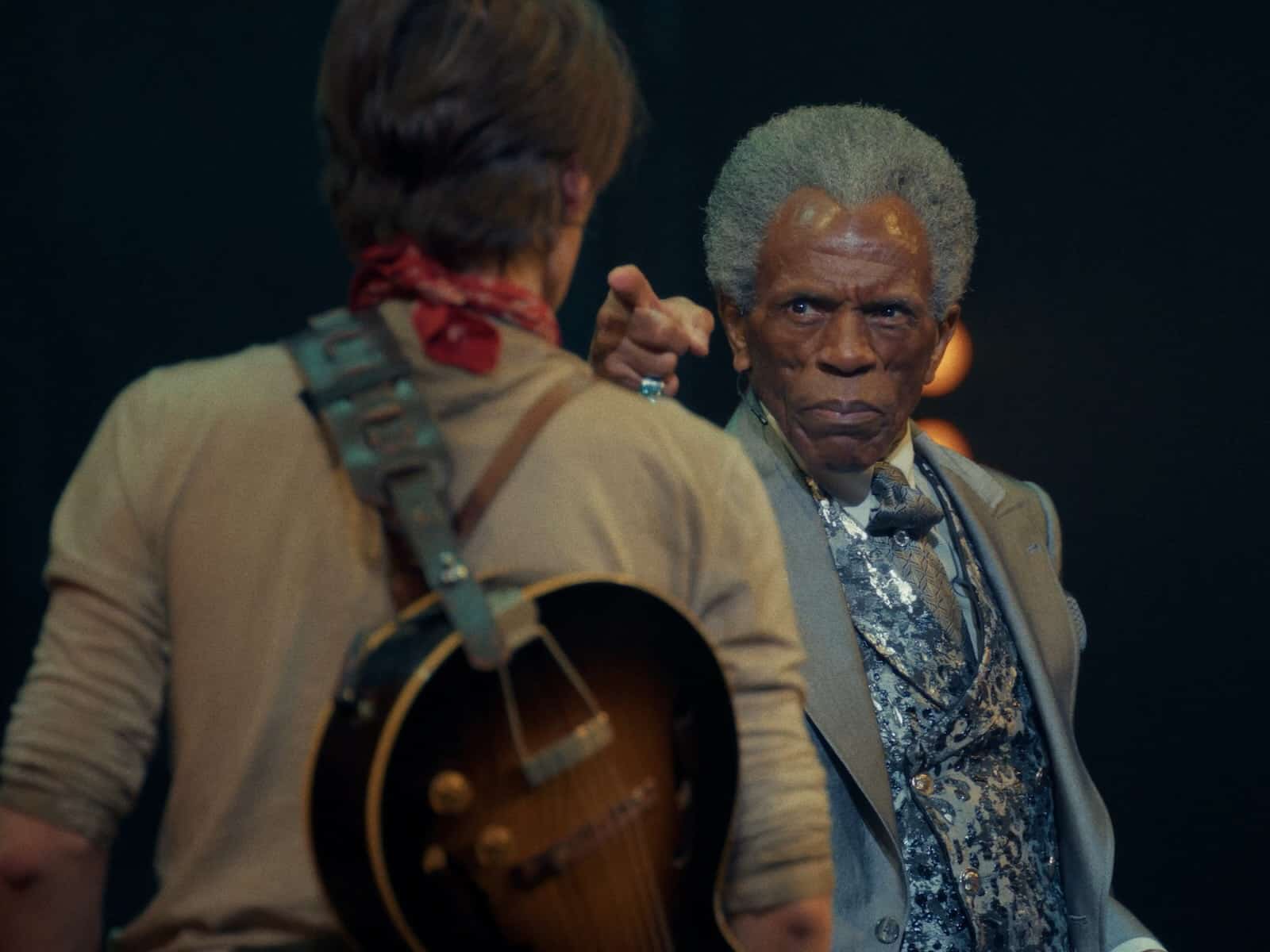
Photo courtesy of Bleecker Street and LD Entertainment.
Created in 2010 by Anaïs Mitchell originally as a concept album, Hadestown made its off-Broadway debut in 2016 (greatly expanded with help from director Rachel Chavkin), its West End debut in 2018, and its Broadway debut in 2019, where it was nominated for 14 Tony Awards, winning 8, including Best Musical.
The story is a modern-ish melding of two Ancient Greek tales of romantic couples: Orpheus and Eurydice, and Hades and Persephone. The stories in a nutshell: 1) Orpheus and Eurydice meet and fall in love; Orpheus neglects Eurydice to focus on his music; Eurydice is despondent and is seduced to the Underworld by Hades; Orpheus attempts to rescue her. 2) Hades imprisons Persephone as his wife in the Underworld; Persephone makes a deal where she can return to the surface half the year; when she returns, it’s spring, and when she is below it’s winter. Mitchell adds themes of class structure and worker oppression while building upon the ideas of faith, love, and the cyclical nature of life already present in the myths.
The phenomenal success of Hadestown is well-deserved; however, it is hardly the first adaptation of this material — many important staged works were inspired by the Orpheus and Eurydice story. Two of the very first operas were Euridice by Jacopo Peri (1600) and L’Orfeo by Claudio Monteverdi (1607). Christoph Willibald Gluck wrote his opera Orpheus and Eurydice in 1762, and Jacques Offenbach debuted Orpheus in the Underworld in 1858 (you know it; it has the French can-can music). The story permeates the world of visual arts too, with significant paintings and sculptures by Titian and Rodin, among many others. Choreographer George Balanchine created a ballet of the story in 1948. French New Wave filmmakers Jean Cocteau, Marcel Camus, and Jacques Demy all adapted unique versions of the story for the screen. And more recently, playwright Sarah Ruhl wrote her surreal retelling from the female character’s perspective in her play Eurydice (2003).
Mitchell’s adaptation draws heavily from the musical palette of early 20th-century New Orleans jazz and zydeco while retaining the pop-influenced sensibilities of contemporary musical theater. The instrumentalists engage with the actors and remain onstage and visible the entire show. The result is largely celebratory and exuberant, even when the stakes are high and the situation dire, which is pretty much all the time. The ballad “Wait for Me” became a TikTok hit and a way into the musical for many people.
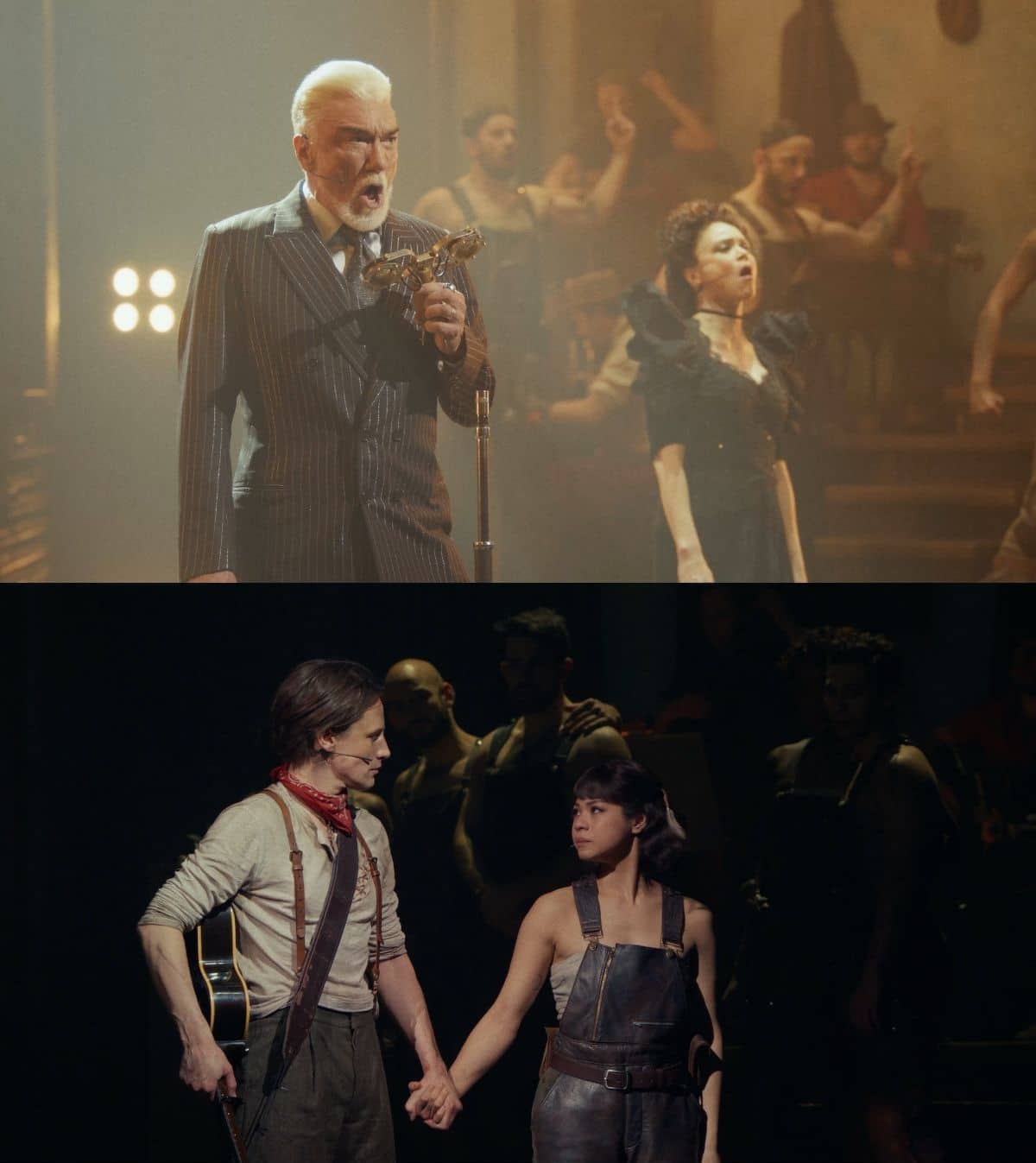
For the 2026 filmed production (performed live on stage in London for an audience and multiple cameras), the beloved lead actors from the original 2018 West End and 2019 Broadway productions were reassembled: Reeve Carney as Orpheus, Eva Noblezada as Eurydice, Patrick Page as Hades, Amber Gray as Persephone, and André De Shields as Hermes, the story’s narrator and master of ceremonies.
While capturing this award-winning ensemble for the filmed version makes perfect sense, I noticed something interesting while I watched the screener. At the very top of the show, shots of a giddy audience rapt with attention, waiting in anticipation for a moment they know is coming. The impeccably precise André De Shields enters as Hermes, takes a still position downstage, and with a quick flick unbuttons his jacket to reveal a sparkly waistcoat. The audience roars. For the superfan, this is the first of many “he did the thing!” celebrations of joy. For the uninitiated, this is the first of many “wait, what did I miss?” FOMO moments. Subsequent shots of audience members singing along reinforce that we are not watching the 2018 lightning-in-a-bottle production, but instead a victory tour for an established fanbase. This version of Hadestown is more of a well-polished reunion than a documentation of the original production.
But really, does it matter? This is the cast both fans and newcomers want to see and hear. All of the leads fill their roles perfectly (Reeve Carney haters, we hear you, but calm down). Eva Noblezada is both fragile and resolute; Patrick Page exudes gravitas and seductive menace (even while nursing a torn Achilles and in a black walking cast up to his knee, causing him to move carefully and cat-like through his modified choreography); Amber Gray positively blows the roof off of the theater in both her songs and character; and André De Shields could not be more perfect and captivating if you designed him in a lab. Joining the leads are a featured trio of Fates (Bella Brown, Madeline Charlemagne, Allie Daniel) and an ensemble of workers that create complete and compelling worlds, both over and under.
Rachel Hauck’s original scenic design is a character unto itself. The effectively single location of a café and streetcorner that is both indoor and out transforms in subtle and dramatic ways, with concentric turntables for endless walking, swinging industrial pendant lights, a central elevator platform, and upstage walls that seem to move as if taking heaving breaths (I saw the 2021 touring production of Hadestown with highly simplified scenic automation and can attest to how much of a difference the fully realized set makes).
Film director Brett Sullivan and cinematographer Clayton Jacobson make choices about shots that could never be seen from the perspective of the audience (e.g., pointing up from the elevator platform as it descends into the Underworld). But the additional layer of cinematic mise-en-scène feels restrained and respectful of Chavkin’s original directorial vision. (Conversely, I was less enthusiastic about the 2020 Disney+ pro-shot version of Hamilton, which frequently prioritized extreme closeups over full ensemble views of the stage. It felt too removed from the theater-going experience.)
So if it’s the most authentic theater-going experience you’re after, shouldn’t you just stick a single locked-off camera in the mezzanine and call it a day? Obviously not. In a live theater environment, your eyes are drawn to focus on what the performers intend. You are always aware of the full stage, but your attention shifts along with the story and movement, tracking performers, lighting, sound, and scenic elements through a dimensional space per the artists’ intention. Television and movie screens flatten this experience when reduced to a single perspective. Storytelling on film is told in camera movements and edits.
We are still collectively evolving the visual vocabulary of how to present an amalgam of the best of both the stage and the screen. The best filmed stage production should play to the strengths of both art forms. Hadestown comes much closer to achieving this balance than Hamilton did by showing restraint in what was added — a close-up of a tear on a cheek or a quivering jaw — but otherwise retaining something closer to the perspective of an audience member.
While I don’t think anyone believes movie theaters or streaming-at-home experiences are replacements for being in a live theater audience, filmed stage productions are a way for fans who can’t get to New York or London to see the performances and the original casts they adore. If you’re already a fan, seeing Hadestown: The Musical in a movie theater (or eventually by streaming it at home) will be everything you hoped it would be (Patrick Page’s ankle notwithstanding). If you’re new to the show, this film might be both the perfect start and ultimate destination on your journey to the Underworld.
Running Time: Two hours and 21 minutes.
Music, lyrics, and book by Anaïs Mitchell. Originally directed for the stage by Rachel Chavkin. Filmed version directed by Brett Sullivan.