
August Wilson’s Two Trains Running takes the stage in a Theatre Morgan production that captures the humor, humanity, and social commentary that define the playwright’s work. Directed by CJay Philip as part of the Baltimore August Wilson Celebration, the play is presented at the Turpin-Lamb Theatre inside Morgan State University’s Murphy Fine Arts Center. From the staging to the music, the production establishes an inviting atmosphere that draws the audience into the story. The thoughtful design choices and attention to detail make this an engaging theatrical experience and a fitting celebration of Wilson’s legacy.
Set in Pittsburgh’s Hill District in 1969, Two Trains Running centers on Memphis Lee, a restaurant owner fighting to protect his business as urban redevelopment threatens his neighborhood. Within his establishment, a collection of distinct personalities gathers, each navigating personal struggles, ambitions, and uncertainty about the future. Through their conversations, Wilson examines racial inequality, economic hardship, dignity, and the importance of community during a period of social change. Humor balances the heavier themes, allowing the characters’ everyday interactions to reveal the complexities of their lives. At its heart, the play explores what people stand to lose when the places and communities that shape them begin to disappear.
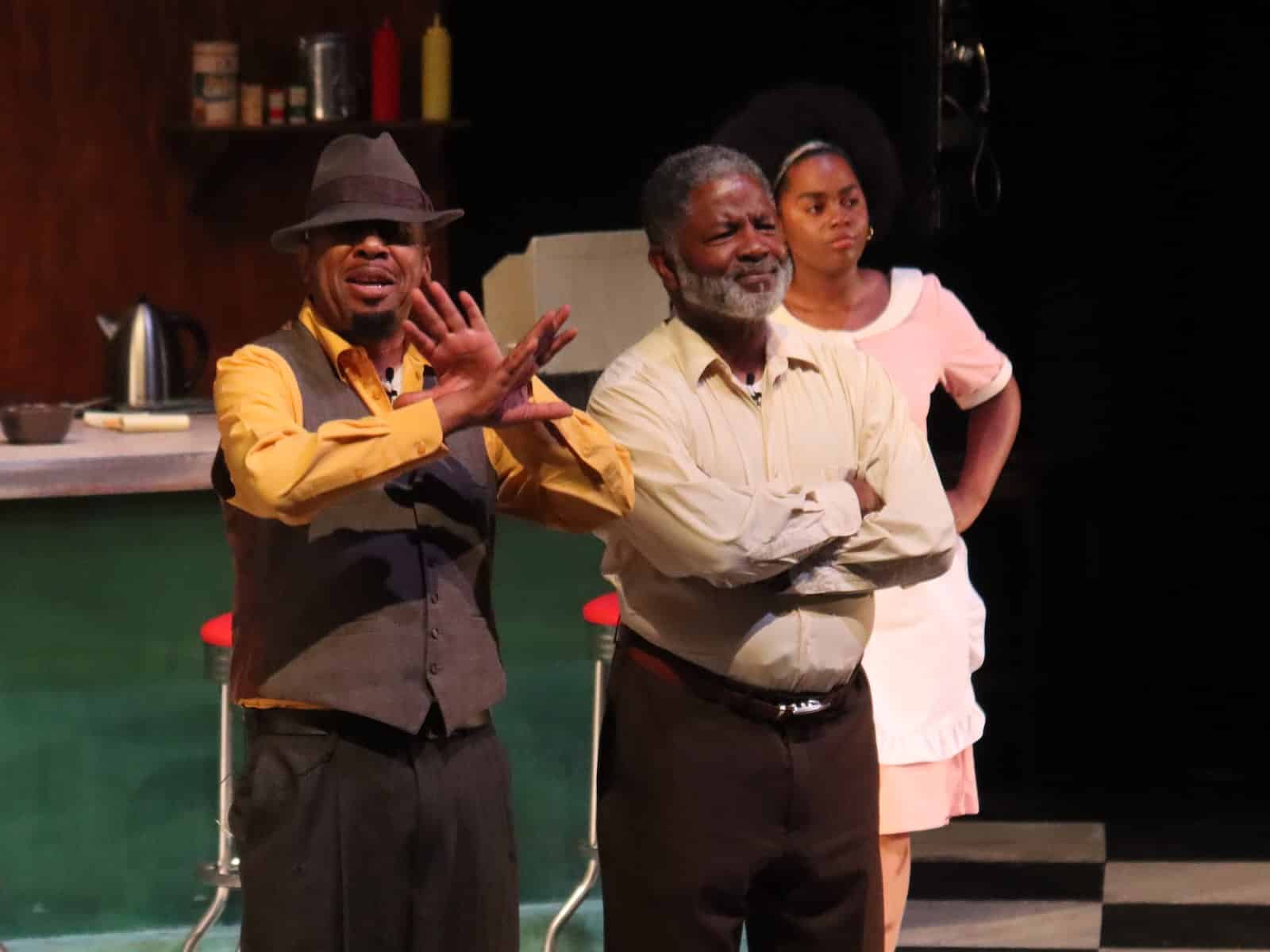
Ronald K. Malone delivers a compelling performance as Memphis Lee. His portrayal conveys the character’s determination and pride while making room for the humor that runs throughout the story. Malone’s comedic timing is particularly effective, helping bring levity to conversations without diminishing their underlying significance. He gives Memphis a strong personality and a commanding presence, making it easy to understand why the character stands his ground. Malone brings conviction to the role, providing one of the production’s most engaging performances.
As Risa, Amina Banks offers a believable and measured portrayal. She approaches the character with sincerity, allowing Risa’s personality to emerge naturally through her interactions with the other characters. Banks avoids unnecessary theatrics, instead grounding her performance in the subtleties of the role. Her work contributes to the ensemble’s balance and gives Risa a distinct place within the story.
Carltaise Ransom is a scene stealer as Wolf. Chef’s kiss! His performance is lively, confident, and thoroughly entertaining. Ransom inhabits the character so comfortably that his presence feels effortless, and his timing makes his scenes especially enjoyable. Whenever he appeared onstage, he drew my attention. His expressions and delivery give Wolf a personality that resonates beyond the dialogue itself. Ransom clearly understands the character, and that connection translates into a performance that is both entertaining and convincing.
Dwight R.B. Cook also makes a strong impression as West, the undertaker. His physical appearance and mannerisms immediately communicate the character’s profession. From his pale complexion and dark clothing to his deliberate walk, Cook embodies the image one might associate with a mortician. These details help establish West’s identity before he even speaks, demonstrating how physical characterization can strengthen a theatrical performance. Cook’s attention to these elements makes the role particularly memorable.
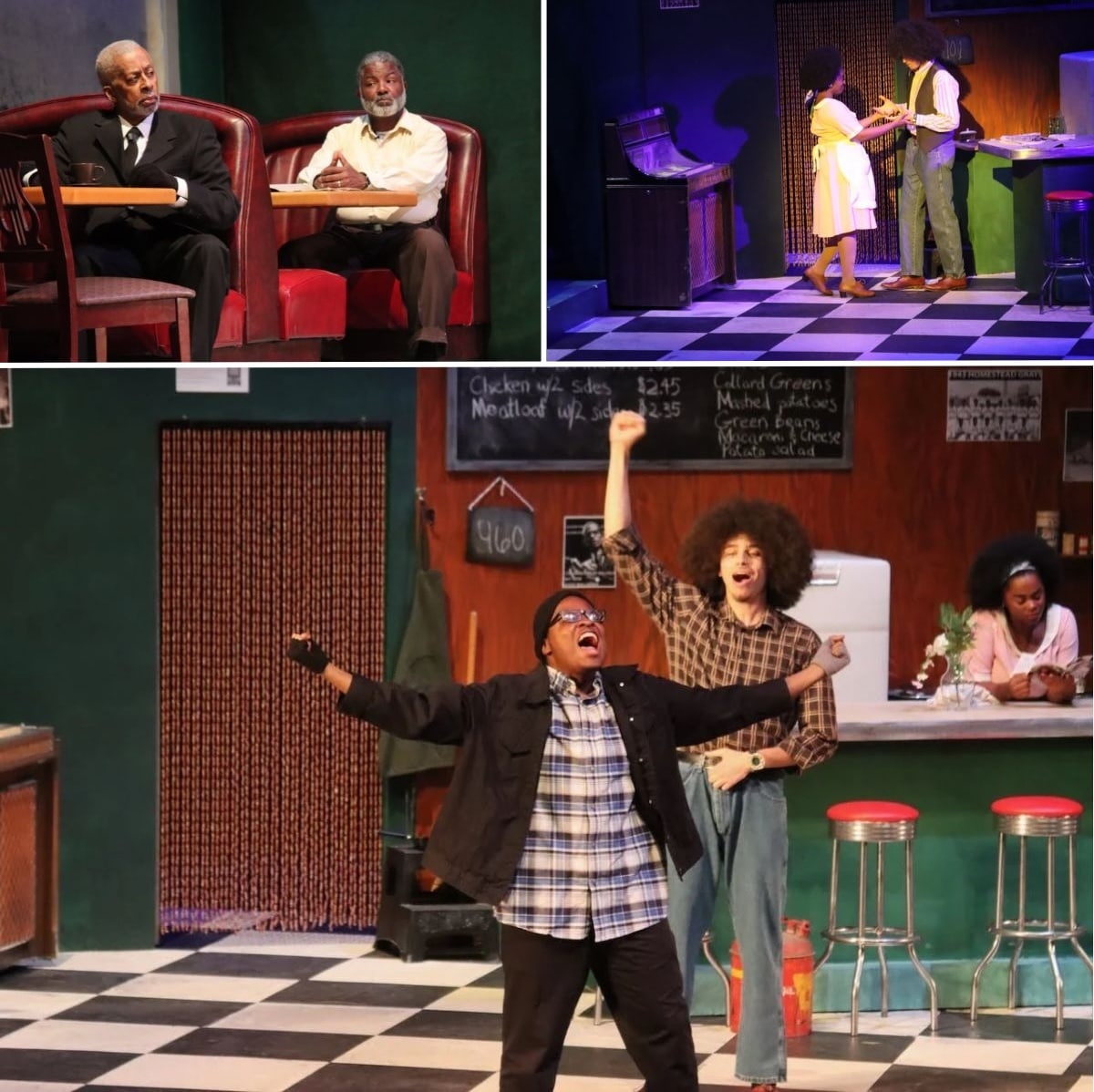
The scenic design is one of the production’s most impressive features. Shartoya Jn. Baptiste creates a setting that feels appropriate to the period and the community at the center of Wilson’s story. The stage is arranged with care, giving the restaurant a lived-in quality that supports the characters’ interactions. Rather than serving merely as a backdrop, the scenery helps establish the play’s atmosphere and situates the audience within Memphis’s world. The design reflects a clear understanding of how the physical environment can contribute to storytelling, and it deserves particular recognition.
Music is another notable strength. It complements the setting and helps establish the mood without overwhelming the action. Sound and video designer Jonathan Lesane Jr. contributes to this cohesive presentation, bringing together the technical elements that support the production. The music and sound enhance the atmosphere, while the visual components complement the staging. Together, these choices help create a theatrical environment that feels considered and consistent with the story.
My primary criticism concerns a few missed lines that occasionally disrupted the dialogue. Because Wilson’s writing relies heavily on conversational rhythm and carefully timed exchanges, these moments sometimes made scenes feel choppy. More consistent delivery would strengthen the pacing and allow certain lines, particularly the humorous ones, to land as intended. Still, the issue was not significant enough to detract from the production as a whole.
Ultimately, Two Trains Running offers an enjoyable opportunity to experience August Wilson’s work through Theatre Morgan. The cast brings individuality to the characters, while the scenic design and music establish an atmosphere that complements the play’s themes. It is especially gratifying to see this production at Morgan State University, an institution that contributes meaningfully to Baltimore’s educational and cultural landscape. Theatre Morgan has presented a work that invites audiences to reflect on community, change, and the human experiences connecting us across generations. I look forward to seeing what the institution brings to the stage next.
Running Time: Three hours with a 15-minute intermission.
Two Trains Running plays through November 1, 2026, presented by Theatre Morgan at Morgan State University Carl J. Murphy Fine Arts Center in the Turpin-Lamb Theatre, 2201 Argonne Dr, Baltimore, MD. Tickets ($10–$35) can be purchased in person at the box office (Wednesday–Friday, 1:00 pm–6:00 pm; Saturday, 11:00 am–4:00 pm) or online.
Two Trains Running
By August Wilson
CREATIVE TEAM:
Director: CJay Philip
Production Stage Manager: De’Lesa Adams
Assistant Stage Managers: Keith Norwood, Dakhir Lee
Scenic Designer: Shartoya Jn. Baptiste
Costume Designer: Sharlene Clinton
Lighting Designer: Niya John
Sound and Video Designer: Jonathan Lesane, Jr.
CAST
Memphis: Ronald K. Malone
Risa: Amina Banks
Wolf: Carltaise Ransom
Holloway: Chevell Thomas
Hambone: Amani Nkere
Sterling: Juel Senn
West: Dwight R.B. Cook