The play’s premise sounds like a gimmick, and it is: Three real-life Victorian sisters who became renowned for their novels — Charlotte, Emily, and Anne Brontë (authors of, respectively, Wuthering Heights, Jane Eyre, and The Tenant of Wildfell Hall) — have been consigned by a witch to purgatory, where they are required to throw nightly parties until they attain “The Point of Celebratory Reverence” (a never-specified transcendent state of being). The sisters have thus dutifully partied on — more than 5,000 times — so far without success. We, the audience, are their guests as they try once again. Will they or won’t they reach that vague “Celebratory Reverence”? That’s essentially the suspense that sustains all the storytelling that follows.
In fairness, we are promised not a conventional, dramatic-arc sort of play but rather a party, pure and simple, in a quaint dollhouse-like set (designed by Maggie Troutman) hung with vintage framed photos and wittily bedecked with a calendar’s worth of celebratory trimmings, including sparkly Christmas, Happy Birthday, and Valentine’s plus some Halloween, St. Patrick’s, Hannukah, Thanksgiving, and Buddhist prayer flags (props design and set dressing by Roo Sultan). When and where we are is a mystery, but we are assured by our hosts, the three sisters — as they graciously offer a few of us cordials — that these are their purgatorial digs, and they would be dying to get out were they not already dead.
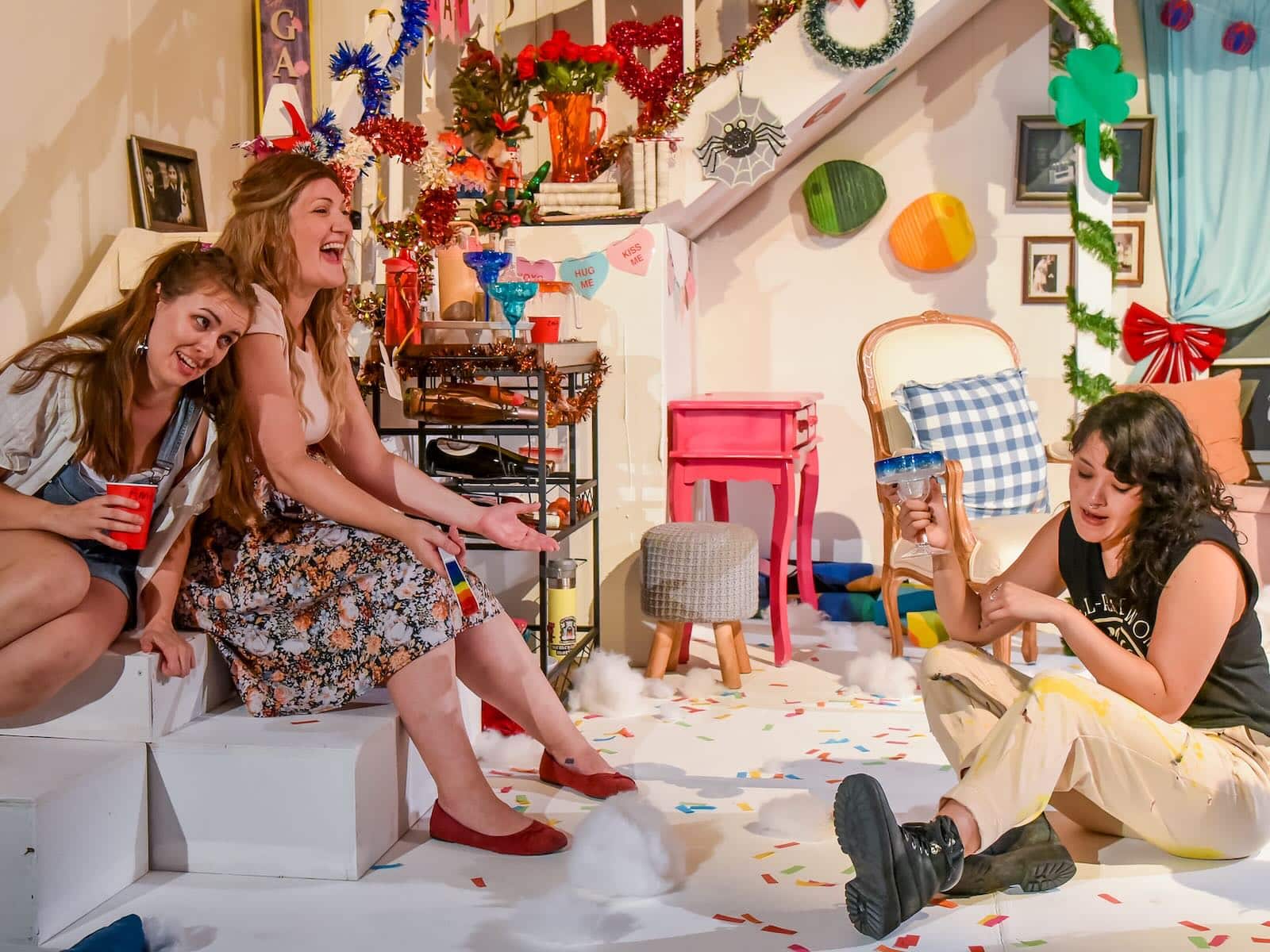
Presented by Nu Sass Productions, which leans into the surreal and eccentric and “strives to encourage marginalized genders in all aspects of theater, especially in those roles traditionally dominated by cisgender men,” Courtney Bailey’s Brontë Sister House Party would seem the company’s perfect cuppa. (Bailey’s playwriting oeuvre includes scripts created for incarcerated performers, which makes this her fiction about sisters stuck in the afterlife seem weirdly on the nose.)
“A party is like a rebellion against everyday life,” Charlotte says chipperly — and then, she reflects soberly, “This is not a good party.” Indeed, the silly festivities require the characters to wear a forced cheer that wears thin even for those onstage.
This is not a play with a story arc that unfolds with revelation after revelation, nor does it attain the euphoric buzz of a good bash. In fact, the script functions more like a loopy lineup for an off-the-wall variety show, with an assortment of monologues, scenelets, and set pieces (some hits, some misses).
A question one might have going in is whether Brontë Sister House Party will make any sense if one knows nothing of the historical characters’ backstories or literary output. Be assured, the playwright doesn’t assume we all will fill that in; there’s plenty of contextualizing exposition (though Brontë buffs will likely recognize easter eggs along the way).
Ironically, the arbiter of the sisters’ purgatorial confinement, the so-called “Lavender Witch of Gondol,” is a character the sisters concocted in their childhood. (They had “stupidly excessive imaginations,” Anne explains to us.) The witch’s presence in the play is heralded by a chime, its ding signaling her approval of whatever the sisters have just done to attain “Celebratory Reverence.”
Early on, Charlotte (Aubri O’Connor, earnestly conveying the character’s cloying need for approval) has a long monologue about the older man she has a massive but unrequited crush on, a former professor who is married with kids. Her longing for him borders on cringe, and in her doting delusion, she fully expects him to come to the party, bearing a bouquet of roses.
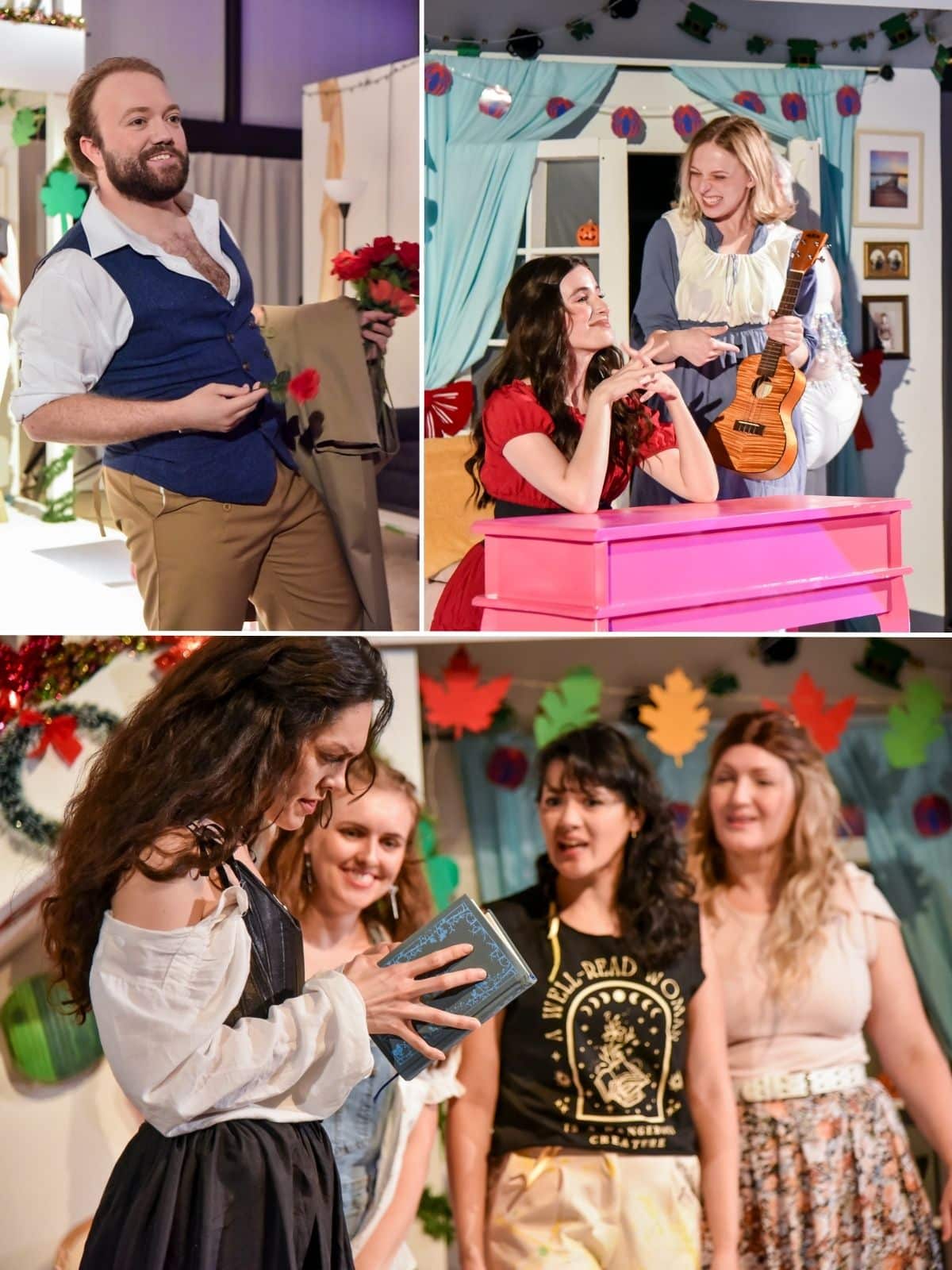
The man who shows up at the door bearing roses is not the adored professor, however; it is the sisters’ obstreperous brother, Branwell (Ty Edwards, embodying a spoiled boy child’s annoying habit of lording it over his sisters). Curiously, Branwell, who fancies himself a writer, is unaware of his sisters’ literary success (their books have been published to acclaim under male pseudonyms). As if to spare his fragile ego, the sisters try to keep him in the dark about that. Meanwhile, the wannabe belletrist behaves like a belligerent jerk, which injects into the proceedings a tension it had heretofore lacked. Amid these sisters’ forever revelry, we get a fascinating if unnerving glimpse of gendered sibling rivalry.
Youngest sister Anne (played like a ditzy cheerleader with a mild misanthropic streak by Rose Hahn) is striking in a scene in which she goulishly channels the Lavender Witch. And Emily is given a nicely quasi-goth sullenness by Leah Ly, wearing a T-shirt that says, “A well-read woman is a dangerous creature” (the cleverly anachronistic costumes are by Lanae Sterrett).
Three other women drop in, each introducing a mini story, a music number, or both. Two of them are the ghosts of fictional characters: Cathy Earnshaw from Charlotte’s Wuthering Heights and Helen Burns from Emily’s Jane Eyre. Amusingly, the party-crashers argue with their respective authors, disputing how they were dispensed with. At one point, Alyssa Nolan as Helen demonstrates rockin’ pipes on a hand mic, and throughout, Brenna Horner as the specter Cathy gives the production’s most arresting performance. In a high-point musical sendup, Cathy and the three sisters perform “like a white rap group.”
The real singer Kate Bush, whose debut single, “Wuthering Heights,” became a huge hit in the late 1970s, makes a startling entrance through a window and offers several songs for the sisters’ situational stasis. Madeline Marie brings a quiet but lovely internalized voice to the role.
Act Two has a chilling monologue by Branwell that mirrors, in reverse, Charlotte’s soppily sentimental monologue about her prof, the one she piteously expects to show up at the party. Branwell too has a tale of unrequited passion, but it’s decidedly darker, more manospheric. Branwell’s aggrieved monologue is about a sexual obsession he had with an older woman whose kids he tutored. She jilted him. “Would you hate me if I told you that all the women I’ve ever loved deserved my anger?” he asks his sibs and us self-righteously. “I can’t think of a single woman I’ve ever loved who didn’t see fit to hurt me intentionally.”
Connor Lugo-Harris’ sound design contributes much to the narrative. Besides those intermittent witch chimes, a recurring sound cue has characters pronouncing, “Alexa: play the best party song ever.” The joke is that it’s a different song each time. And Heather Rody’s nimble lighting design proves well up to the task in a storefront space never intended to serve as a theater.
Brontë Sister House Party culminates in feel-good sisterhood closure, but the play’s episodic structure feels random and aimless until then (though director Kathleen Barth manages the many tonal shifts with admirable aplomb). Moreover, on opening night, execution was uneven, with the sort of uncertainty more excusable in a preview.
Still, the admittedly gimmicky premise is intriguing; the characters, both as written and as performed, are appealingly quirky; and the musical interludes are fun. A satisfying Brontë-esque saga it’s not, but its sentiments, silliness, and celebratory aspirations have modern merit.
Running Time: Two hours and 30 minutes, including one 10-minute intermission.
Brontë Sister House Party plays through September 12, 2026, presented by Nu Sass Productions, performing at Van Ness Main Street, 4340 Connecticut Ave NW, Washington, DC. Tickets, available online, are $25 for general admission, with various ticket types available at discounted rates, including a limited number of pay-what-you-will seats. Additional fees may apply. Accessible seating and “no-stairs” seating may be purchased online.
The program for Brontë Sister House Party is online here.
Brontë Sister House Party
Written by Courtney Bailey
Directed by Kathleen Barth
CAST
Emily: Leah Ly
Charlotte: Aubri O’Connor
Anne: Rose Hahn
Branwell: Ty Edwards
Cathy: Brenna Horner
Helen Burns: Alyssa Nolan
Kate Bush: Madeline Marie
UNDERSTUDIES
Emily Understudy: Layla Nabavi
Charlotte Understudy: Kate Lurie
Anne Understudy: Aisling Mockler
Branwell Understudy: Michael McCarthy
Cathy Understudy: Hope Cassady
Helen Burns Understudy: Daniella Ignacio
Kate Bush Understudy: Jessica Cooperstock
CREATIVE TEAM
Director: Kathleen Barth
Assistant Director/Dramaturg: Edie Backman
Fight & Intimacy Director: Bess Kaye
Fight & Intimacy Assistant Director: Layali Aljirafi
Costume/Hair Designer: Lanae Sterrett
Props Designer and Set Dresser: Roo Sultan
Composer: Daniella Ignacio
Set Designer: Maggie Troutman
Lighting/Projections Designer: Heather Rody
Sound Designer: Connor Lugo-Harris
Caption Designer: McClain Leong
Vocal Coach: Ty Edwards
PRODUCTION TEAM
Producer: Elle Sullivan
Stage Manager: Lauren Markovich
Assistant Stage Manager: Ray Poukish
Technical Consultants: Complete Fabrications
House Manager: Joe Largess
NU SASS STAFF
Artistic Director: Aubri O’Connor
Marketing Manager: Hannah Wing-Bonica
SEE ALSO:
Nu Sass Productions to present ‘Brontë Sister House Party’ (news story, July 1, 2026)