Elizabeth Dinkova, artistic director of Spooky Action Theater, is directing the upcoming University of Maryland School of Theatre, Dance, and Performance Studies’ (TDPS) production of Anne Washburn’s Mr. Burns: A Post-Electric Play at The Clarice Smith Performing Arts Center. Rebecca Calkin, director of marketing and communications for performing arts with the UMD’s College of Arts and Humanities, sat down with her to talk about the quirky post-apocalyptic play. (This conversation has been edited for clarity and length.)
Rebecca Calkin: I saw the original production of Mr. Burns at Woolly Mammoth Theatre Company in 2012, early in my theater career, and was immediately a huge fan of the play. Ten years later, I moved to the DMV for a job as director of marketing at Woolly Mammoth, in large part because of how much I loved this piece. And now it’s being staged here at The Clarice. So this play is very close to my heart, and part of why I’m particularly excited to talk with you!
How did you come to this project at UMD, especially amidst your very busy schedule as artistic director at Spooky Action Theater?
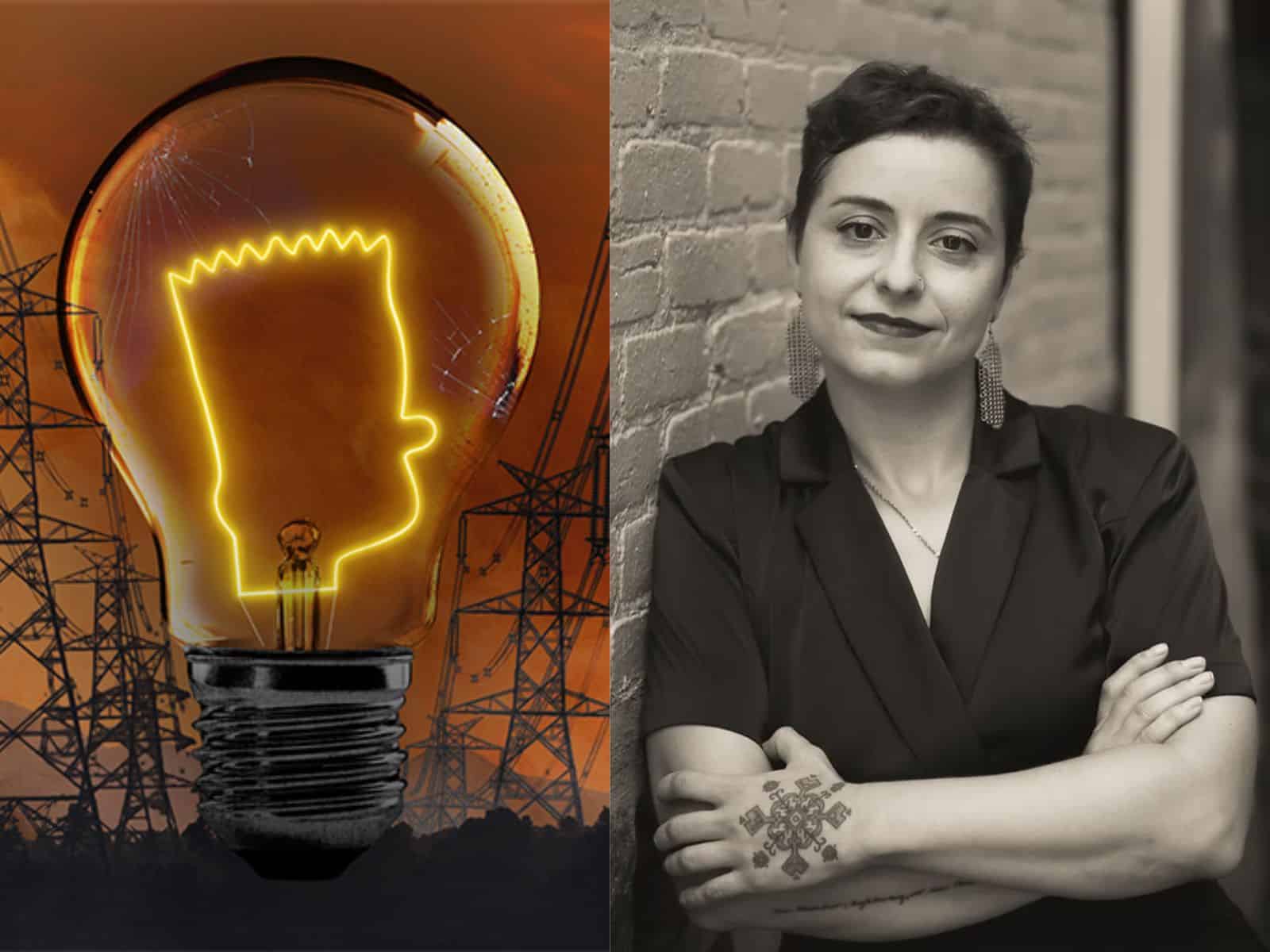
Elizabeth Dinkova: I was approached by UMD to direct a show and was presented with two show options for this season, and I had not read or seen the play until this opportunity came up. As a director and a writer, I have a special interest in the ways in which artists respond to moments of crisis or political or social turmoil. I’ve done a lot of research and I’ve written a couple of shows about artist relationships to dangerous works that make them targets for oppressive political regimes or that have unintended consequences beyond what the artist imagined.
Mr. Burns was such a beautiful, mischievous, and moving testament to a group of people’s love for a story and the way in which a story may transform over time to take a different place in culture. You traverse three different time periods where this particular episode of The Simpsons, “Cape Feare,” starts out as something that is low culture, used for entertainment when the electricity has gone down. By the end of the show, it has become a testament to the resilience of a culture that has survived a major apocalypse.
I love thinking about how a work of art morphs, and also how it is a bit of a Rorschach test for the preoccupations of a community. And how moving it can be to see artists protect that work in a world in which these works are essential for survival.
The last time we talked, you mentioned a good analog being Station Eleven [a book by Emily St. John Mandel and an HBO miniseries], which is also about the resilience of people after an apocalyptic situation, using art as a means of keeping a spark of hope alive and communicating something critical about their humanity.
With Mr. Burns, I came to the piece originally as a fan of The Simpsons, but also of storytelling as a theater artist myself. Do you have any connection to The Simpsons? And if not, how do you see people who don’t have much familiarity with The Simpsons connecting with the piece?
I am Bulgarian, and I didn’t get to the States until I was in college. So I never saw a full episode of The Simpsons until I was directing this show. I only knew what they looked like and a little bit about the tone and the cultural attachment to The Simpsons. I actually purposefully kept it that way through some of the early phases of the design process because it was actually useful for me to be responding to design ideas as a person with a distant connection to The Simpsons rather than deep knowledge and familiarity. But halfway through the design process, I started to watch it, starting with the “Cape Feare” episode mentioned in the show.
The first time I read the play, I didn’t feel alienated or confused by what was going on. However, it is really important that it is The Simpsons, as that show has such a wide impact and long history of being a reflection of popular concerns of the time. And then the visuals, right? I remember reading somewhere that Anne Washburn also considered Friends as source material for this play, but the visuals are not as iconic.
We have some resources from a really talented student dramaturg, and the pre-show, playing distorted pieces of Simpsons episodes, giving the audience a taste of the tone and visuals of The Simpsons.
In the third act, much time has passed and the characters are far removed from a time when they could actually watch the episode. It’s become this game of telephone with distorted memories. And to your point, if you watch the “Cape Feare” episode of The Simpsons, you can enjoy it without having seen Cape Fear the film, even though the episode heavily references it.
Yes, that is a great and useful parallel; it’s an adaptation of an adaptation of an adaptation.
With this show spanning decades and showing multiple stages of this post-apocalyptic world, with the story being twisted and changed, there’s such fun opportunities for designers. What were some of the guiding points in conversations with designers to create the world of the play?
One of the big values was definitely transformation, especially seeing how images transform over the course of these three acts. It felt like that trajectory visually could parallel the trajectory of how The Simpsons story itself transforms. One of the central images of the production is an electrical transmission tower that no longer works. At the beginning, you see that looming in the distance. In the second act, it is more obscured. And then in the third act, it becomes almost a temple to The Simpsons and electricity.
Similarly, when it came to the projection and lighting designs, it was this interesting notion of how do you portray, in an indoor theatrical space, a world that has lost electricity? We talked about finding ways for projection to appear like magic, shadows that start to look like different things, taking on life of their own. For lighting, depicting more natural environments and localized sources.
When it came to the costume design, the first two acts are more continuous since they are the same characters. In the first act, we tell the story of who these people are, because this is an ensemble of misfits, a group that is cobbled together from people who have met each other on the road. In the second act, they’ve now become a community and they’re also building their own aesthetic for how they translate The Simpsons characters in theatrical ways. And then in the third act, seeing what happens once these Simpsons figures have metastasized into these heroic, iconic, almost religious figures. So there’s this journey across a lot of elements of design, from the more mainstream to the almost sacred in the third act.
There’s also the sound and music in the play. Some fun pop numbers in act two, but then we get a much different experience of music in act three. The audience doesn’t have to know all of the musical references, but it is fun when you hear Easter eggs of songs and melodies that you may have heard before. How do you approach this hybrid of theater with musical theater?
One of the things that is fascinating about the play is how our relationship to instrumentation changes in a world without electricity, because we’ve learned to rely so much on electrical instrumentation and sampling and track mixing in our current culture.
It was a similar world-building exercise in the sonic-world thinking: “what instruments would persist and how would we use them?” String instruments would probably remain, but what the strings are made of might change. There’s a lot of strange sounds in the orchestration, this notion of a trash orchestra where then there are sounds and textures that are produced by things that aren’t supposed to be musical instruments. The ensemble vocals, both in the second act and in the third act, are really cool to hear, centering the human voice and then augmenting with these other clever ways of what a post-electric musical landscape may sound like.
I can’t wait to hear the way the orchestration’s been adapted! One final question: what’s it been like working with TDPS students and the team at The Clarice?
UMD is one of the best theatrical design MFA programs in the country, and it’s great being able to work with students who are at a very special phase of their artistic development, where they’ve absorbed so many insights from their studies and are now getting to put that into practice with really excellent logistical and production support from the school. This is definitely one of the more elaborate productions I’ve worked on in a while, so I really appreciate how well supported we’ve been on the production side [at The Clarice].
And then on the acting side as well, it is so great to work with undergraduate students who come in extremely prepared, with great questions and thoughts and ideas. The way they support each other, and support me, has been really joyous. I feel very excited by the way in which we, as a community of theatermakers, trying to make this piece about making theater, have also supported each other.
Mr. Burns: A Post Electric Play runs October 9, 10, 15, 16, and 18, 2026, at The Clarice Smith Performing Arts Center. Tickets are available at The Clarice’s website, with free student tickets available to UMD students.