More than a decade after its world premiere at Arlington, Virginia’s Signature Theatre in 2014, the musical adaptation of Beaches, based on the 1985 novel by Iris Rainer Dart and the 1988 film starring Bette Midler and Barbara Hershey, is making its Broadway debut for a limited engagement at the Majestic Theatre. Developed in collaboration with David Austin, written by Dart and Thom Thomas, with songs by Mike Stoller (music) and Dart (lyrics), and directed by Lonny Price and Matt Cowart, the story, with significant changes from the movie version, follows a decades-long female friendship from childhood, through the highs and lows of their distinctly different lives, to the death of one and the glowing tribute to her by the other, with the Grammy-winning song “Wind Beneath My Wings,” made famous by Midler.
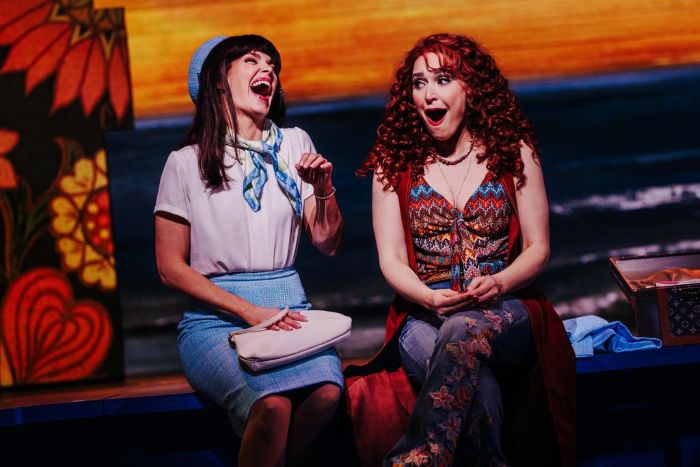
The show’s two stars – Jessica Vosk as singer, comic, and actress Cee Cee Bloom and Kelli Barrett as Bertie White, a wealthy lawyer and heiress – bring their blockbuster voices to the songs and deliver their contrasting characterizations of the polar-opposite personalities. Unfortunately, the musical numbers (25 in total, with rich orchestrations for a full eighteen-piece orchestra by Charlie Rosen, music supervision by Joseph Thalken, and music direction by conductor Paul Staroba) tend to be redundant (the lyrics largely expressing their admiration for and encouragement of each other) and not particularly memorable (aside from the beloved aforementioned classic, written by Jeff Silbar and Larry Henley in 1982, and not for the later film), and the women, who are more laughable than likeable, are largely two-dimensional (as described in the show, Cee Cee is “trashy” and Bertie “repressed”).
Though the narrative, framed in the device of a memory play, moves back and forth in time, from the central emergency that causes Cee Cee to leave the stage in the middle of her show, to the first meeting of Little Cee Cee (Samantha Schwartz) and Little Bertie (Zeya Grace) on the beach, the communication of Teen Cee Cee (Bailey Ryon) and Teen Bertie (Emma Ogea) as pen pals, and the main incidents they experienced as adults, for the most part, their backstories are untold, aside from the careers and the spouses they’ve chosen. We just see snippets of their mothers – Sarah Bockel as the unrefined Leona Bloom and Lael Van Keuren as the snooty Rose White – who, like their daughters, are completely different in class and bearing, and even more abrasive and less sympathetic. The same can be said of the men they marry – John Perry, portrayed by Brent Thiessen, and Michael Barron played by Ben Jacoby – who trigger a major rift and multi-year estrangement between the women, after they just spent the evening chatting, laughing, drinking together, and largely ignoring their husbands.
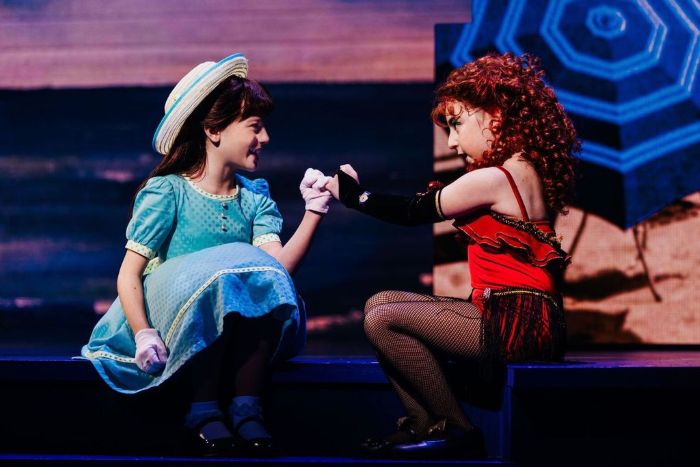
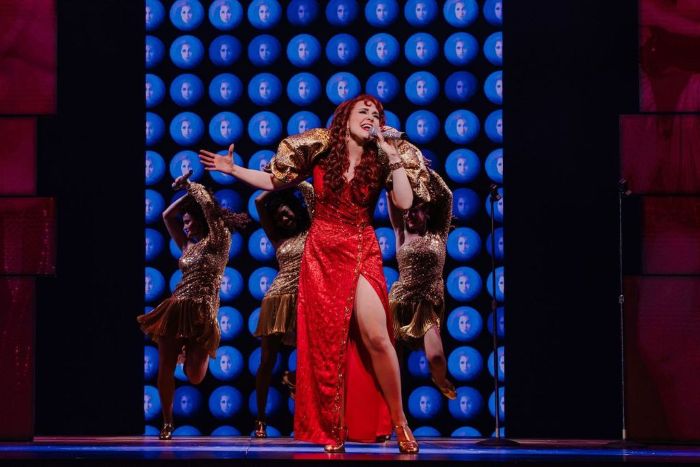
The tone of the show also moves back and forth from comedy to drama, from the feisty Cee Cee’s juvenile and repetitive foul language, sexual innuendo, and pushy ambition, and the sophisticated Bertie’s naiveté and inhibitions, to her terminal illness, her bestie’s response, and her decision about who should get custody of her young daughter Nina (Harper Burns). And the segments of on-stage performances throughout Cee Cee’s ever-burgeoning fame follow suit, from the lively little girl’s exuberant song-and-dance routines and the ebullient appearances with sparkling back-up dancers by the celebrated adult, to her sincere recognition of all that Bertie did for her and meant to her in the smash-hit showstopping finale.
An uneven artistic design is brought to life by an array of character-defining costumes (by Tracy Christensen, with wigs, hair, and make-up by J. Jared Janas), contrasting the traditional understated blue and white attire of Bertie and her upper-class family with Cee Cee’s brightly colored, mostly red, sparkling clothes and curls, in a style designed to mimic those of the real Bette Midler. But a minimal set (by James Noone), employing a few pieces of movable furniture and small stationary mounds of sand downstage left and right, is dominated by projections (by David Bengali) on a full-scale upstage backdrop and a large number of busy, differently shaped, roll-in, and drop-down screens that display countless images of the star and identify the locales, enhanced with shifting colors of light and spotlights (by Ken Billington). The acrobatic moves of Little Cee Cee are a highlight of the show’s choreography (by Jennifer Rias), but the sound (by Kai Harada) leaves some of the girls’ lyrics and dialogue unintelligible.
While the message of Beaches is centered on the importance and endurance of female friendships, the production does little to convince us of the likelihood of their connection and bond, other than to give credence to the old commonplace, “opposites attract,” as proposed by sociologist Robert Francis Winch in the 1950s, in his Theory of Complementary Needs. Their need to have someone very different from themselves that they can motivate and laugh with, even when death becomes the butt of a joke, seems to be the main attraction here.
Running Time: Approximately two hours and 30 minutes, including an intermission.

Beaches plays through Sunday, May 24, 2026, at the Majestic Theatre, 245 West 44th Street, NYC. For tickets (priced at $54-311, including fees), go online, call (212) 239-6200, or find discount tickets at TodayTix.