Returning to the NYC stage after its 2025 premiere at The Bushwick Starr in Brooklyn, Rheology, now playing a limited Off-Broadway engagement at Playwrights Horizons, is an experimental collaboration between playwright, director, and Pulitzer Prize finalist Shayok Misha Chowdhury and his mother Bulbul Chakraborty, an esteemed theoretical physicist who received an Obie Award for her debut performance in this very personal work.
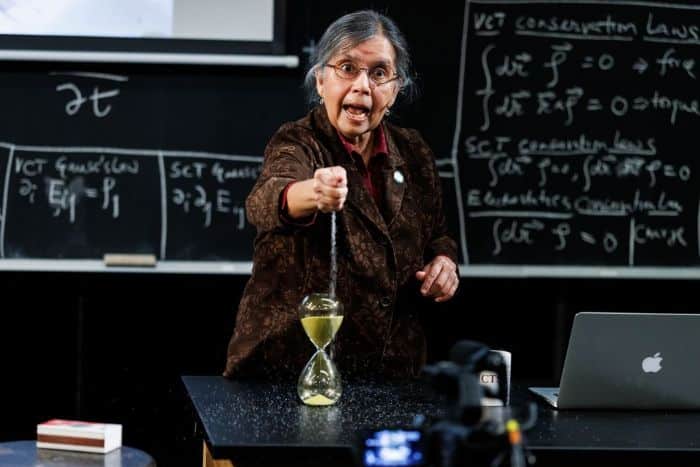
Rheology is the science that studies the flow of matter (solids and liquids) and its time-dependent response to the influence of external stresses. Here Chakraborty specifically considers the baffling phenomenon of sand, with which she was obsessed for two decades, and its classification as “Fragile Matter.” Though its particles are solid, it behaves like a liquid, when stepped on or dug into in a sandbox, as they do in the show, or passes through an hourglass, featured prominently on stage and employed as a metaphor for the passage of time and the flow of life.
In keeping with the theme and her expertise, the physicist and educator is writing countless equations on an upstage blackboard as we enter the house, and the show begins with her 20-minute lecture on sand, during which there is no fourth wall; she speaks directly to us and solicits audience participation, asking us what constitutes a solid, and a liquid, as if we were her students in a lecture hall and she our devoted professor. Her presentation also includes demonstrations, the last of which results in an enacted emergency, which was so convincing that members of the audience, on the date I attended, screamed out in panic and called for someone to help, triggering a shift from physics to theater, as her son, in an aisle seat with a notepad and pencil, gives her directions on several other ways to approach the scene, but in a much less articulate manner than his mother, inserting “like” repeatedly into his ideas – “What else might you do? Like do you like – like do you call out to me?” (which struck me as a somewhat derogatory stereotype of the lack of eloquence of an artist versus a scientist and the younger versus the older generation).
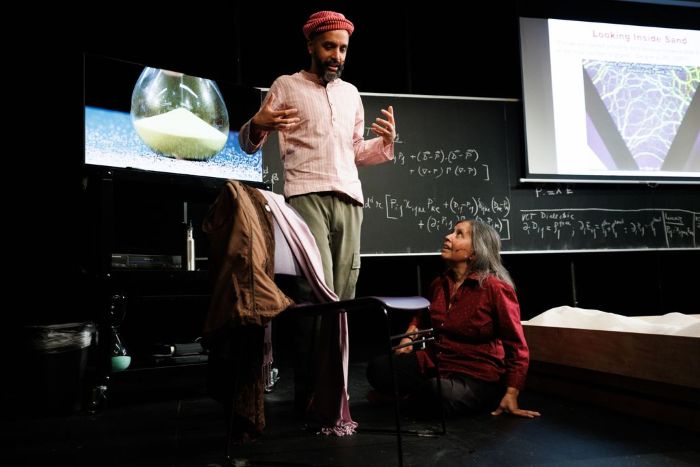
The remainder of the interdisciplinary, intergenerational, semi-autobiographical, bilingual story (there are many passages in her native Bangla language, with English translations on a central projection screen) is centered on their mutual love, pride, and respect, familial memories, and his traumatic obsession with the inevitability of her death, as the tone switches from realistic to melodramatic to surreal in his visions of losing her, his determination to go with her (as Bengali widows did in the past), and lighting matches to ignite their funeral pyre.
He also reveals that the impetus for this play was to have them contractually obligated to spend more time together, even though they talk on the phone almost every day, aware that, like sand through an hourglass, they’re running out of time. But his mother, the scientist who knows best and provides the voice of reason, recognizes that he, too, is “fragile matter” and can find the capacity to rearrange himself, confident that he will survive her death, as she did her own mother’s, and challenging him to test her hypothesis, in this meditation on mortality and family that merges physics and theater.
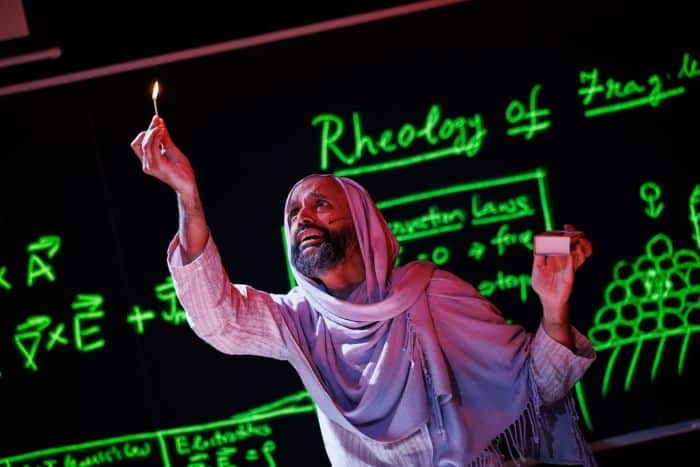
A talented artistic design team masterfully evokes the changing perceptions and moods of the work. The set (by Krit Robinson) easily transitions from a current classroom to a childhood sandbox to the mother’s bed and autopsy table, from a normal blackboard inscribed in white chalk to one that glows green (which will make you wonder how they did that!), with projections and live-feed videos (by Kameron Neal) that range from scientific illustrations of Chakraborty’s lecture to vintage family photos, and significant props (by Matt Carlin) that include the hourglass and the matches Chowdhury strikes for their intended cremation. Lighting (by Masha Tsimring and Mextly Couzin), full and bright for the lecture, then dark and menacing for the son’s morbid imaginings, and sound (by Tei Blow), with expressive passages on live cello (by Music Director George Crotty), further enhance the increasingly supernatural/metaphysical tone. And costumes (by Enver Chakartash) define the characters, their professions, and their ages, with Chowdhury as a young boy appearing in striped pajamas to distinguish him from his current adult self, who wraps a scarf around his head to suggest the self-sacrificing Bengali widows.
In Rheology, Chowdhury and Chakraborty explore not only the titular scientific discipline, but also the process of creating a work of theater and their personal mother-son relationship, combining the format of a lecture with self-help therapy (as a son who subjects himself to his own internal pressure, as well as the usual external stresses posited in theoretical physics), and ultimately bringing their distinct interests together for posterity.
Running Time: Approximately 85 minutes, without intermission.

Rheology plays through Friday, May 29, 2026, at Playwrights Horizons, Peter Jay Sharp Theater, 416 W 42nd Street, 4th floor, NYC. For tickets (priced at $53.50-93.50, including fees), go online, or find discount tickets at TodayTix.