The production of Emma at Everyman Theatre seems worried that audiences find one of the greatest English storytellers boring, assuring us, “This is not your great-grandmother’s Jane Austen.” This is, of course, not new. Classics are classics because their plots, characters, and messages can speak to any era (for instance, among many other revisions, Emma has already been adapted into the 1995 film Clueless). Playwright Kate Hamill, who has already updated Austen’s novels Sense and Sensibility and Pride and Prejudice for the stage, does not go so far as to set the story in the modern day, but heavily modifies it to suit modern attention spans, attitudes, musical taste, and broader sense of humor. Everything is turned up to 11 — the pacing, comedy, and even volume.
And mostly, it works.
On first entering the theater, there is no indication that this will be anything but a classic, delicate, faithful adaptation. The set, by Daniel Ettinger, is a graceful and gorgeous Regency interior with delicate grisaille forest murals and a shimmering chandelier. But once the action begins, it is soon livened up by disco balls and flashing lighting by Juan M. Juarez. Jane Shaw’s sound design makes it easy to hear the actors, but the modern music during scene changes and dance numbers is jarringly loud. It quickly becomes clear that there will be no Regency cotillions here when Shalyce Hemby’s choreography breaks out into funky fun. And as has become standard in the era of Bridgerton, David Burdick’s costumes retain the pieces and silhouettes of Regency dress, but in colors and fabrics that clearly delineate characters, from delicate and dignified to garish and silly. Laura Kepley’s direction goes for laughs and movement wherever possible, with comically melodramatic physical gestures as well as verbal barbs.
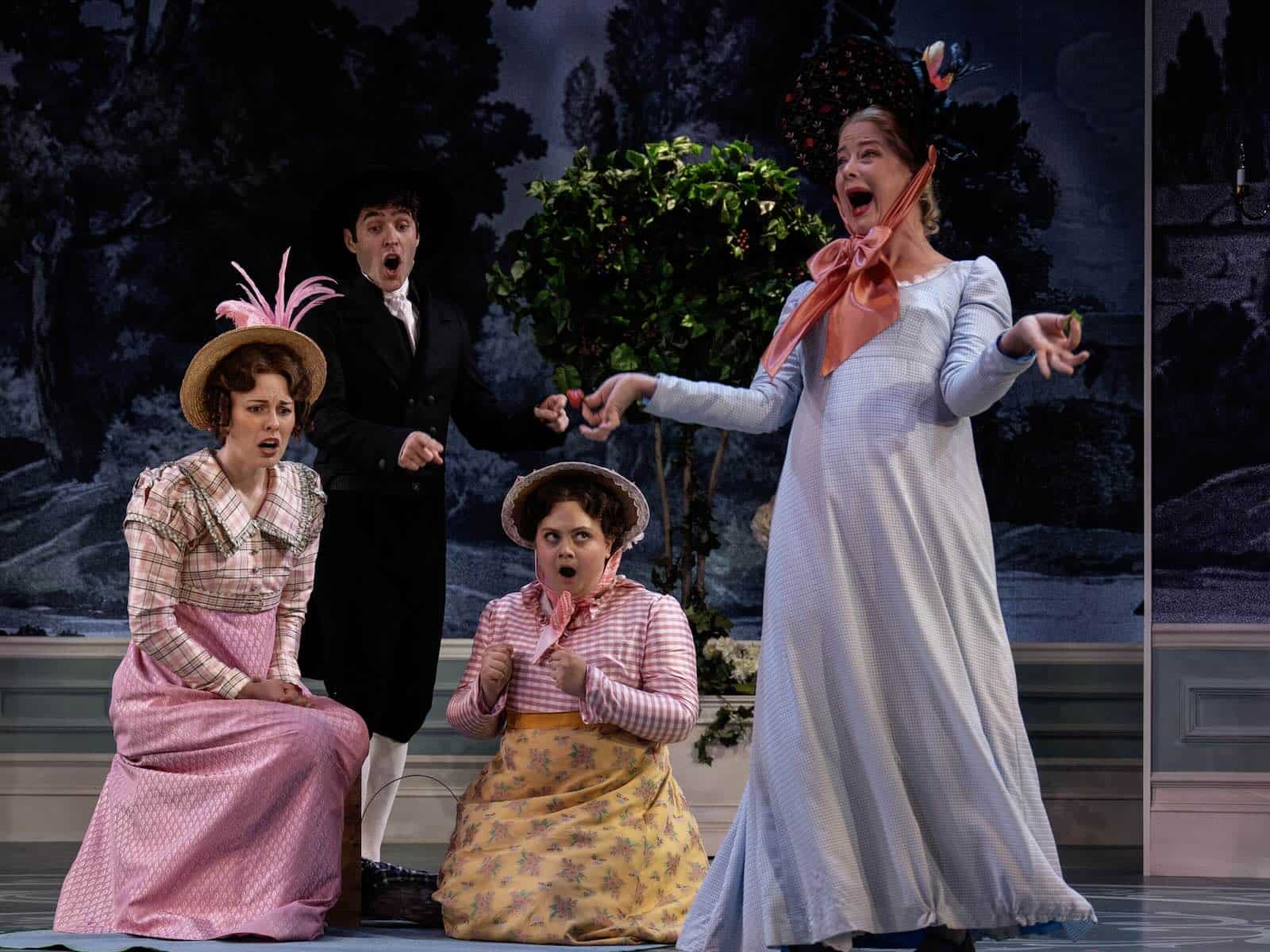
This is clearly not meant to be the 1815 Emma. It loses Austen’s language, with its delicacy, nuance, and the sly humor of Austen’s narration, although Emma (the tremendous and engaging Katie Kleiger, a comic tour-de-force who almost never leaves the stage), breaking the fourth wall and addressing the audience, achieves much the same thing in a more modern manner. The plot is radically compressed, for the most part, well, although sacrificing some logic, such as the real reason for Frank Churchill’s (Zach Powell) flirting, making him out to be simply a selfish jerk. But to readers of Austen, perhaps the biggest loss is the character of Mrs. Elton. Here, she is made out to be a sex-crazed ninny, played broadly for physical laughs as well as the chameleon-like contrast with the other character Megan Anderson plays, the ultra-demure, perfect Jane Fairfax. At one point, she makes this 180° switch in full view, to the delight of the audience. But in the novel, Mrs. Elton is an ultra-snob, a distorted commentary on Emma herself. Anyway, the multi-casting, seen with other characters as well, is especially effective in Zach Powell’s playing all three suitors in the play, reflecting the way Emma herself treats them as interchangeable.
But a stage production cannot perfectly match the source novel, nor should it. This production provides, first of all, a lively and laugh-filled evening’s entertainment, readily accessible and enjoyable by those who have never read the book, as well as, ideally, by those who have. It also improves the relationship between the main couple, Emma and Mr. Knightley (the charming and not-always-dignified Tony K. Nam). In the novel, Knightly is much older than Emma, and acts almost like a surrogate father, so that their romance is slightly discomfiting. But here, they are nearer in age and have been brought up together, almost like warring siblings, and their squabbling seems to stem more appropriately from hidden (from them) romantic tension. Most importantly, the play also builds upon and amplifies the strong feminist message that is only implied in the original novel. Harriet (the terrifically funny Nia Zagami), who starts out as a stammering nitwit, finds her voice in the course of the play, even announcing to the audience at one point that it “should be called Harriet!” And the underlying theme that female education is vital, and that women with brains need work to do as much as men, is brought home to Mr. Knightley as much as to Emma. They end up on equal terms, looking forward to a future when their daughters and their daughters’ daughters can grow up and take their rightful place in the world.
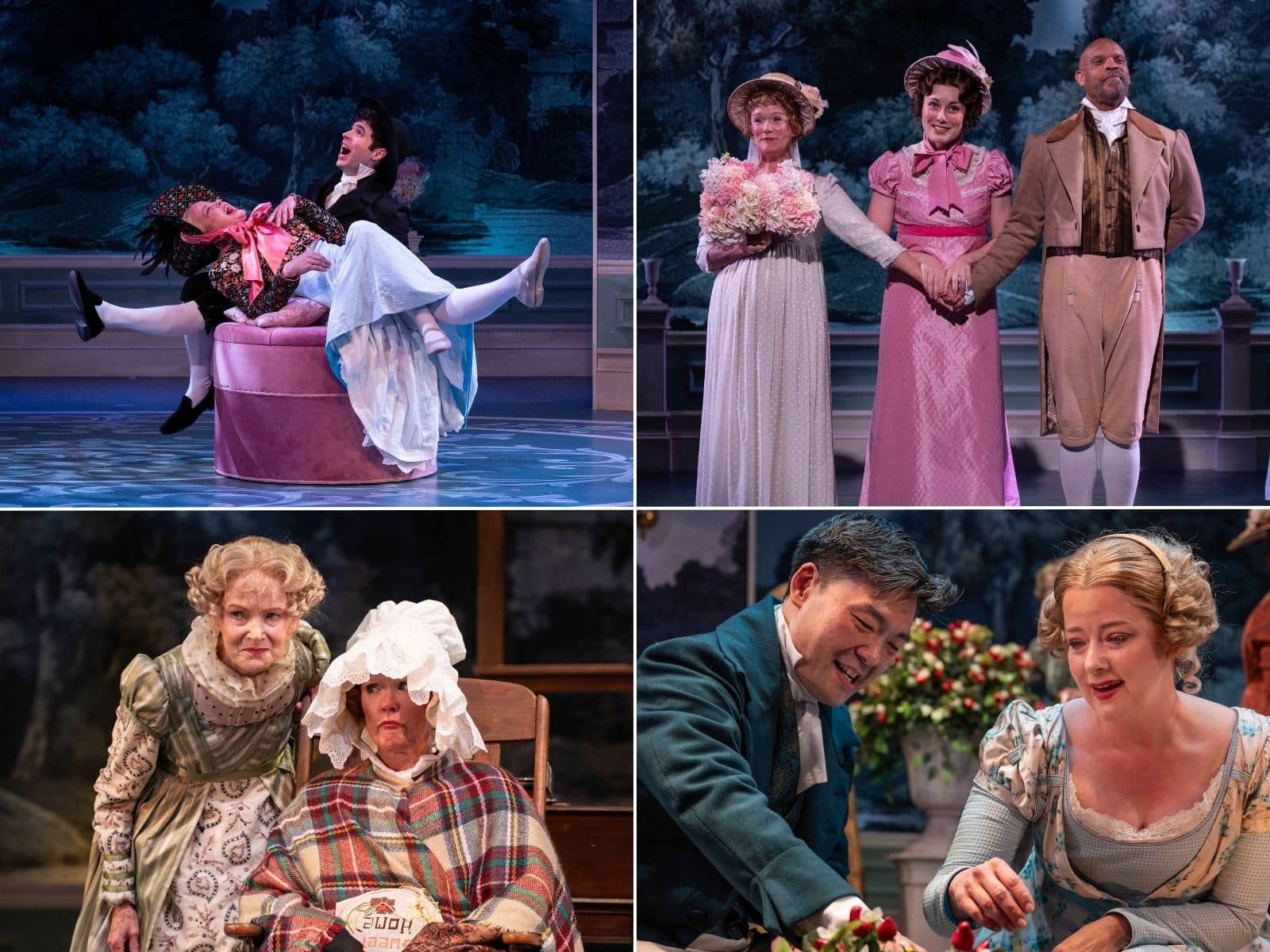
All in all, Everyman’s Emma is a beautifully mounted, terrifically funny production that will easily entertain those who have never read Jane Austen. For those who have but are not too strict in their devotion — Austen was always the first to laugh at herself, after all — it can provide many laughs at its deviations from the original, while even adding new perspectives. And if some of those who haven’t yet enjoyed the books are inspired to seek out the original, so much the better.
Emma is a rollicking, fresh, and funny take on a marvelous classic, definitely worth seeing.
Running Time: Approximately two hours and 30 minutes including one 15-minute intermission.
Emma plays through June 14, 2026, at Everyman Theatre, 315 West Fayette Street, Baltimore, MD. Purchase tickets ($59–$97) online, by contacting the box office at boxoffice@everymantheatre.org, or by calling 410.752.2208. Standard box office hours are Monday through Friday, 12 pm-5 pm and closed on Saturday and Sunday. The Box Office will open 2 hours before every performance, including weekends. Everyman offers more than 700 Pay-What-You-Choose seats throughout the run, with seats allocated for every performance.
The playbill is online here.
Emma
Adapted by Kate Hamill
Based on the Novel by Jane Austen
Directed by Laura Kepley