Beatrice L. Thomas’s life journey from suburban Maryland to the Middle East to San Francisco propelled the creation of her performance piece Black Benatar vs. The Cistem based on her personal reproductive health experiences. As stated in the program:
The play shines a light on gaps in the healthcare system — particularly regarding uterine fibroids, ovarian cysts, delayed diagnosis, and reproductive loss — while emphasizing how vital it is for women to be heard and believed.
At the heart of the show is entertaining storytelling, mixed with humor and urgency to give voice to people whose reproductive health experiences often go unseen or unheard, particularly those in communities historically overlooked by the healthcare system.

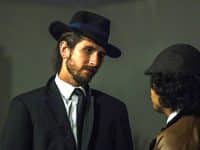
Beatrice was immersed in theater from an early age and raised under the influence of three remarkable parents: Dr. Beatrice Denefield, a psychiatrist; Dr. Alice H. Thomas, Executive Director of AmaZing Theatre Company; and Dr. Percy W. Thomas, the Theatre’s Artistic Director. As a youngster, Beatrice was often present at theatrical productions, rehearsals, and post-show events. While appearing in one of her father’s Off-Broadway productions, a young Beatrice performed for and was introduced to the legendary writer James Baldwin, one of many early experiences that placed art, ideas, and cultural storytelling within the fabric of her childhood. Despite her early intentions not to follow the family path in theater or psychology, Beatrice ultimately found her life calling at the intersection of both realms. Black Benatar vs. The Cistem is rooted in those early influences. In creating and performing the production, Beatrice weaves in aspects of her personal journey with a family legacy rich in theater, psychology, education, and storytelling, transforming lived experience and family legacy into an original theatrical work.
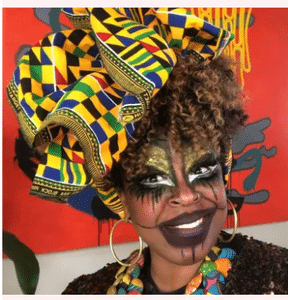
Beatrice incorporates a range of theatrical styles into the performance, including music, puppetry, and drag. She becomes most animated when describing how drag performance became foundational to the work’s theatrical language. Dr. Percy Thomas noted that drag dates back long before it was popularized by Sylvester and RuPaul. He explained that William Dorsey Swann, born into slavery, threw parties and gatherings where men dressed in women’s attire. “The National Archives identifies Swann as the first known person to call himself a ‘queen of drag,’ and his story marks an early chapter in Black LGBTQ+ history.” As such, unbeknown to many, drag is rooted in Black history and performance tradition. Percy continues: “It is also important to remember that drag is performance, not gender identity. As the Human Rights Campaign notes, drag is a theatrical transformation — just as actors become characters onstage.”
Beatrice Thomas: The San Francisco Bay Area has a rich drag tradition, and the community is warm and inclusive. I was accepted and embraced. Performers in the Bay Area each have their own unique over-the-top styles and do not shy away from social and political commentary. The makeup alone can take as long as three hours to put on, and yes, I have learned to do it myself. Add extravagant costumes, stance, and movement, and I can disappear into an entirely different original persona. Drag itself is not gender specific. Over the past 13 years, San Francisco drag performers have provided me with valuable mentorships, and icons like Honey Mahogany, Fauxnique, Miss Shugana, and Miss Rahni helped me shape Black Benatar.
Debbie Jackson: Why were you so comfortable using your life experience as a basis for this piece?
During those years when I could not get a clear diagnosis on why I could not conceive, I felt like I had failed at something. Pregnancy was supposed to be easy, and I had womb failure and was alone. To keep from wallowing in depression, I felt compelled to give voice to what was going on with me. Surely, I was not the only woman having this experience. The more open I became, the more others confided about similar situations, and I knew I had to give this a voice.
Could you provide some insight about the term “cistem” for system?
I enjoy wordplay, so “Cistem” began as a simple, playful way to bring the term “cis” into the mix — a shortened form of cisgender, which describes a person whose gender identity corresponds to their sex assigned at birth. It also points to something more serious: the assumptions built into healthcare systems about gender, bodies, reproduction, and what a family is supposed to look like. The title lets me play with language while also putting those assumptions on trial.
It was wonderful hearing how AmaZing Theatre decided to produce Black Benatar vs. The Cistem as a drag performance in the Sandy Spring community even though they were getting some pushback from populations not familiar with aspects of the LGBTQ+ communities. They recognized this is a step into a larger spiral of human experience. The question for them was “If Beatrice were not our daughter, would we produce this play?”
Both emphatically responded, “Yes!” Black Benatar vs. the Cistem provides an opportunity for conversation among audiences with varying levels of familiarity with drag, LGBTQ+ communities, reproductive health, and the experiences explored in the work. Putting unfamiliar experiences onstage and creating space to engage with them falls squarely in AmaZing Theatre’s vision, mission, and values. In fact, to provide the audience with additional insights into reproductive health, a physician specializing in maternal health has been invited to facilitate the post-show talkback.
You seem to have found a unique way to address serious content in an engaging manner filled with sparkling comedy and laugh-out-loud humor. You must have been steeped in a solid storytelling tradition to create such unique characterizations and personal touches.
Each of my parents in separate ways has taught me that for us to advance and come together as people, we need to learn from and share our stories. Only when we listen to, trust, love, and respect each other’s journeys can we step into our power and advocate for ourselves.
AmaZing Theatre has been around in some form since 2005. Its mission is to produce events of historical and social significance for all culturally diverse populations. Thank you for taking the time to share information about this exciting new show with us.
Running Time: 90 minutes with intermission.
Black Benatar vs. The Cistem will perform once on Saturday, September 26, 2026, at 3 PM, presented by AmaZing Theatre Company, at Sandy Spring Friends School, Performing Arts Center, 16923 Norwood Rd, Sandy Spring, MD. Purchase tickets ($25–$35 or two for $50, plus fees) online.