
“Lord, if this little old plant don’t get more sun than it’s been getting it ain’t never going to see spring again.” —Lena (Mama) Younger
A struggling potted plant holds the promise — and precariousness — of the Younger family’s dreams. This one image captures a multitude of symbolism and what I believe to be the core message of Lorraine Hansberry’s seminal play, A Raisin in the Sun. There is plenty of life in the Younger household, but room to grow is another matter entirely.
This was my first time seeing Hansberry’s play, and I’m glad my experience was through the lens of KenYatta Rogers’ direction. For the staging in the Kogod Theatre of the Clarice Smith Performing Arts Center at the University of Maryland, Rogers, in collaboration with lighting designer Yannick Godts, contrasts light and darkness to reveal this family’s underlying needs and struggles. Moreover, what stayed with me was the care with which this play’s symbolism took physical form. A gesture, an illuminated wall, even the work performed between the scenes adds to our understanding of a family whose dreams press against the limits of its circumstances. Rogers makes those connections palpable without allowing the characters to disappear beneath them.
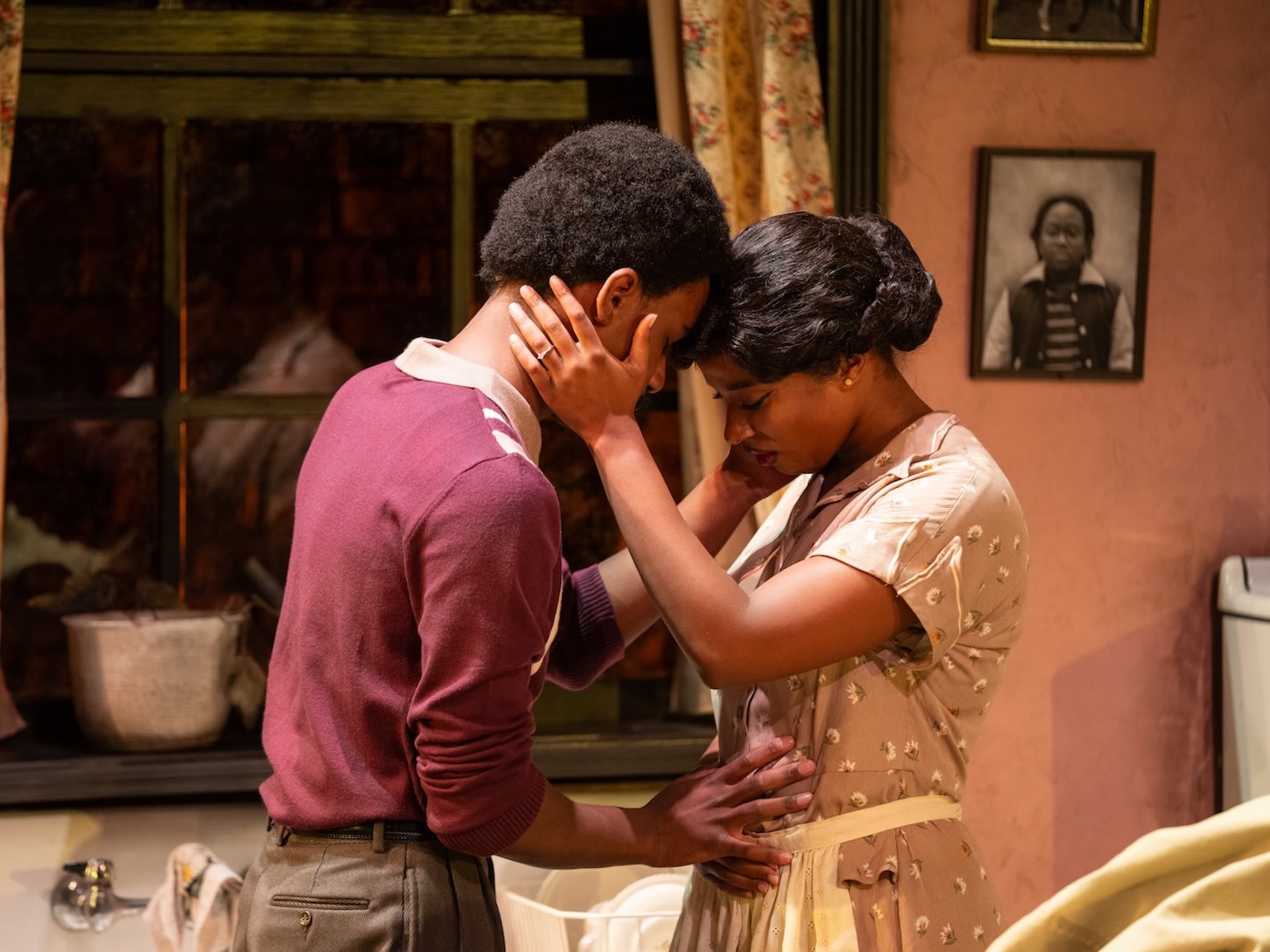
On Chicago’s South Side in the 1950s, the Younger family awaits a life insurance payment following the death of their patriarch, Walter Sr. His widow, Lena, wants a home with a backyard garden. Their son, Walter, sees a business venture as his route to financial independence, while his sister, Beneatha, plans to become a doctor. Walter’s wife, Ruth, keeps the household moving as their son, Travis, grows up amid competing visions of his future. Each wants something of their own, but their decisions are inextricably linked to each other’s fate, and this is where the fault lines in their family dynamic begin to rupture. The money promises possibility, but deciding what to do with it makes deep-seated tensions erupt.
Epiphany Grant anchors the family as Lena, balancing quiet confidence, subtle humor, and formidable resolve. Her tenderness never diminishes her authority. Grant gives Lena’s attachment to her plant a tenderness tinged with longing. Hansberry supplies the symbol; Grant makes us feel the relationship. When Lena later compares her children’s spirit to the plant’s persistence despite insufficient sunlight, her pride and worry become inseparable.
Scenic designer Bridgette Tran gives those conditions texture and convincingly places us in another era. Rose-colored walls, a blue patterned sofa placed in front of a braided yellow rug, well-worn appliances like a rickety ironing board, record player, and wooden dining furniture give the apartment a deeply lived-in character. Ragged plaster and exposed framing leave the apartment looking vulnerable. Visible lighting and electrical infrastructure extend that sense of exposure. The family has made a life here, but the room offers little protection from the pressures bearing down on it.
Godts’ has cast light against the brickwork beyond the window: the view remains blocked. To me, that image holds much of the Youngers’ predicament: possibility is close enough to imagine, yet financial constraints and racial exclusion keep obstructing its path. The obstacle is outside the apartment, but its consequences enter every conversation within it.
Even the transitions have work to do. Ruth puts away the ironing board; Beneatha cleans and sprays for cockroaches, her activity spilling directly into the next scene. We see these tasks and can still overlook them, already anticipating the next exchange. Rogers gives the labor space to register. Someone must keep this household going while everyone argues about where it should go.
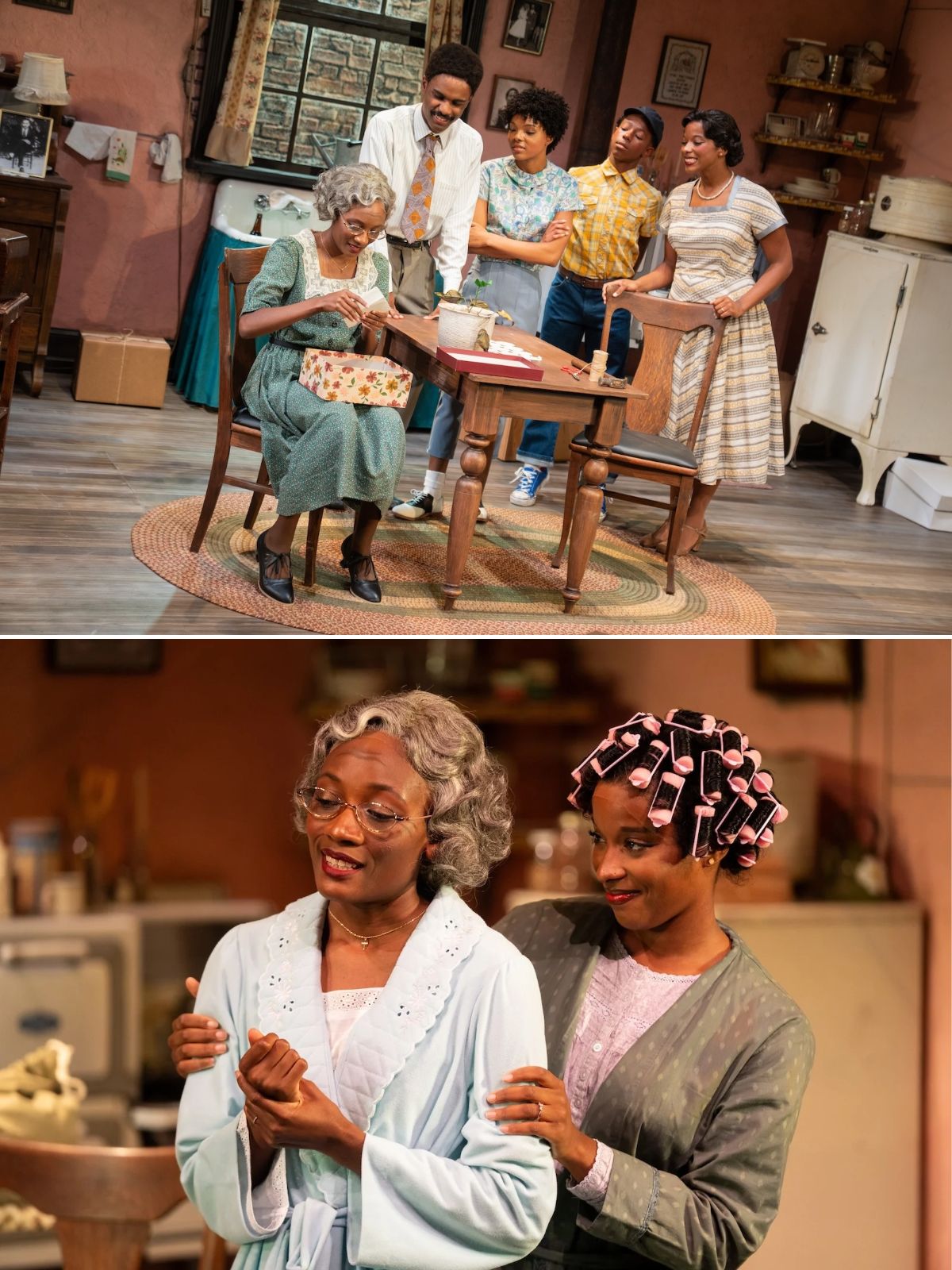
Shakuur Nyabingi’s Ruth makes the cost of that responsibility felt. Her softness does not conceal her exhaustion. Walter and Beneatha give their ambitions a forceful hearing; Ruth’s contributions are constant, tangible, and too often taken for granted by the two people who benefit so much from them. She wants a different life, too. Nyabingi allows that desire to emerge through the strain of sustaining the one she has.
As Walter, Ebou Dibba makes wounded pride palpable. His hunger for recognition feeds choices that can be maddening, yet the pain beneath his arrogance remains visible. In a pivotal confrontation, Dibba sustains uncertainty about which impulse will prevail. We watch a man struggle with himself while his family waits for an answer.
Briana Bryant gives Beneatha a playful petulance that makes her alternately endearing and exasperating. Her medical ambitions challenge expectations, but her certainty sometimes outruns her experience. Bryant lets us see the learning beneath the argument. Her natural hair and exploration of African identity also make self-definition a visible struggle against the standards she has inherited.
Beneatha’s suitors sharpen those choices. Jabari Crenshaw gives George Murchison the physical assurance of someone accustomed to getting his way. Nathan Campbell brings warmth and conviction to Joseph Asagai, making his challenges to Beneatha feel sincere. His encouragement asks her to imagine how hope might survive a setback, rather than treating disappointment as the end of her aspirations.
Eitan Amster makes Karl Lindner’s discomfort suspenseful while preserving the civility that makes his racism so insidious. His careful manner cannot soften the exclusion beneath his language. As dramaturg Julia Smith’s program note emphasizes, the Youngers’ housing aspirations encounter institutional barriers. Their struggles may feel familiar across many kinds of families, but Hansberry’s specificity matters: the Youngers face obstacles that self-reliance alone cannot remove.
Sound designer Madeline “Mo” Oslejsek gives music a lively role in the household, offering escape, connection, and commentary during transitions. With selections by Mahalia Jackson, not only is the time period felt but the themes come to life in these moments, making the transitions satisfying reflection points for the audience. Johnna Presby’s period costumes, complemented by the production’s wigs and makeup, help the young ensemble inhabit different generations.
Evey Vo’s projected captions provide a welcome point of access. However, there were occasional differences between the spoken dialogue and captions, which briefly pulled focus away from the scene unfolding before us, but the actors recovered without disrupting the story’s emotional continuity.
I kept returning to Lena’s plant. Its survival depends on daily care, much of it as unremarked upon as Ruth’s household work. In the transitions, that care continues in the shadows, suggesting the growth beneath the soil before anything breaks the surface. There is faith in such tending. But Hansberry’s opening warning about the plant will not let faith become an easy answer. Lena can keep watering. Her family can keep working. They still need the light.
Running Time: Two hours and 45 minutes, including one 15-minute intermission.
A Raisin in the Sun plays through November 21, 2026, presented by the UMD School of Theatre, Dance, and Performance Studies at the Kogod Theatre, The Clarice Smith Performing Arts Center, 8270 Alumni Drive, College Park, MD. Tickets are $30 plus a $5 booking fee for regular admission and $10 for students and youth. Remaining performances of A Raisin in the Sun are sold out. To join the waitlist, contact the Ticket Office at tickets-theclarice@umd.edu or (301) 405-ARTS.
The program is online here.